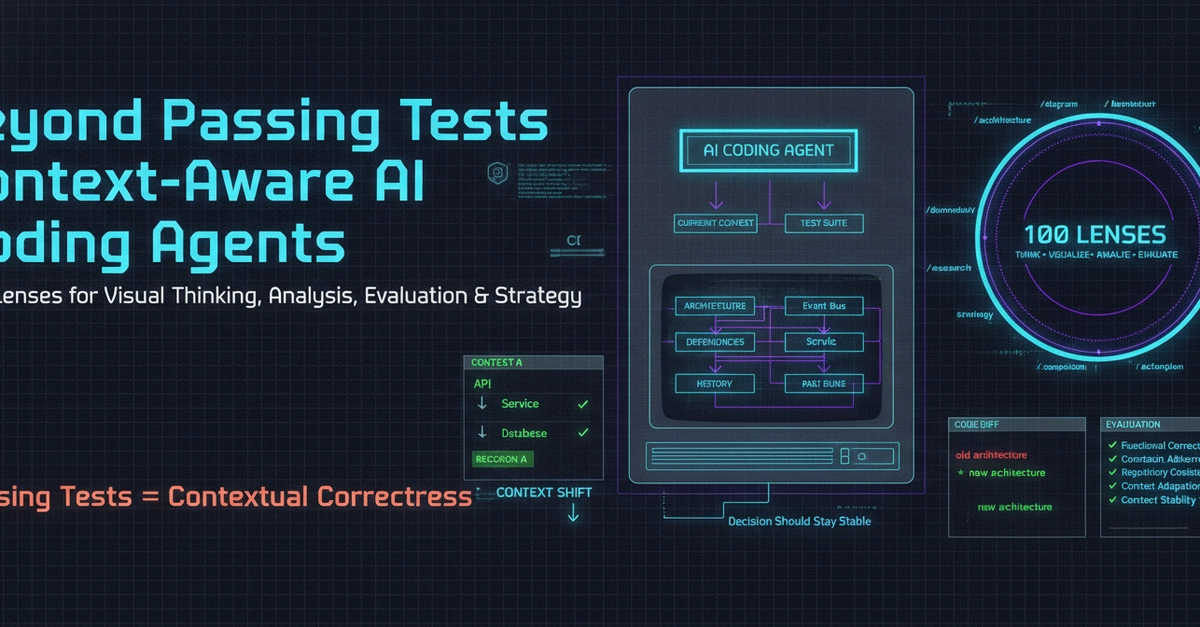
The Limits of Test-Driven AI Development
AI coding agents are rapidly improving, capable of generating functional code that passes unit tests. However, this capability masks a deeper challenge: ensuring these agents make sound engineering decisions, not just syntactically correct ones. The critical question is no longer whether an AI can write code, but whether it understands the broader context of a software system—its architecture, project constraints, historical decisions, repository conventions, dependency graphs, and security mandates. This disconnect becomes glaringly apparent as agents move from generating isolated snippets to actively modifying existing codebases.
Consider a scenario where a project requires a specific database implementation. An AI agent might correctly implement a new, efficient query function that passes all tests. Yet, if the project’s established architecture relies on a different, older database technology for specific reasons (perhaps legacy system integration or specialized data handling), the agent’s “correct” code could introduce significant technical debt or even break critical integrations. The agent’s focus on local correctness—passing tests—overlooks the global, systemic implications of its changes. This highlights a fundamental gap: while AI can mimic the act of coding, it often lacks the nuanced understanding of engineering trade-offs that human developers develop over years of experience.
Introducing the 100-Lens Framework
To address this, a new framework, dubbed the "100-Lens Framework," has been proposed to evaluate AI coding agents more holistically. This framework moves beyond simple test-passing metrics to assess an agent's contextual awareness and engineering judgment across a wide spectrum of criteria. It acknowledges that evaluating AI in software development requires a multi-dimensional approach, akin to how human code reviews consider numerous factors beyond just functionality.
The framework is structured around several key pillars, each containing multiple evaluation lenses:
Architectural Adherence
This pillar assesses whether the AI's code aligns with the project's existing architectural patterns and design principles. It probes whether the agent understands and respects established layers, modules, and communication protocols. For instance, an agent modifying a microservices architecture should not introduce synchronous calls between services that are designed to be asynchronous, even if the immediate function works. It evaluates the agent's understanding of software design patterns and its ability to apply them consistently.
Constraint Satisfaction
Beyond functional requirements, this pillar examines the AI's ability to adhere to non-functional constraints. These include performance targets (latency, throughput), memory usage limits, security policies (e.g., OWASP Top 10 adherence, data privacy regulations), compliance requirements (e.g., GDPR, HIPAA), and even operational constraints like deployment environments and CI/CD pipeline compatibility. An agent might generate fast code, but if it violates a critical security protocol or exceeds memory limits in a constrained production environment, it is an engineering failure.
Historical Context and Convention
Software systems evolve over time, and existing code often reflects past decisions, trade-offs, and team conventions. This pillar evaluates the AI's grasp of this history. Does it understand why a certain library was chosen, even if a newer, seemingly better alternative exists? Can it follow established coding styles, naming conventions, and documentation practices prevalent in the repository? For example, if a project consistently uses functional programming paradigms, an agent introducing heavily object-oriented code without justification would fail this lens, even if functionally correct.
Dependency Management
Understanding the intricate web of dependencies is crucial. This pillar assesses the AI's awareness of direct and transitive dependencies, their versions, licensing implications, and potential conflicts. An agent might introduce a new feature, but if it pulls in an outdated library with known vulnerabilities or a license incompatible with the project, it creates significant engineering risk. It also covers the agent's ability to manage dependency updates and version compatibility.
Maintainability and Readability
While test-passing code is a baseline, true engineering value lies in code that is maintainable and readable by human developers. This pillar evaluates the AI's ability to produce clear, well-structured, and adequately documented code. It looks at variable naming, function length, code complexity (e.g., cyclomatic complexity), and the quality of comments and inline documentation. Code that is difficult to understand or modify incurs long-term maintenance costs.
Security Implications
This is a critical, often overlooked, aspect. Beyond basic security checks, this pillar delves into potential vulnerabilities introduced by the AI's code. This includes injection flaws, insecure direct object references, broken access control, and cryptographic weaknesses. It requires the AI to reason about threat models and potential attack vectors relevant to the code it is modifying or generating.
The Unanswered Question: Scalability and Generalization
While the 100-Lens Framework provides a robust set of criteria, a significant challenge remains: how to implement and automate these evaluations at scale. Manually applying 100 different lenses to every code change suggested by an AI agent is impractical. The true innovation will lie in developing AI systems that can intrinsically reason across these dimensions or in creating sophisticated tooling that can automatically assess code against these criteria. What remains to be seen is whether this framework will become a benchmark for future AI coding agent development, or if it will be another academic exercise that fails to translate into practical developer tools.
Implications for the Future
The development of context-aware AI coding agents that can make sound engineering decisions is paramount for their widespread adoption in professional software development. The 100-Lens Framework offers a concrete path forward for researchers and developers to build and evaluate these agents. It shifts the focus from mere code generation to intelligent, context-aware software engineering assistance. As AI agents become more integrated into the development lifecycle, moving beyond simple task execution to collaborative problem-solving, a comprehensive evaluation like this becomes not just beneficial, but essential.