Rethinking Sprint Velocity with AI Coders
The advent of AI coding assistants fundamentally alters the economics and measurement of software development. Traditional Agile methodologies, where sprint velocity is a direct proxy for human hours spent coding, debugging, and unit testing, are becoming obsolete. A new model is emerging, one that recognizes the AI Coder not as a replacement for human developers, but as a synergistic partner. This partnership redefines velocity from raw code production to the speed and effectiveness of human validation, integration, and strategic decision-making.
When an AI Coder can generate boilerplate code, unit tests, and even initial drafts of complex functions in minutes rather than days, the bottleneck shifts. The human developer's role transforms from a code typist to an architect, reviewer, and integrator. This means sprint velocity can no longer be measured by lines of code or story points completed solely by human effort. Instead, it must account for the throughput of validated, integrated features that have passed human review and strategic alignment. The AI Coder acts as a powerful 'variance absorber,' capable of rapidly generating alternative implementations or refactoring code in response to evolving requirements. This dramatically reduces the financial penalty associated with requirement changes, particularly within the short iterations of 1-3 day sprints common in AI-assisted workflows.
The Baseline Costing Model for AI-Assisted Teams
To accurately model the costs and benefits of an AI Coder integrated with a Senior Developer, we must expand traditional economic formulas. The core of this new model rests on understanding the 'AI Coder + Senior Developer' pairing. The Senior Developer's time is now allocated differently: less on manual coding and more on prompt engineering, code review, architectural design, and complex problem-solving that AI cannot yet handle. The AI Coder's contribution is primarily in rapid code generation and iteration.
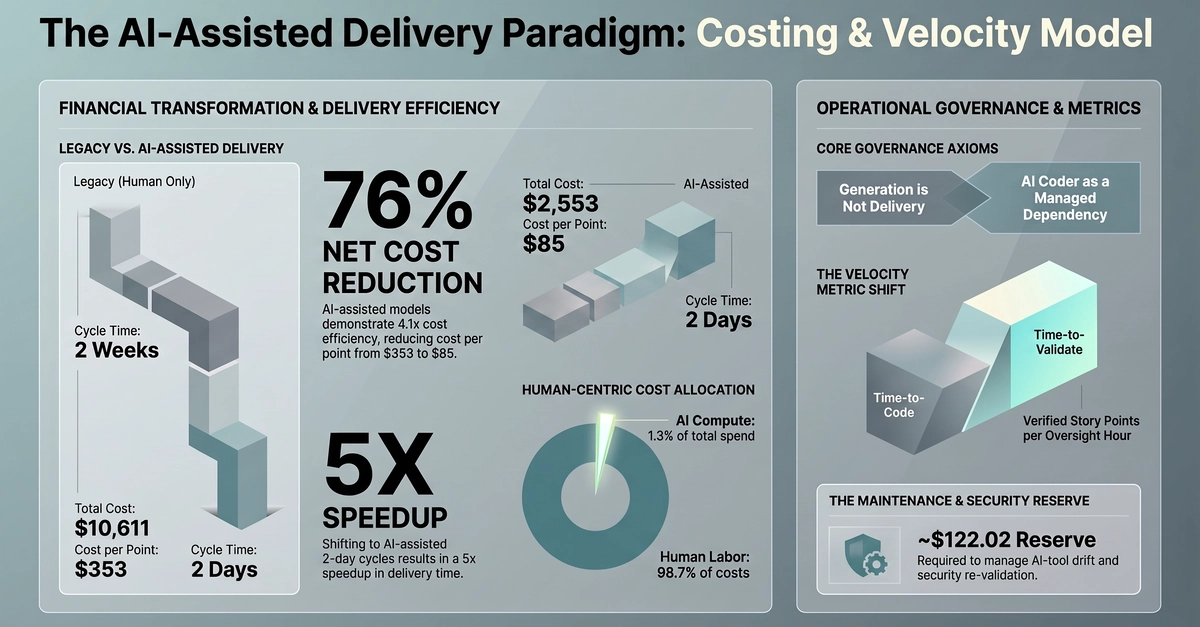
The cost structure changes. While there's an investment in AI tools and potentially specialized training for developers, the reduction in human hours spent on routine coding tasks offers significant savings. The key is to accurately attribute value. The AI Coder's speed in generating code is a powerful tool, but its true economic value is realized when it accelerates the human developer's ability to deliver integrated, validated features. This means the cost per feature delivered can decrease significantly, even with the added expense of AI tooling, because the overall cycle time is compressed and rework due to requirement changes is minimized.
Consider a scenario where a feature requires 100 hours of traditional development. With an AI Coder, the Senior Developer might spend 10 hours on prompt engineering and initial setup, the AI Coder generates the bulk of the code in 2 hours (human equivalent time), and the Senior Developer spends 20 hours on review, integration, and testing. This totals 32 hours, a substantial reduction from 100. Furthermore, if requirements change mid-sprint, the AI Coder can regenerate the affected code in minutes, allowing the Senior Developer to adapt the integration and review process rapidly, rather than facing days of manual rework. This 'variance absorption' is a direct financial benefit, preventing costly sprint extensions or scope creep penalties.
Measuring Velocity: Beyond Raw Output
The critical shift in measuring velocity lies in redefining what 'output' means. In a legacy system, velocity is often measured in story points completed, which implicitly correlates to the human effort involved. With AI assistance, this metric becomes misleading. A team might close more story points, but if the underlying work is primarily AI-generated and minimally validated, the actual delivered value and quality can be compromised.
The new velocity measurement must focus on human validation and integration throughput. This means tracking:
- Time to Review and Integrate: How quickly can a Senior Developer take AI-generated code, review it for correctness, security, and adherence to architectural standards, and integrate it into the main codebase?
- Cycle Time for Validated Features: What is the total time from feature conception to deployment, with 'validated' meaning it has passed human review and automated tests?
- Requirement Adaptation Speed: How quickly can the team pivot or adjust features when requirements change, leveraging the AI's ability to rapidly regenerate code?
This approach aligns velocity measurement with business value. It prioritizes the speed at which the team can deliver high-quality, strategically aligned software, rather than simply the volume of code produced. The AI Coder's role is to augment the human developer's capacity, allowing them to focus on higher-value tasks, thereby increasing the team's overall effective velocity.
The AI Coder as a Variance Absorber
One of the most significant economic impacts of AI coders is their ability to absorb the financial penalty of evolving requirements. In traditional software development, requirement changes, especially mid-sprint, are costly. They often necessitate significant rework, leading to schedule delays, budget overruns, and team frustration. The longer the time it takes to implement a change, the higher the cost.
AI coders act as a 'variance absorber' by drastically reducing the time required to generate or modify code. Imagine a scenario where a feature is halfway through a 3-day sprint, and a critical requirement change is introduced. In a legacy environment, this could mean discarding hours of work and starting anew, potentially jeopardizing the sprint goal. With an AI Coder, the Senior Developer can provide the updated requirements, and the AI can regenerate the relevant code segments in minutes. The developer then focuses on integrating these changes and re-validating, a process far quicker and less costly than manual recoding.
This capability is particularly potent in short, iterative sprints. The rapid feedback loop enabled by AI allows teams to experiment and adapt more freely. The financial consequence of 'getting it wrong' or 'changing our minds' diminishes considerably. This doesn't eliminate the need for careful planning, but it provides a powerful buffer against the inherent uncertainty in software development, making projects more predictable and financially stable.
Future Implications for Development Teams
The integration of AI coders into development workflows necessitates a fundamental re-evaluation of team structures, skill sets, and economic models. Teams that embrace this shift will see increased productivity, reduced costs associated with requirement churn, and a faster time-to-market. Developers will need to hone skills in prompt engineering, AI-assisted code review, and strategic architectural thinking. For founders and engineering leaders, understanding and implementing these new costing and velocity measurement models will be crucial for optimizing resource allocation and maximizing return on investment in AI-assisted software engineering.