The Rise of AI-Generated Code and Its Hidden Risks
AI coding assistants like GitHub Copilot, Cursor, ChatGPT, and Gemini are rapidly integrating into development workflows. Their ability to generate code at speed means they are now present in production codebases across countless companies. However, these tools, trained on vast datasets of existing code, inevitably learn and reproduce security flaws present in that training data. This results in the repeated introduction of the same security vulnerabilities, often overlooked by conventional security checks.
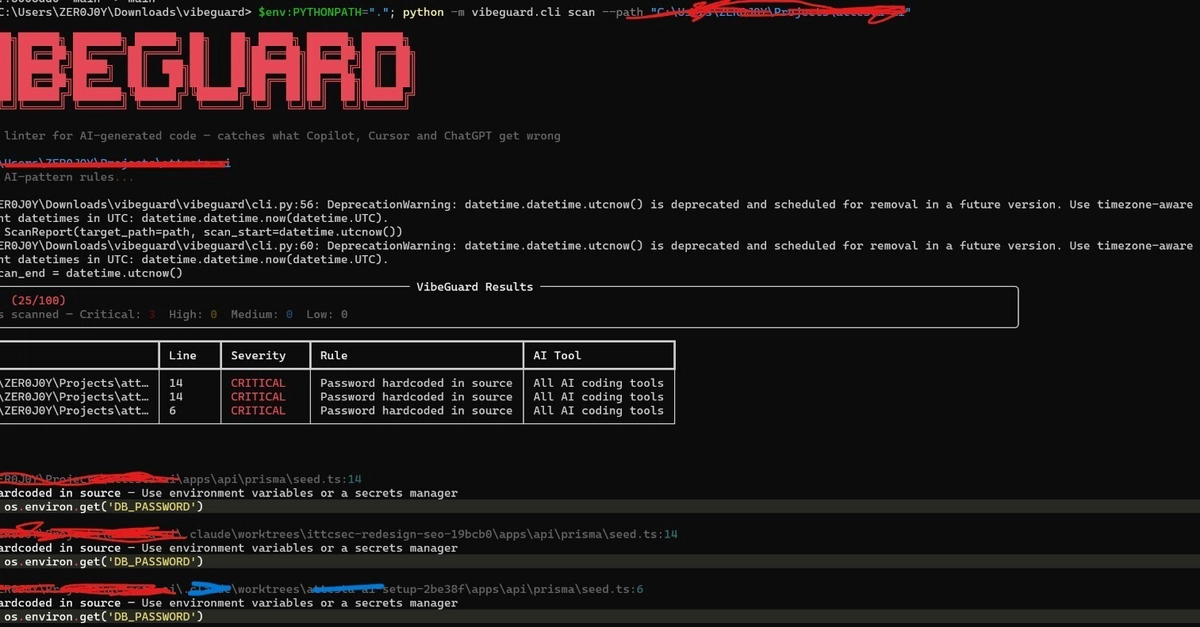
A recent audit of a production codebase highlights this issue starkly. A developer tasked with an audit ran a newly developed security linter, VibeGuard, on their live production environment. The results were immediate and concerning: out of 533 files scanned, the tool identified three critical security vulnerabilities. Alarmingly, all three were generated by AI coding tools and had bypassed the company's existing security pipeline. The silver lining was that each vulnerability could be fixed with a single-line command, underscoring the precise nature of the issues found.
Introducing VibeGuard: A Linter for AI's Blind Spots
VibeGuard is a free, open-source security linter specifically engineered to address the unique security challenges posed by AI-generated code. Unlike general-purpose linters, VibeGuard is trained to recognize patterns of insecure code that AI models frequently produce. Its development stems from the observation that AI tools, while powerful, are not inherently security-aware; they reflect the security posture of their training data, warts and all. VibeGuard acts as a specialized filter, catching the specific types of errors that traditional tools might miss because they are subtle or context-dependent in ways AI models reproduce.
The linter operates by analyzing code for known anti-patterns and vulnerabilities commonly found in AI-generated code. This includes issues such as improper input validation, insecure direct object references, and potential injection flaws that AI models might generate if their training data contained examples of such practices. The goal is not to demonize AI coding tools but to provide developers with a targeted mechanism to ensure the code produced by these powerful assistants meets security standards before deployment.
The Audit Findings: Critical Vulnerabilities Uncovered
The developer who ran VibeGuard on their production codebase provided a concrete example of its efficacy. The audit covered 533 files, a substantial portion of a live application. The linter flagged three critical vulnerabilities. These were not minor coding style issues; they represented significant security risks that could potentially be exploited by malicious actors. The fact that these vulnerabilities were AI-generated means they might have been introduced unintentionally during the development process, perhaps through copy-pasting AI-suggested code snippets without thorough security review.
The failure of the existing security pipeline to detect these critical flaws is a key takeaway. This suggests that current security tools and practices may not be adequately equipped to handle the nuances of AI-generated code. Traditional static analysis tools often rely on predefined rules and signatures that may not recognize novel or context-specific vulnerabilities introduced by AI. VibeGuard's success in this audit points to the need for more specialized security tooling that understands the specific failure modes of AI code generation.
The ease of remediation is another crucial aspect. Each of the three critical vulnerabilities identified by VibeGuard could be resolved with a single-line code change. This implies that the issues were not deeply rooted architectural problems but rather specific coding errors that AI models introduced. This characteristic makes VibeGuard particularly valuable: it not only identifies problems but does so in a way that suggests straightforward solutions, minimizing the development effort required to secure the codebase.
Implications for Development and Security Teams
The findings from this audit have significant implications for how development teams approach AI coding tools and security. Firstly, it underscores the necessity of treating AI-generated code with the same, if not greater, scrutiny as human-written code. Developers cannot assume that code suggested by an AI is inherently secure or correct. A robust review process, incorporating specialized tools like VibeGuard, is essential.
Secondly, it highlights a potential gap in existing security tooling. Companies relying solely on traditional security pipelines may be vulnerable to AI-introduced flaws. This necessitates an evaluation of current security strategies and the potential adoption of AI-specific security linters. The open-source nature of VibeGuard makes it an accessible option for many teams looking to enhance their security posture.
For security professionals, this development signals a shift in the threat landscape. The nature of vulnerabilities may change as AI tools become more prevalent. Understanding the common pitfalls of AI code generation will be crucial for effective threat modeling and incident response. The ability to quickly identify and fix these vulnerabilities, as demonstrated by VibeGuard, will be a key differentiator in maintaining secure production environments.
The Future of Code Security with AI
The integration of AI into software development is irreversible. Tools like VibeGuard represent a proactive approach to managing the associated risks. As AI coding assistants become more sophisticated, they may also become better at avoiding common security pitfalls. However, the fundamental challenge of learning from imperfect training data will likely persist. Therefore, the need for specialized security tools that can adapt to the evolving landscape of AI-generated code will only grow.
The developer who built VibeGuard has provided a valuable resource to the community. By sharing their findings and the tool itself, they enable other teams to benefit from this knowledge. The success of VibeGuard in identifying critical vulnerabilities in a real-world scenario serves as a compelling argument for its adoption. As AI continues to transform the way software is built, ensuring its security will require a parallel evolution in our security tools and practices.