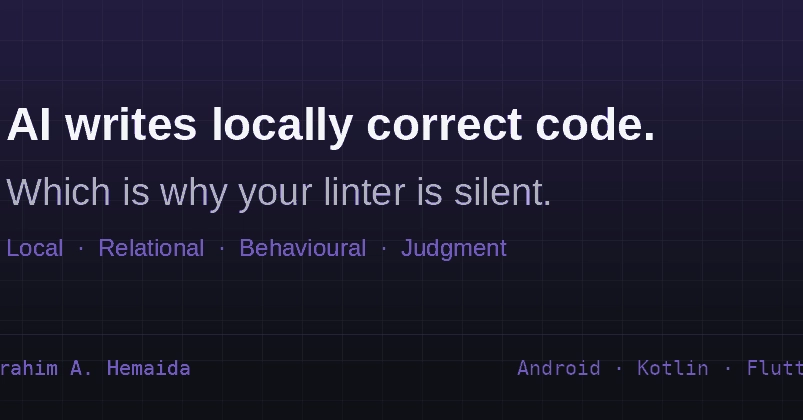
The Silent Error: AI vs. Static Analysis
The proliferation of AI-powered code generation tools has introduced a subtle but significant challenge for software development teams: code that appears correct to linters and static analysis tools but contains fundamental, application-breaking flaws. While traditional linters like ktlint, detekt, and Android Lint are adept at catching syntactical errors, style violations, and even some common logical mistakes within a single file or function, they are increasingly blind to the types of errors emerging from Large Language Models (LLMs). This isn't a new problem in principle; human developers have always introduced bugs like null dereferences, scope leaks, or incorrect operator usage. What has changed is the rate at which these errors appear and the nature of the tools that can catch them.
The core issue is that AI assistants, while capable of generating syntactically sound code, often fail to grasp the broader context of an application. They might produce code that is locally correct—meaning it compiles and adheres to style guides—but violates architectural principles, leaks resources, or introduces subtle race conditions that only manifest under specific runtime conditions or in interaction with other parts of the system. These are not errors that a linter, which operates on a file-by-file basis, is designed to detect. Think of a linter as a diligent proofreader checking for spelling and grammar on individual sentences. An AI-generated bug, however, might be akin to a factual inaccuracy or a logical inconsistency that undermines the entire paragraph, something the proofreader would never catch.
The Shifting Landscape of Code Quality
For years, development teams relied on linters and code review checklists to maintain code quality. These tools enforce consistency and catch common mistakes. However, the underlying assumption was that the developer understood the application's architecture and intent. AI code generators, operating differently, can produce code that satisfies the linter's constraints without fulfilling the deeper requirements of the system. This means that code generated by LLMs might pass all automated checks, leading to a false sense of security. Developers might merge code that looks clean but is fundamentally flawed, relying on the linter as a proxy for correctness when that proxy is no longer sufficient.
The types of errors AI assistants are prone to are often contextual. For instance, an LLM might generate a piece of code that handles a specific data transformation correctly within its own scope. However, if this transformation needs to occur within a larger, multi-threaded operation, the LLM might not infer the need for synchronization or proper error propagation across threads. The code itself, viewed in isolation, is pristine. But in the context of the application's execution flow, it could lead to deadlocks, data corruption, or unexpected application crashes. These are systemic issues, not local ones.
The Role of Human Review and New Tools
The implication for development teams is clear: the reliance on automated linters alone is no longer adequate for code generated by AI. A more rigorous, context-aware human review process is essential. Developers need to shift their focus from purely local checks to understanding the architectural implications and runtime behavior of AI-generated code. This requires developers to ask different questions during code review: Does this code integrate correctly with existing modules? Are there potential race conditions? Is resource management handled properly across the entire application lifecycle?
Furthermore, new tools and techniques are emerging to address this gap. Dynamic analysis, runtime monitoring, and more sophisticated integration testing are becoming increasingly critical. These methods can uncover bugs that static analysis tools miss by observing the code's behavior during execution. Teams that adopt AI code generation must invest in strengthening their testing and review practices, moving beyond the superficial correctness provided by linters to ensure deep, contextual integrity.
What This Means for Developers
For developers, this shift demands a re-evaluation of their workflow and a deeper engagement with the code they integrate, even when AI assists in its creation. The comfort of a silent linter is now a potential red flag, signaling that the code might be deceptively simple and locally correct, but globally problematic. Developers must become the ultimate arbiters of correctness, using their understanding of the system's architecture and runtime behavior to validate AI-generated contributions. This isn't about abandoning AI tools, but about augmenting them with human oversight that understands the bigger picture.
The challenge is not a new category of bug, but a new delivery mechanism. AI assistants are exceptionally good at generating code that looks plausible and passes superficial checks. They excel at tasks that are self-contained and follow predictable patterns. However, they struggle with the nuanced, system-wide considerations that experienced developers manage implicitly. This necessitates a proactive approach from development teams, ensuring that their review processes evolve alongside the capabilities of AI code generation tools.