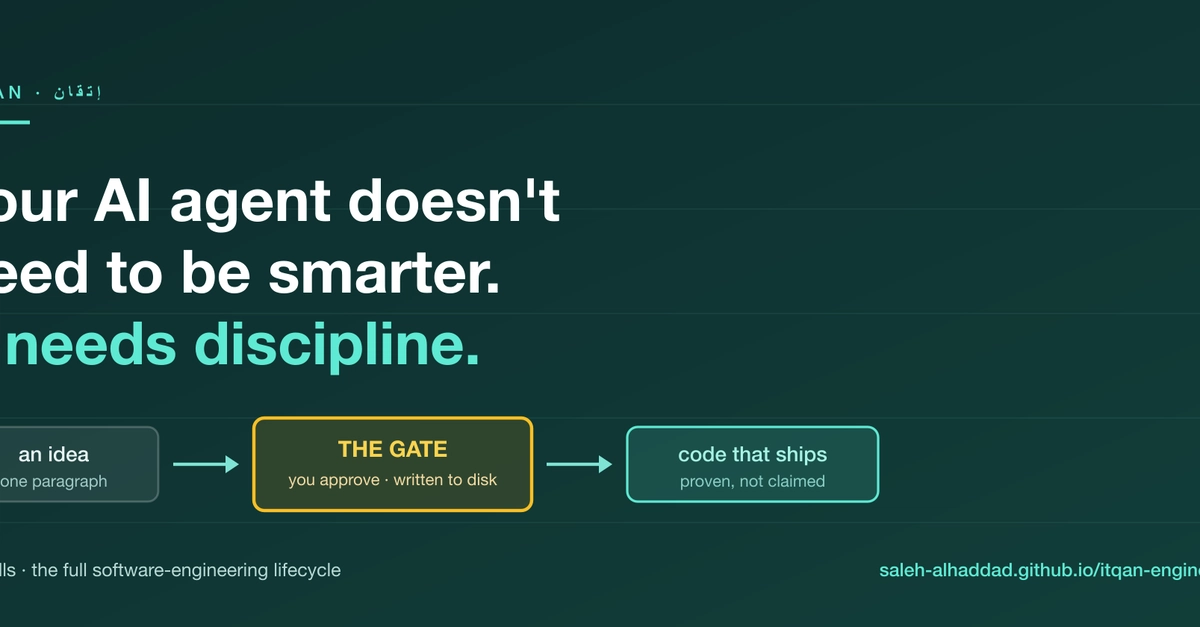
The Bottleneck Isn't Intelligence, It's Discipline
The rapid advancement of AI coding assistants has delivered models capable of understanding vast codebases, reasoning across complex services, and producing output that often surpasses the quality of existing code. Yet, for those who have deployed these tools on real-world projects—not just demos or personal experiments—the familiar frustration remains: reading hundreds of lines of confident, well-formatted AI-generated code only to realize it’s fundamentally unusable and must be discarded. This significant gap between AI capability and practical application is the core problem. Crucially, this isn't a limitation of the AI's reasoning power; the issue lies deeper, in the absence of a structured, disciplined approach to its output.
Consider the best engineer on your team. Imagine them starting a new project by immediately writing code without understanding the requirements, the existing architecture, or the team's established conventions. This hypothetical engineer would be unproductive. Similarly, AI agents, despite their impressive technical prowess, often operate without this essential context. They generate code that looks good on the surface but fails to align with project-specific constraints, business logic, or operational realities. The models have become incredibly knowledgeable, but they lack the inherent discipline of a seasoned developer who knows when to ask questions, when to pause, and how to integrate their work within a larger system. This missing discipline is the true bottleneck preventing AI from seamlessly integrating into professional software development workflows.
A Twelve-Skill System for AI Discipline
To bridge this gap, a structured system is required. My approach focuses on instilling discipline through a twelve-skill framework, treating the AI less like an oracle and more like a junior developer who needs clear guidance and feedback. This system addresses the AI's tendency to hallucinate, its lack of context awareness, and its inability to self-correct effectively when deviating from implicit or explicit project goals. The twelve skills are categorized to cover the entire development lifecycle, from initial understanding to final integration.
The first set of skills focuses on Requirement Assimilation. This involves teaching the AI to deeply understand user stories, technical specifications, and existing documentation before generating any code. It’s about ensuring the AI asks clarifying questions—or simulates asking them—to grasp the true intent behind a request. This moves beyond simply parsing keywords to understanding the underlying business problem. For instance, instead of just seeing 'implement login,' the AI must understand the security protocols, the user experience goals, and the specific authentication methods required by the application.
The second category addresses Contextual Awareness. AI agents need to understand the broader project architecture, including existing libraries, frameworks, and design patterns. They must recognize the implications of their generated code on other parts of the system. This involves training the AI to analyze the current codebase, identify relevant modules, and predict potential conflicts or dependencies. Think of it like a chef knowing not just how to cook a dish, but also how it fits into the overall menu and the restaurant's operational capacity.
Next, we focus on Iterative Refinement and Self-Correction. This is perhaps the most critical aspect of discipline. Instead of producing a single, monolithic block of code, the AI must be trained to produce smaller, testable units. More importantly, it must be able to evaluate its own output against the initial requirements and identify errors or deviations. This involves implementing feedback loops where the AI can review its work, pinpoint inaccuracies, and suggest or implement corrections. This mimics the human developer's process of writing code, testing it, finding bugs, and fixing them.
The final set of skills pertains to Integration and Compliance. This ensures that the AI-generated code adheres to team coding standards, security policies, and deployment procedures. It means the AI needs to understand not just how to write code, but how that code will be integrated into the CI/CD pipeline, how it will be tested, and how it will be monitored in production. This involves generating code that is not only functional but also maintainable, secure, and compliant with organizational best practices.
Building this twelve-skill system requires a shift in how we interact with AI coding assistants. It necessitates moving beyond simple prompt-response interactions to developing more sophisticated training regimens and evaluation frameworks. The goal is to imbue these powerful tools with the equivalent of professional judgment and discipline, transforming them from impressive code generators into reliable development partners.
Referenced Sources
- verified
- verified