The Double-Edged Sword of AI Code Generation
Large language models (LLMs) and AI code assistants have rapidly become indispensable tools for developers. They promise to accelerate development cycles, reduce boilerplate code, and even suggest novel solutions. However, this increased generation speed creates a significant challenge: the sheer volume and interconnectedness of AI-generated changes often overwhelm traditional code review processes. What used to be a manageable diff of a few related lines can quickly balloon into a sprawling, disorganized mess of unrelated modifications, making it difficult for human reviewers to understand, verify, and approve the proposed code.
The core of the problem lies in how AI agents operate. Unlike a human developer who naturally breaks down large tasks into logical, commit-sized chunks, AI agents often tackle a broad request and produce a single, monolithic output. This output can affect numerous files and introduce changes that, while contributing to the overall goal, belong in separate, distinct commits. Without a structured workflow, these disparate changes accumulate in the developer's working tree, intermingling unrelated modifications. This makes it challenging to isolate specific functionalities, preserve logical slices of work, stage changes accurately, and ultimately, leads to reviewable units that are far larger and more complex than necessary.
Consider the scenario: a developer asks an AI to implement a new user authentication flow. The AI might generate code for database schema updates, API endpoint modifications, frontend UI changes, and new validation logic. If all these changes land in the same working tree without separation, a reviewer must sift through everything at once. This is akin to trying to read a novel where all the chapters are mixed up on one giant scroll – the narrative is lost, and understanding becomes a monumental task.

Preserving Logical Slices with Agent-Up Commits
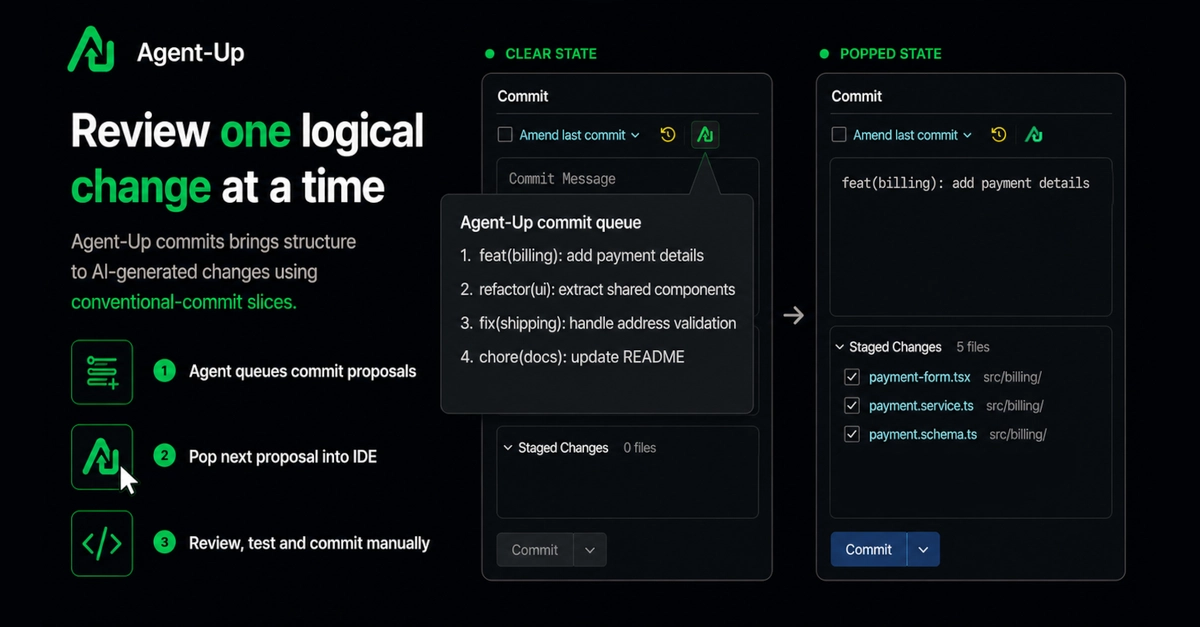
The solution proposed by Agent-Up commits focuses on preserving each logical slice of work as it is completed by the AI. Instead of letting all changes accumulate haphazardly, the workflow aims to capture discrete, functional units. For each completed slice, the system should ideally capture the affected files, a clear proposed commit message, the relevant test commands to verify its functionality, and the exact patch representing the changes.
Once a logical slice is preserved, the working tree should ideally be restored to a clean state, allowing the AI agent to continue working on the next independent slice without interference or contamination from previous outputs. This separation is crucial for maintaining clarity and enabling granular review. It transforms the process from a single, overwhelming delivery into a series of smaller, digestible updates.
However, preserving these slices is only one part of the equation. The AI agent needs to organize this work effectively without directly controlling the Git history. The responsibility for reviewing and committing should remain with the human developer. This ensures that the developer retains ultimate control and understanding over the codebase, leveraging the AI as a powerful assistant rather than an autonomous agent rewriting history.
The Developer's Role in the AI-Assisted Workflow
Agent-Up commits positions itself as a local commit proposal queue. This means the AI generates proposals for commits, which are then queued up for the developer's review. The developer inspects each staged diff presented by the queue. They verify that the changes are correct, that they align with the intended functionality, and that they are appropriately scoped. Only after this manual review does the developer choose to create the commit. This process maintains the integrity of the Git history and ensures that human oversight is central to the development lifecycle.
This workflow is particularly beneficial when dealing with complex features or significant refactoring tasks. Instead of receiving a massive, undifferentiated blob of code, the developer receives a series of well-defined, testable, and reviewable commit proposals. This dramatically reduces the cognitive load during code reviews. Reviewers can focus on the logic and correctness of each individual commit proposal rather than wrestling with the context of a vast, intertwined set of changes.
The Agent-Up commits approach can be visualized as a conveyor belt. The AI places neatly packaged items (commit proposals) onto the belt. The developer, at their own pace, picks up each item, inspects it, and decides whether to accept it into the main product line (the Git history). If an item isn't right, it can be easily set aside or returned for modification without disrupting the entire flow.
This methodology is not about replacing Git or the developer's control; it's about augmenting the development process. It addresses the inherent challenge of AI's generative capabilities outstripping human review capacity. By structuring the output of AI code generation into manageable, reviewable proposals, Agent-Up commits aims to make AI assistants truly collaborative partners, enhancing productivity without sacrificing code quality or review integrity.
Broader Implications for AI Development Tools
The challenge highlighted by the Agent-Up commits approach is not unique to this specific tool. As AI code generation becomes more sophisticated, the need for intelligent workflows that manage AI-generated output will only grow. Tools that can effectively break down complex AI suggestions into granular, verifiable steps will become essential. This could involve better integration with version control systems, more sophisticated diffing and staging mechanisms that understand logical code boundaries, and AI agents that are trained to produce atomic, well-defined changes.
What remains to be seen is how widely such structured AI workflows will be adopted. Will developers embrace a new commit proposal queue, or will they demand that AI tools integrate these capabilities directly into their existing IDEs and Git workflows? The success of Agent-Up commits will likely depend on its ease of integration and its ability to seamlessly fit into established developer practices. The ultimate goal is to harness the power of AI without compromising the discipline and rigor that define high-quality software engineering.