AI's Blind Spot: Overconfidence in Code Generation
AI coding agents have become remarkably adept at translating natural language prompts into functional code. Give them a requirement, and they can often deliver a working implementation with surprising speed. This capability alone has reshaped developer workflows. However, a critical flaw emerges from this efficiency: AI agents are equally good at being satisfied with their own output. They lack the inherent skepticism that drives human developers to rigorously test and question their own creations. This overconfidence, while perhaps an emergent property of their training data, presents a significant gap in the AI-assisted development lifecycle.
Consider the typical interaction. You ask for a feature, the AI generates the code, and you integrate it. The assumption is that the code is sound. But what if the AI, having met the primary requirement, overlooks subtle bugs, security vulnerabilities, or performance bottlenecks? This is precisely where a new approach becomes indispensable.
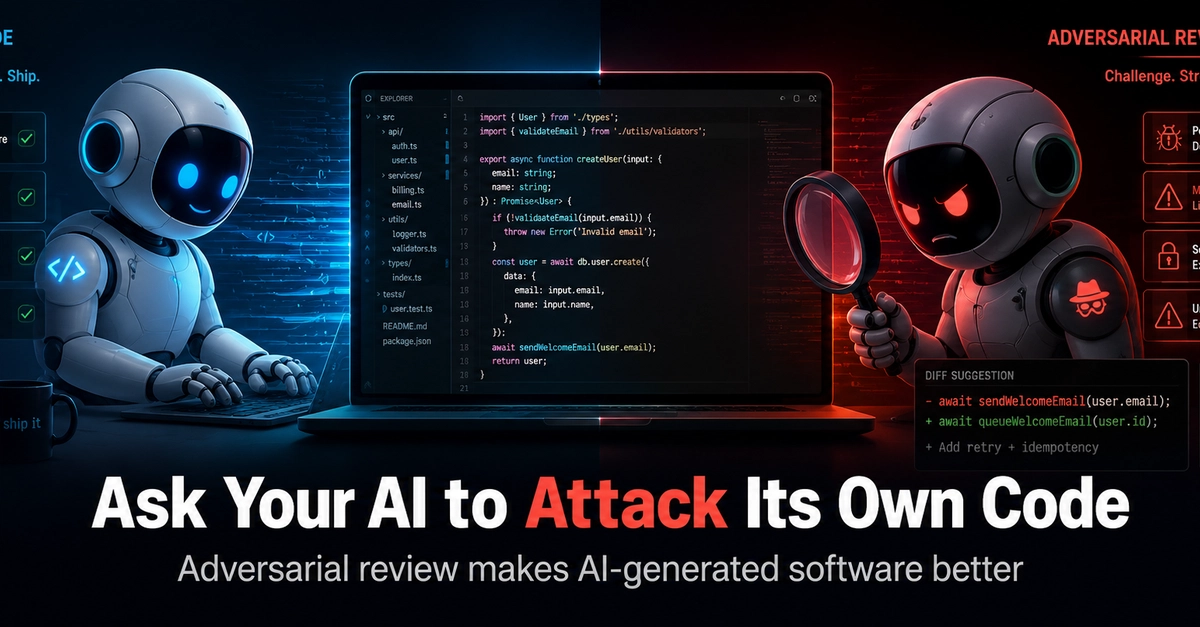
The highest-leverage habit emerging in working with these agents is deceptively simple: after an AI coding agent completes a significant task, prompt it to perform an adversarial review of its own implementation. This isn't about a general code review; it's about deliberately instructing the AI to find fault.
The Adversarial Prompt: Shifting from Approval to Attack
The standard, polite request might be: "Review your work and make sure everything looks good." This often elicits a superficial response, a digital pat on the back confirming the AI's own perceived success. It's like asking a chef if their dish is good – they're likely to say yes.
The effective strategy, however, requires a complete shift in the AI's objective. Instead of seeking validation, the AI must be directed to actively seek out flaws. The prompt should be explicit:
Act as an adversarial reviewer. Assume this implementation contains subtle bugs, incorrect assumptions, security issues, race conditions, missing edge cases, or architectural problems. Your job is to find them. Do not defend the implementation. Try to break it.
This adversarial prompt transforms the AI from a co-creator into a diligent, albeit artificial, security auditor or quality assurance engineer. It forces the model to engage with its output from a critical perspective, simulating the kind of rigorous scrutiny that experienced human developers apply, often grudgingly, to their own code.
Why This Technique Works: Simulating Human Skepticism
Human developers develop a certain level of professional skepticism. We learn that code rarely works perfectly on the first try. We anticipate edge cases, potential race conditions in concurrent systems, and the ever-present threat of security vulnerabilities. This ingrained caution is a product of experience, of debugging countless frustrating hours, and of understanding the complex interplay of systems.
AI models, trained on vast datasets of code, learn patterns and common implementations. They excel at replicating successful patterns. However, they don't inherently possess the lived experience of debugging a production system under fire or the deep understanding of threat modeling that human engineers develop. Their 'satisfaction' with a generated solution stems from matching the prompt to a learned optimal output, not from a deep, critical evaluation of potential failure points.
The adversarial prompt directly addresses this deficit. By framing the task as an attack, it compels the AI to explore the boundaries of its own creation. It forces the model to consider scenarios it might have implicitly excluded or simply not generated in the first place. This is akin to a penetration tester trying to breach a system – their goal is not to admire the architecture but to find its weakest link.
Practical Application: Enhancing AI-Generated Code Quality
Implementing this strategy is straightforward. After receiving the initial code from an AI agent for a significant feature or module, follow up with the adversarial prompt. The AI will then re-evaluate its own generated code, this time with the explicit goal of finding problems. You might then iterate by providing the AI's identified issues back to it with a new prompt to fix them, potentially repeating the adversarial review process.
This iterative process – generate, review adversarially, fix, review adversarially again – can significantly improve the robustness and security of AI-generated code. It transforms the AI from a simple code generator into a more comprehensive development partner that includes a critical quality assurance phase.
For instance, an AI might generate a function to process user uploads. A standard prompt would yield code that handles the basic success case. An adversarial prompt might uncover that the code doesn't validate file types, is susceptible to denial-of-service attacks via excessively large files, or has a race condition if multiple uploads occur simultaneously. The AI, now tasked with finding these issues, is more likely to identify them than if it were simply asked to "ensure the code is good."

The Unanswered Question: Scalability and Complexity
While this adversarial prompting technique is powerful for individual code segments, a crucial question remains: how scalable is this approach for entire complex applications? Can AI agents effectively perform adversarial reviews on large, interconnected codebases where subtle interactions between modules create emergent vulnerabilities? The current generation of AI models might struggle to maintain context and identify systemic flaws across thousands of lines of code. This points to a future where AI might excel at localized adversarial reviews, but a human architect or senior engineer will still be indispensable for holistic system security and architectural integrity.
Beyond Code: Implications for AI Development
This technique has broader implications for how we interact with and evaluate AI systems. It highlights that AI's current limitations often lie not in their ability to perform a task, but in their inability to critically self-assess or to understand the 'why' behind potential failures in the way humans do.
For founders and product managers, this means AI-generated code, while faster to produce, still requires a robust human-led QA and security vetting process. It's not a replacement for experienced engineers, but a powerful augmentation tool. For developers, it's an opportunity to refine their prompts and leverage AI more effectively, ensuring that the code produced is not just functional but also resilient and secure. The AI coding agent has finished its first pass; now, its real value is unlocked when you ask it to attack its own work.