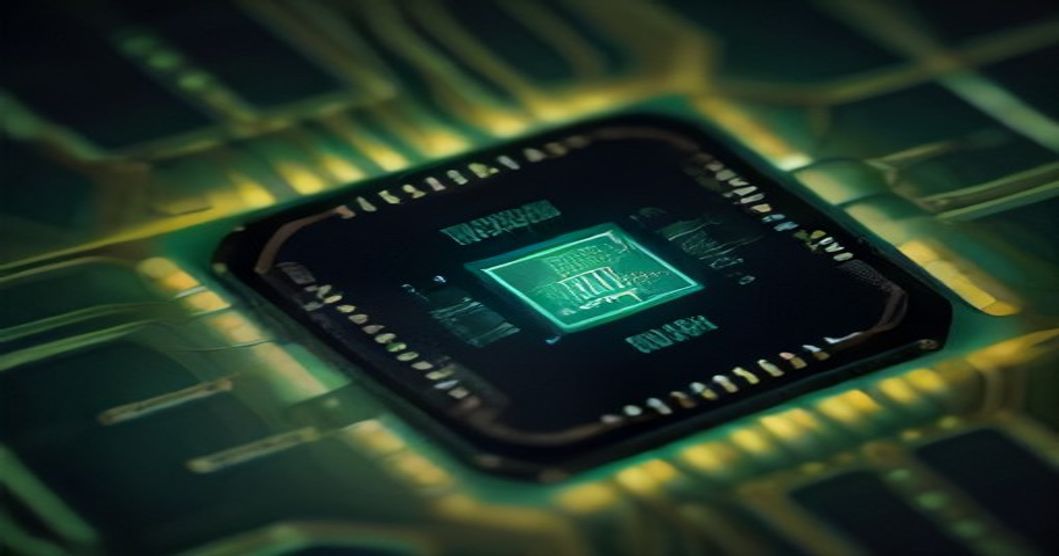
The Looming AI Hardware Disruption
The relentless construction of massive data centers, fueled by the insatiable demand for AI computation, might be blindsided by a technological paradigm shift. The question on many minds in the AI and tech industry is whether a new class of AI-specific microchips could emerge, similar to how smartphones disrupted the PC market or how GPUs transformed graphics processing, rendering current infrastructure investments obsolete. This isn't about incremental improvements; it's about a potential 'black swan' event that could fundamentally alter the economics of AI development and deployment.
Current AI workloads, particularly large language models (LLMs) and complex generative AI tasks, are heavily reliant on massive clusters of general-purpose GPUs and specialized AI accelerators housed in these data centers. The sheer scale of these operations, involving billions in capital expenditure for hardware, power, and cooling, makes them vulnerable to any technology that can achieve comparable or superior performance with drastically lower power consumption, cost, or latency. Such a disruption could lead to significant write-downs for companies that have bet heavily on the current architecture.
The core of this potential disruption lies in the fundamental architecture of computation. Today's dominant approach often involves moving data to processing units, which is inherently inefficient for the massive datasets AI models train on. A true AI microchip moment would likely involve architectures that are designed from the ground up for AI, minimizing data movement and maximizing parallel processing of AI-specific operations like matrix multiplication and tensor operations. This could manifest in several ways: novel chip designs, new materials, or entirely new computing paradigms.
Candidates for the AI Microchip Moment
Several avenues of research and development are being pursued that could lead to such a disruptive shift. These range from advancements in neuromorphic computing, which mimics the human brain's structure and function, to analog computing, which uses physical phenomena to perform calculations, and specialized ASIC designs that are hyper-optimized for specific AI tasks.
Neuromorphic Computing: The Brain Mimic
Neuromorphic chips are designed to emulate the structure and electrophysiology of the biological brain. Unlike traditional digital computers that use binary logic, neuromorphic systems often employ spiking neural networks (SNNs) where information is transmitted through discrete events, or 'spikes,' similar to neurons. This approach promises extreme energy efficiency for certain types of AI tasks, particularly those involving pattern recognition, sensory processing, and real-time inference. Companies like Intel with its Loihi research chip and startups such as GrAI Matter Labs are pushing this frontier. The challenge lies in scaling these systems and developing software ecosystems that can effectively program and utilize them for a broad range of AI applications beyond specialized tasks.
Analog Computing: Beyond Binary
Analog computing performs calculations using continuous physical quantities, such as voltage or current, rather than discrete binary numbers. For AI, this can be incredibly efficient for operations like matrix multiplication, which are fundamental to deep learning. Instead of representing numbers in binary and performing operations digitally, analog chips can perform these calculations directly through the physical properties of their components, such as resistors and capacitors. This can lead to orders of magnitude reduction in energy consumption and potentially higher speeds for specific workloads. Companies like Mythic AI have been developing analog compute-in-memory chips, aiming to perform computations directly where data is stored, drastically reducing data transfer bottlenecks. The main hurdles include precision issues inherent in analog systems and the difficulty in programming and debugging them compared to digital counterparts.
Optical Computing: The Speed of Light
Optical computing uses photons (light) instead of electrons for computation. Light travels faster and generates less heat than electricity, offering theoretical advantages in speed and energy efficiency. Some approaches involve using light to perform matrix-vector multiplications, a core operation in neural networks. Startups like Lightmatter and Lightelligence are exploring this path. The integration of optical components with existing semiconductor manufacturing processes and the development of robust optical memory and logic gates remain significant engineering challenges.
Specialized ASICs and Domain-Specific Architectures (DSAs)
While not a completely new paradigm, the evolution of Application-Specific Integrated Circuits (ASICs) and Domain-Specific Architectures (DSAs) for AI is becoming increasingly sophisticated. Companies like Google (TPUs), Amazon (Inferentia, Trainium), and Apple (Neural Engine) have developed custom silicon tailored for their specific AI workloads. These are not necessarily aiming to replace all data centers but rather to optimize specific parts of the AI pipeline far more efficiently than general-purpose hardware. The risk here is that a truly novel architecture could leapfrog even these highly specialized designs if it addresses the fundamental limitations of current approaches more effectively.
The Investment and Business Implications
The construction of new data centers represents a colossal investment in current AI infrastructure. If a disruptive AI chip emerges that offers superior performance-per-watt or performance-per-dollar, it could render these investments significantly less valuable, or even obsolete, much like the shift from dial-up to broadband internet changed the landscape for telecommunications infrastructure. This is the 'microchip moment' concern: a rapid, fundamental change in the underlying technology that redefines the market.
For founders and investors, this presents both a risk and an opportunity. The risk is backing the wrong infrastructure or AI platform that becomes outdated. The opportunity lies in identifying and investing in the companies developing these next-generation AI hardware solutions. The challenge is that many of these promising technologies are still in early-stage R&D, making their commercial viability and scalability uncertain. The path from a lab prototype to mass-produced, reliable, and cost-effective silicon is long and fraught with engineering and manufacturing challenges.
The current trajectory of AI development is heavily dependent on compute power. While companies are exploring algorithmic optimizations and model compression techniques to reduce computational demands, the raw power requirement for cutting-edge AI continues to grow. A breakthrough in hardware efficiency could accelerate AI adoption across industries, enabling applications that are currently too computationally expensive or power-hungry to be feasible. Conversely, a failure to innovate in hardware could become a bottleneck, slowing down the pace of AI advancement and limiting its accessibility.
An Unanswered Question: The Software Chasm
What remains largely unaddressed by the hardware race is the software ecosystem required to fully leverage these novel architectures. Developing compilers, programming models, and libraries for neuromorphic, analog, or optical computing is a monumental task. Without robust and accessible software tools, even the most efficient hardware risks remaining a niche solution. The transition from the current CUDA-dominated landscape to entirely new programming paradigms will be a significant hurdle, potentially delaying the widespread adoption of any truly disruptive hardware.