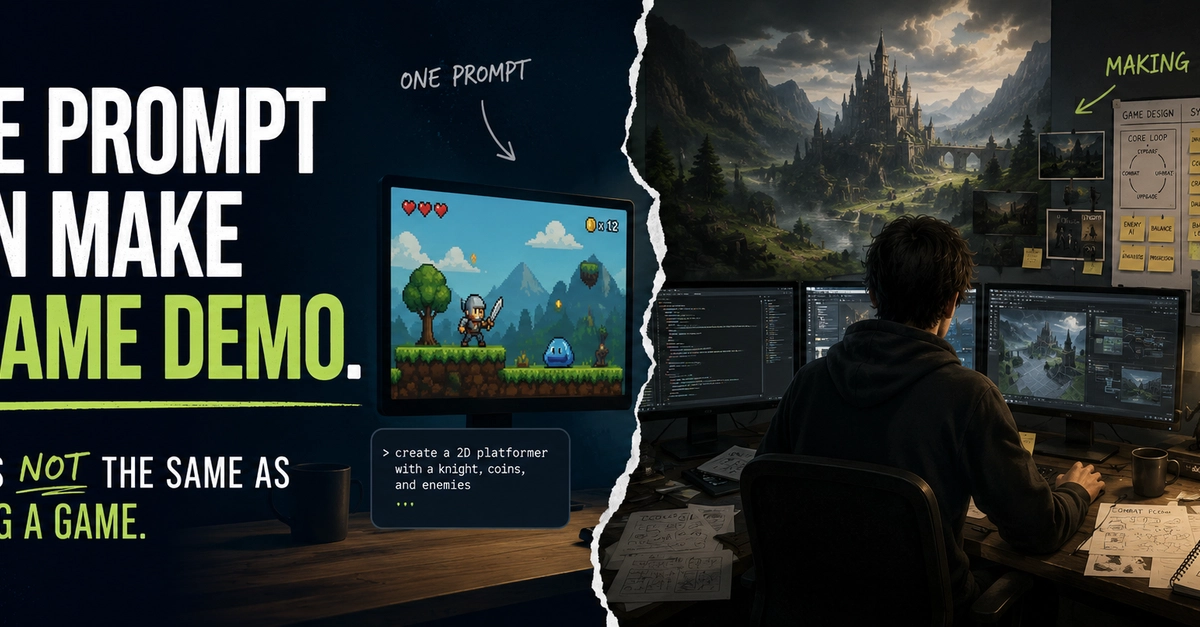
The AI Game Demo Phenomenon
The ability to generate a playable first-person shooter from a single AI prompt would have sounded like science fiction just a short time ago. Today, videos of AI-generated browser games, often mimicking popular titles like Call of Duty and Counter-Strike, are rapidly circulating on social media. This surge in "one-shot" AI game prompting, where a detailed instruction is given to a model which then outputs playable code, represents a significant technical milestone.
On August 10th, Axios reported on this emerging trend, highlighting how effectively AI models can now assemble core game mechanics. While this capability is impressive, it is also prone to misinterpretation. A one-prompt game can demonstrate an AI's proficiency in integrating controls, graphics, physics, enemy AI, and a basic game loop. However, it does not inherently prove that the resulting experience will remain engaging or compelling beyond the initial novelty.
The crucial distinction lies between creation and development. The initial prompt serves to generate a functional demo, a proof of concept. The actual process of making a game—one that captivates players and offers depth—involves a continuous series of decisions made long after the first line of code is generated.
Beyond the Prompt: The Depth of Game Development
Game development is an iterative process that extends far beyond the initial generation of a playable prototype. While AI can now proficiently assemble the building blocks of a game, it currently struggles with the nuanced design decisions that transform a technical demonstration into an enjoyable experience. This involves extensive work in areas such as:
- Level Design: Crafting intricate and balanced environments that guide player experience, provide challenges, and foster exploration. AI-generated levels can be procedurally assembled, but they often lack the intentionality, pacing, and thematic coherence that human designers imbue.
- Narrative and Lore: Developing compelling storylines, character arcs, and world-building that immerse players and provide context for their actions. A single prompt can suggest a premise, but it cannot weave the complex tapestry of a narrative that resonates with an audience.
- Gameplay Balancing: Fine-tuning mechanics, enemy difficulty, progression systems, and reward structures to create a satisfying and challenging experience. This requires extensive playtesting and iterative adjustment based on player feedback, something AI is only beginning to approximate.
- Art Direction and Polish: Establishing a unique visual style, creating high-quality assets, and refining animations and user interfaces to create a cohesive and aesthetically pleasing experience. AI can generate assets, but achieving a consistent and compelling art direction is a deeply human creative endeavor.
- Long-Term Engagement: Designing systems that encourage replayability, provide meaningful progression, and foster community. This includes features like multiplayer modes, endgame content, and ongoing live services, all of which require strategic planning and execution beyond a single prompt.
Think of an AI-generated game demo like a beautifully constructed skeleton. It demonstrates the underlying structure and potential, but it lacks the flesh, organs, and nervous system that bring it to life and allow it to move with purpose. The AI can assemble the bones of a game – the physics, the controls, the basic enemy behavior – but the artistry, the narrative soul, and the intricate balancing that make a game truly compelling are still firmly in the human domain.
The Role of AI in the Game Development Pipeline
While AI may not be ready to single-handedly create finished games, its role in the development pipeline is rapidly evolving. The current capabilities, as demonstrated by one-shot prompting, are invaluable for several stages:
- Rapid Prototyping: Developers can use AI to quickly generate playable prototypes to test core mechanics and game ideas. This accelerates the ideation phase, allowing for faster iteration and validation of concepts before committing significant resources.
- Asset Generation: AI tools can assist in generating placeholder assets, textures, sound effects, and even basic character models. This can significantly speed up the art pipeline, freeing up human artists to focus on higher-level creative tasks and polish.
- Code Assistance: AI can help write boilerplate code, suggest optimizations, and even debug common issues, acting as a powerful assistant for programmers. This allows developers to focus on complex logic and unique system design rather than repetitive coding tasks.
- Playtesting and Analysis: Future AI applications could potentially assist in analyzing playtest data, identifying balance issues, or even simulating player behavior to uncover potential problems.
The surprise here is not that AI can produce a functional game demo; it's the speed and fidelity with which it can assemble disparate game elements into something playable from a single instruction. This capability significantly lowers the barrier to entry for conceptualizing game mechanics and visualizing early-stage ideas.
What the Future Holds
The current generation of AI game generation tools is best understood as powerful accelerators for human creativity, not replacements for it. The ability to produce a playable demo from a single prompt is a remarkable feat of engineering, showcasing the progress in large language models and their ability to understand and execute complex instructions. However, the journey from a functional demo to a polished, engaging, and commercially viable game remains a deeply human endeavor.
Developers and studios will increasingly leverage these AI tools to streamline workflows, experiment with ideas, and enhance productivity. The focus will shift from the AI's ability to generate a basic game to how effectively human designers and engineers can guide, refine, and build upon AI-generated foundations. The true innovation will lie in the synergy between human creativity and AI capabilities, leading to new forms of interactive experiences and potentially democratizing game creation to an unprecedented degree.
The question remains: as AI continues to advance, at what point will its capacity for iterative refinement and creative decision-making begin to blur the line between demo and a truly complete game, and what will that mean for the definition of authorship in game development?