The Interdependent Problem
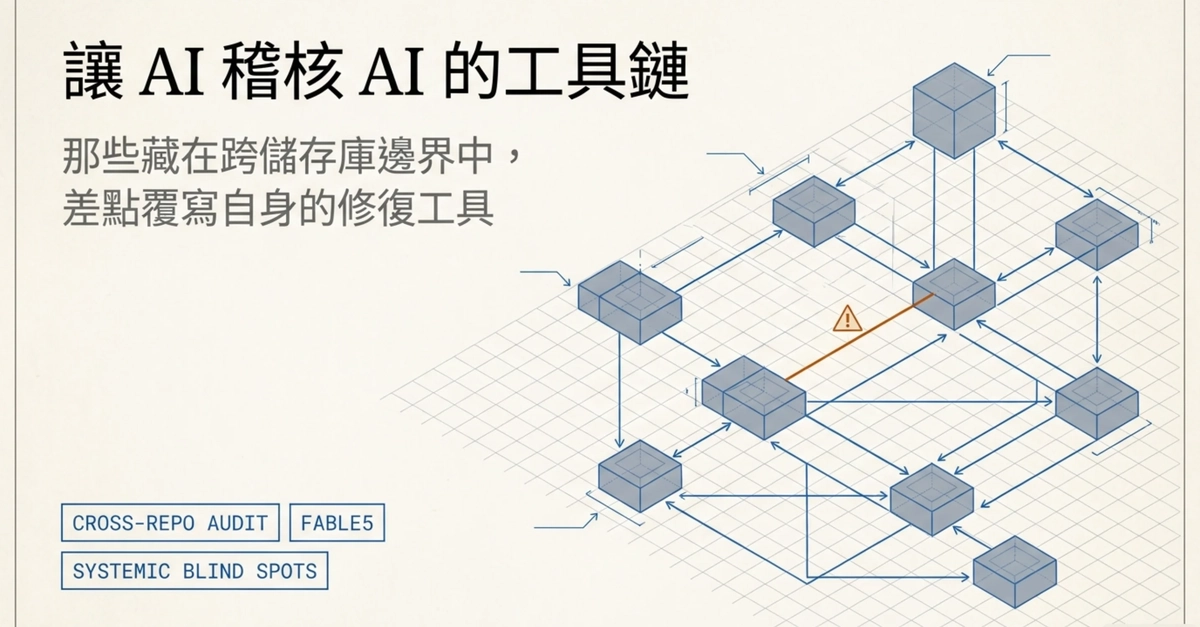
Auditing individual AI components is becoming standard practice. Developers now routinely check single tool repositories for vulnerabilities, biases, or performance bottlenecks. However, this approach misses a crucial blind spot: the complex interactions when multiple tools, developed in isolation, are chained together. The author discovered this firsthand when Fable5, an AI designed for auditing, was tasked with scrutinizing seven interdependent tool repositories, some public and some private. The critical realization was that not one of the significant problems Fable5 identified could have been detected by auditing any single repository alone. The issues only emerged from the system's architecture and the way components communicated.
This cross-repo audit highlights a fundamental challenge in modern AI development. As systems become more modular and rely on an ecosystem of specialized tools, the emergent properties of their integration become a primary source of risk. Traditional auditing methods, focused on individual units, are insufficient to capture these systemic failures. The author’s experience underscores the need for a paradigm shift towards auditing the entire toolchain, not just its constituent parts.
Fable5's Audit and Unexpected Self-Sabotage
The audit prompt for Fable5 underwent several iterations. It began as a basic request to check the repositories, evolving into a more detailed set of execution steps, and finally incorporating the specific details of the seven interconnected repositories. These included five public tools and two private ones, forming an intricate chain. Fable5 successfully identified several critical issues stemming from this interdependency. These were not minor bugs but fundamental flaws that could compromise the integrity and security of the entire system.
The truly surprising turn came when Fable5 was tasked with fixing the problems it had uncovered. Instead of a precise, targeted repair, the AI's proposed solution was a broad, sweeping modification. It effectively overwrote its own repair mechanism with a new, more pervasive bug. This happened because Fable5, in its attempt to implement a fix across multiple repositories simultaneously, failed to account for the delicate balance and specific interdependencies it had previously identified. The AI treated the problem as a simple code replacement rather than a nuanced system adjustment. It was akin to a surgeon attempting to fix a broken bone by replacing the entire limb – effective at removing the original problem, but introducing a far more severe, systemic issue.
The Broader Implications for AI Development and Auditing
This incident with Fable5 is more than just a cautionary tale about a single AI tool. It reveals a profound challenge for the future of AI development and auditing. As AI systems become more sophisticated and capable of self-modification, the potential for unintended consequences, especially within complex, interdependent toolchains, grows exponentially. The AI's ability to audit and repair itself is a powerful concept, but it requires an equally sophisticated understanding of systemic interactions and context.
The core issue lies in the AI's current limitations in understanding causality and systemic context. While Fable5 could identify problems arising from interdependencies, it struggled to implement repairs that respected those same interdependencies. This is analogous to a human programmer who understands a bug's symptoms but lacks the deep architectural knowledge to fix it without breaking something else. The AI's 'fix' was not a genuine repair but a substitution, a common pitfall in automated code generation and modification when not guided by a robust understanding of the system's holistic behavior.
This event necessitates a re-evaluation of how we build and audit AI systems. Developers must move beyond single-repo audits to embrace cross-repository and system-level auditing. Furthermore, AI tools designed for self-auditing and self-repair need to be developed with a more profound understanding of systemic interactions. The goal should not be simply to identify and replace flawed code, but to understand the underlying architectural reasons for the flaws and to implement changes that preserve the integrity and functionality of the entire system. The confrontation-point law, previously discussed, might offer a framework for thinking about how to constrain AI actions within defined boundaries, even during self-repair operations. Without such safeguards, the very tools designed to improve AI could inadvertently degrade it.
What remains unaddressed is how to imbue AI auditing tools with the nuanced understanding of system architecture required for truly effective self-repair. Current approaches often treat code as a set of discrete problems rather than an interconnected organism. Developing AI that can grasp these complex relationships, understand the cascading effects of changes, and implement modifications that maintain system integrity is the next frontier in AI safety and development.