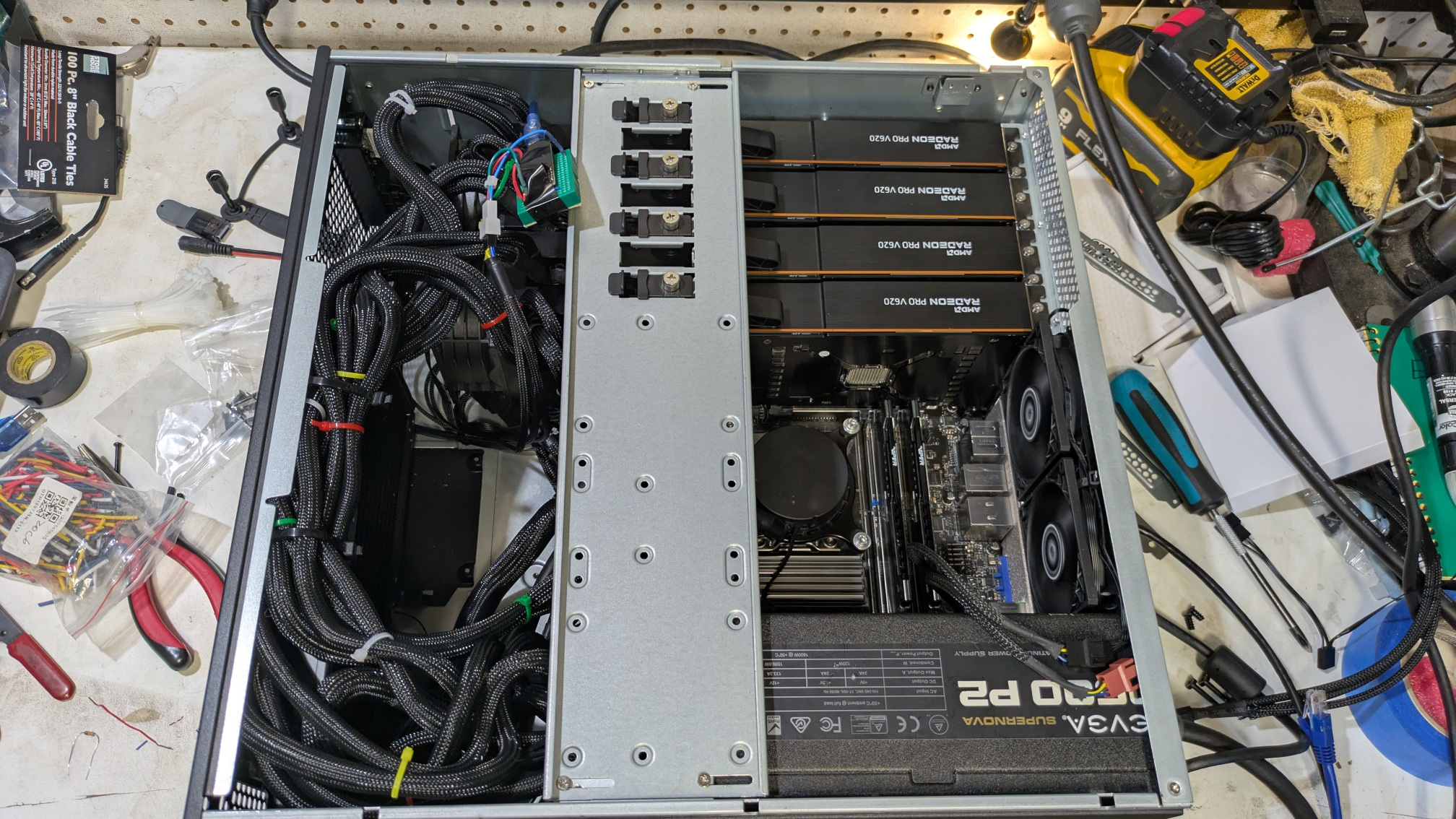
The 'AI at Home' Movement: Repurposing Old Hardware
The notion of running advanced Artificial Intelligence models locally, on consumer-grade hardware, is rapidly shifting from a niche hobby to a practical necessity for many. The "We Have AI at Home" movement, as explored in "Chapter 1: A Box of Scraps," champions this shift, focusing on how individuals can leverage existing, often aging, computer components to build capable AI systems. This isn't about cutting-edge, server-farm-scale AI; it's about democratizing AI by making it accessible through clever repurposing and optimization. The core idea is that powerful AI doesn't always require brand-new, enterprise-grade equipment. Instead, it often hinges on understanding how to extract maximum performance from what's already available.
This approach tackles several key challenges. Firstly, cloud-based AI services, while powerful, can incur significant costs, especially for continuous or heavy usage. Data privacy is another major concern; sensitive information processed on remote servers raises questions about control and security. By running AI locally, users maintain full control over their data. Furthermore, the accessibility of AI is broadened. Instead of being confined to developers or organizations with substantial budgets, individuals can experiment, learn, and deploy AI solutions on their own terms. The "Box of Scraps" philosophy is inherently about resourcefulness, turning discarded or underutilized hardware into valuable AI processing units.
Hardware Considerations: Beyond the Latest GPUs
The central thesis of "A Box of Scraps" is that a significant portion of AI inference and even some training can be accomplished without the newest, most expensive GPUs. The article highlights how older, mid-range, or even integrated graphics processors can be surprisingly effective when paired with optimized software and smaller, more efficient AI models. This is particularly true for inference tasks, where the model has already been trained and is simply being used to make predictions or generate outputs. The focus shifts from raw processing power to intelligent model selection and efficient execution.
Key hardware components that are often overlooked but critical for this DIY AI setup include:
- CPUs: While GPUs get much of the attention, modern CPUs with sufficient core counts and clock speeds can handle certain AI workloads, especially when optimized with libraries like OpenVINO.
- RAM: AI models, particularly large language models (LLMs), can be memory-intensive. Having ample RAM is crucial for loading models and processing data efficiently. 16GB is often a minimum, with 32GB or more being ideal for larger models.
- Storage: Fast SSDs (Solid State Drives) significantly reduce model loading times and data access speeds, contributing to a smoother user experience.
- Older GPUs: Even GPUs that are several generations old, or those not at the top of the performance charts, can be surprisingly capable. The key is to match the model's requirements to the GPU's VRAM and computational capabilities. For example, a GPU with 8GB or 12GB of VRAM can often run quantized versions of popular LLMs.
The article emphasizes that the goal is not to compete with massive cloud infrastructure but to create a personalized, functional AI environment. This often involves a trade-off: you might not be able to run the absolute largest, state-of-the-art models in their full precision, but you can run smaller, quantized, or specialized models that still deliver excellent results for specific tasks.
Software Optimization: The Key to Unlocking Potential
Hardware is only half the battle; software optimization is where the "Box of Scraps" truly shines. The article delves into various techniques and tools that allow users to run AI models efficiently on less powerful hardware. This includes model quantization, which reduces the precision of the model's weights (e.g., from 32-bit floating-point numbers to 8-bit integers), significantly decreasing memory footprint and computational cost with minimal loss in accuracy for many tasks.
Several software frameworks and libraries are highlighted as essential for this endeavor:
- llama.cpp: This C++ library is a cornerstone for running LLMs locally. It's highly optimized for CPU inference and supports various quantization formats (like GGML and GGUF), making it possible to run large models on standard computers.
- Ollama: A user-friendly wrapper around tools like llama.cpp, Ollama simplifies the process of downloading, setting up, and running LLMs locally. It provides a consistent API and makes model management straightforward.
- WebGPU and ONNX Runtime: For leveraging browser-based AI or more general model deployment, frameworks like WebGPU (for in-browser GPU acceleration) and ONNX Runtime (for cross-platform model execution) offer flexibility.
- Specific Model Quantization Tools: Tools like AutoGPTQ or bitsandbytes provide methods for quantizing models to specific bit depths, further enhancing performance on limited hardware.
The surprising detail here is not the existence of these tools, but the extent to which they enable powerful AI capabilities on hardware that would have been considered insufficient just a few years ago. It’s like discovering you can tune a vintage car to outperform a modern sedan on a specific track by meticulously optimizing every component and using specialized fuel.
Practical Applications and Future Outlook
The implications of the "AI at Home" movement are far-reaching. For developers, it offers a sandbox for rapid prototyping and experimentation without incurring cloud costs. For creators, it means the ability to integrate AI-powered features into their workflows – from content generation to image editing – locally and privately. Security professionals can use local AI for threat analysis or anomaly detection on sensitive network traffic without sending data externally.
The article suggests that this trend will continue to grow as models become more efficient and software tools more accessible. We can expect to see a proliferation of specialized AI hardware setups, built from salvaged parts, tailored for specific tasks like local chatbots, personal assistants, or even creative tools. The future isn't just about massive data centers; it's also about a distributed network of personal AI nodes, each contributing to a more accessible and controllable AI ecosystem.
What nobody has addressed yet is the long-term sustainability and e-waste implications of this rapid hardware repurposing cycle. While it's fantastic to extend the life of existing components, the eventual disposal of these systems will need careful consideration. Nonetheless, for now, the "Box of Scraps" approach represents a significant step towards making AI truly personal and accessible.