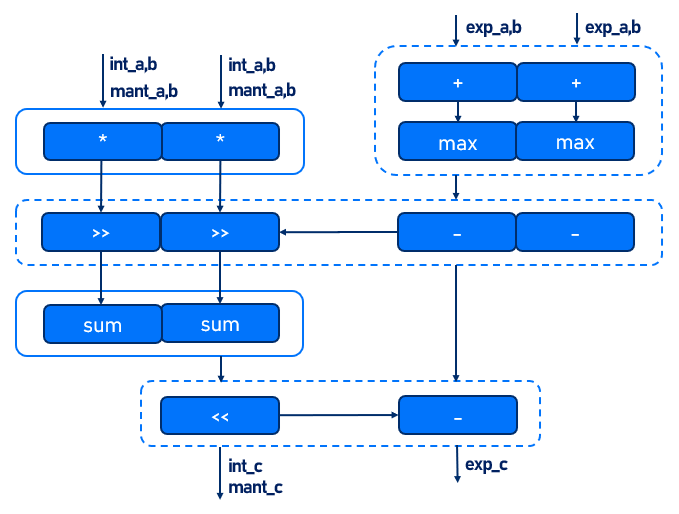
The Core Challenge: AI Arithmetic at Scale
Artificial intelligence workloads, particularly deep learning, are fundamentally driven by massive matrix multiplications. Scaling these operations efficiently is paramount for deploying AI across diverse applications, from real-time inference on edge devices to training colossal models in data centers. The challenge lies in a delicate balancing act: accelerating these computations while maintaining acceptable levels of accuracy and minimizing the physical circuit area required for their implementation. This isn't just about raw speed; it's about doing more with less, a critical constraint for power-sensitive and cost-conscious deployments.
Traditional approaches often rely on high-precision floating-point arithmetic (e.g., FP32, FP16). While offering high accuracy, these formats demand significant computational resources and power. As AI models grow larger and more complex, and as edge AI becomes more prevalent, the demand for lower-precision, more energy-efficient arithmetic has surged. This has led to a proliferation of novel number formats and hardware architectures specifically designed to optimize AI arithmetic.

Exploring Novel Number Formats
The most direct path to reducing computational cost and circuit area is by employing lower-precision number formats. This is not a new concept, but the specific needs of AI have driven innovation in this space. Several key strategies are being explored:
- Reduced Precision Floating-Point Formats: Beyond FP16, formats like BF16 (bfloat16) have gained traction. BF16 retains the 8-bit exponent of FP32, providing a wider dynamic range crucial for training deep learning models, while reducing the significand bits. This offers a better balance for training stability compared to some other reduced-precision formats.
- Integer Quantization: For inference, where absolute precision can often be sacrificed for significant gains in speed and efficiency, integer formats (e.g., INT8, INT4, or even binary/ternary representations) are highly effective. The challenge here is to quantize floating-point weights and activations to these lower-bit integers with minimal accuracy loss. Techniques like post-training quantization (PTQ) and quantization-aware training (QAT) are employed. QAT, by simulating quantization during the training process, generally yields better accuracy.
- Mixed-Precision Arithmetic: This approach leverages different precision formats within the same model or computation. For example, critical layers or operations might use higher precision, while less sensitive parts use lower precision. This requires sophisticated hardware and software to manage the dynamic precision switching, but it can unlock significant performance gains.
- Custom Number Formats: Companies and researchers are designing highly specialized, fixed-point or floating-point formats tailored to the statistical properties of AI model parameters and activations. These formats might have unusual bit widths or exponent/mantissa distributions to maximize efficiency for specific AI tasks.
Hardware Acceleration Architectures
Optimizing arithmetic requires corresponding hardware support. The design of specialized compute units and memory hierarchies plays a crucial role in scaling AI arithmetic efficiently.
- Systolic Arrays: These architectures, popularized by Google's TPUs, are highly efficient for matrix multiplication. They consist of a grid of processing elements (PEs) that perform multiply-accumulate (MAC) operations. Data flows rhythmically through the array, minimizing data movement and maximizing parallelism. Innovations focus on adapting systolic arrays for varying data types and irregular computation patterns.
- Vector Processing Units (VPUs): Modern CPUs and GPUs incorporate powerful VPUs that can perform operations on multiple data elements simultaneously. Optimizing AI kernels for these units, often using specialized instruction sets (e.g., AVX-512 VNNI), is key for leveraging existing hardware.
- Processing-in-Memory (PIM) and Near-Memory Processing (NMP): Moving computation closer to or directly into memory can drastically reduce the energy cost associated with data movement between the processor and DRAM. This is particularly relevant for memory-bound AI workloads.
- Domain-Specific Architectures (DSAs): Beyond general-purpose accelerators, highly specialized ASICs are being developed for specific AI tasks, such as transformer inference or graph neural networks. These DSAs can pack highly optimized arithmetic units for their target workloads.
The Role of Software and Compilers
Hardware innovations are only part of the story. Sophisticated software stacks, including compilers and libraries, are essential for mapping AI models onto these diverse hardware architectures and for exploiting the benefits of novel arithmetic formats. Compilers must be able to analyze AI model graphs, identify opportunities for precision reduction or mixed-precision computation, and generate optimized code that takes full advantage of the underlying hardware capabilities.
Frameworks like TensorFlow, PyTorch, and ONNX Runtime are continuously evolving to support a wider range of data types and to enable automatic mixed-precision and quantization. The development of efficient AI compilers, such as TVM or XLA, is critical for abstracting away hardware complexities and allowing developers to focus on model development. These compilers act as translators, converting high-level model descriptions into low-level, hardware-specific instructions that execute the optimized arithmetic operations.
Future Directions and Unanswered Questions
The quest for efficient AI arithmetic is ongoing. As models continue to grow and new AI paradigms emerge, the demands on compute will only increase. We are seeing a trend towards even lower precision, with research exploring sub-4-bit representations and novel analog computing approaches for certain operations. The integration of AI accelerators into heterogeneous computing systems, where CPUs, GPUs, and specialized AI chips work in concert, will become more common.
What remains to be fully addressed is the standardization of these emerging number formats. While formats like BF16 and INT8 have seen broad adoption, the proliferation of custom formats, while powerful for specific use cases, can lead to fragmentation and vendor lock-in. Establishing industry-wide best practices and potentially even new standards for AI arithmetic precision could accelerate innovation and interoperability. Furthermore, the long-term impact of ultra-low precision on model robustness and generalization across a wide range of real-world scenarios is still an active area of research.