The Shifting Landscape of AI Architecture
The perception of AI often narrows to a single entity, like ChatGPT. However, this view overlooks the intricate engineering stack that powers modern artificial intelligence. Today's sophisticated AI applications are not monolithic models; they are dynamic ecosystems comprising transformers, specialized tools, advanced retrieval systems, sophisticated memory mechanisms, vector databases, flexible orchestration frameworks, and crucial guardrails, all working in concert.
For software engineers, grasping the interplay of these components is significantly more valuable than merely collecting buzzwords. The AI industry has undergone a profound transformation in recent years. The initial phase was characterized by the rise of advanced chatbots. This was followed by the integration of AI copilots into various workflows, augmenting human capabilities. We are now entering the Agentic AI era, a paradigm shift where systems are designed to plan, reason, retrieve information autonomously, interact with external APIs, and execute multi-step workflows with minimal human oversight. Understanding this evolutionary trajectory is paramount for anyone building or deploying AI-powered solutions.
Core Components of the Modern AI Stack
The foundation of many modern AI systems lies in Transformer models. These neural network architectures, particularly those with attention mechanisms, have revolutionized natural language processing and are the bedrock for Large Language Models (LLMs). LLMs, like GPT-4 or Llama, are adept at understanding and generating human-like text, performing tasks ranging from summarization and translation to creative writing.
However, LLMs alone are often insufficient for complex, real-world applications. They require augmentation through techniques like Retrieval-Augmented Generation (RAG). RAG enhances LLM responses by retrieving relevant information from external knowledge bases before generating an answer. This external data can be vast, encompassing documents, databases, or web content. The efficiency of RAG heavily relies on how this external information is stored and accessed.
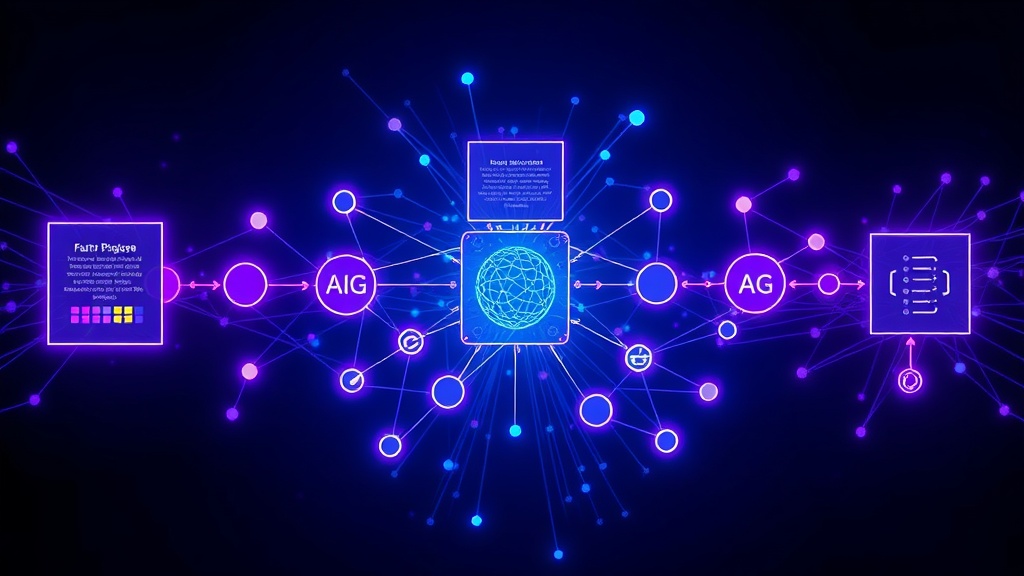
This is where Vector Databases become critical. Unlike traditional databases that store structured data, vector databases are optimized for storing and querying high-dimensional vectors, which are numerical representations of data (text, images, audio). LLMs generate embeddings (vector representations) of text, and vector databases allow for rapid similarity searches. When a query is made, its vector embedding is used to find the most semantically similar embeddings in the database, retrieving relevant context for the LLM. Examples include Pinecone, Weaviate, and ChromaDB.
Beyond information retrieval, modern AI systems need to act. This is the domain of Agentic Systems. An AI agent is an autonomous entity that perceives its environment, makes decisions, and takes actions to achieve specific goals. This involves a cycle of planning, reasoning, tool use, and execution. Agents can leverage LLMs for their reasoning capabilities but also integrate with external tools (like APIs for booking flights, sending emails, or accessing real-time data) to perform actions in the real world. Frameworks like LangChain and LlamaIndex provide abstractions and tools to build these agentic workflows, managing the orchestration between LLMs, tools, and memory.
Memory is another crucial aspect. For an agent to perform complex tasks, it needs to remember past interactions, decisions, and retrieved information. This memory can be short-term (context window of an LLM) or long-term, often managed through vector databases or specialized memory modules that store and retrieve relevant past states. Guardrails, a vital component for safety and reliability, ensure that AI systems operate within defined ethical, legal, and functional boundaries. They act as a protective layer, preventing the AI from generating harmful content, making unauthorized actions, or deviating from its intended purpose.
Engineering for Agentic AI
Building these sophisticated AI applications requires a shift in engineering mindset. It's no longer about simply calling an LLM API. It involves understanding how to:
- Orchestrate multiple components: Designing workflows that seamlessly integrate LLMs, RAG pipelines, vector databases, and external tools.
- Manage state and memory: Implementing mechanisms for agents to maintain context and learn from past interactions.
- Ensure reliability and safety: Deploying robust guardrails and testing methodologies to guarantee predictable and safe behavior.
- Optimize for performance and cost: Selecting the right models, databases, and infrastructure to balance capability with operational efficiency.
The development of agentic systems often involves iterative design and rigorous testing. Engineers must consider the potential failure modes at each step of an agent's decision-making process and build in redundancies or fallback mechanisms. This is analogous to building robust distributed systems, but with the added complexity of unpredictable language model outputs and complex decision trees.
The Future is Agentic
The progression from static chatbots to dynamic AI agents signifies a maturation of the AI field. It moves beyond simple information retrieval and generation towards systems capable of complex problem-solving and task completion. This evolution demands a deeper engineering understanding from developers and architects. As these systems become more capable, the ability to engineer them effectively, ensuring they are reliable, safe, and efficient, will be a defining skill in the coming years. The focus will increasingly be on how to build and deploy these multi-component AI architectures rather than solely on the capabilities of individual models.