
The Evolution Beyond Chatbots
The landscape of AI applications is rapidly shifting. While 2024 saw chatbots dominate as the primary interface, offering single-turn interactions (one prompt in, one completion out), the near future points towards a more sophisticated architecture: the AI agent. These systems are designed to plan, invoke external tools, and iterate through multiple steps to achieve a defined objective. This evolution moves beyond reactive responses to proactive, goal-oriented execution.
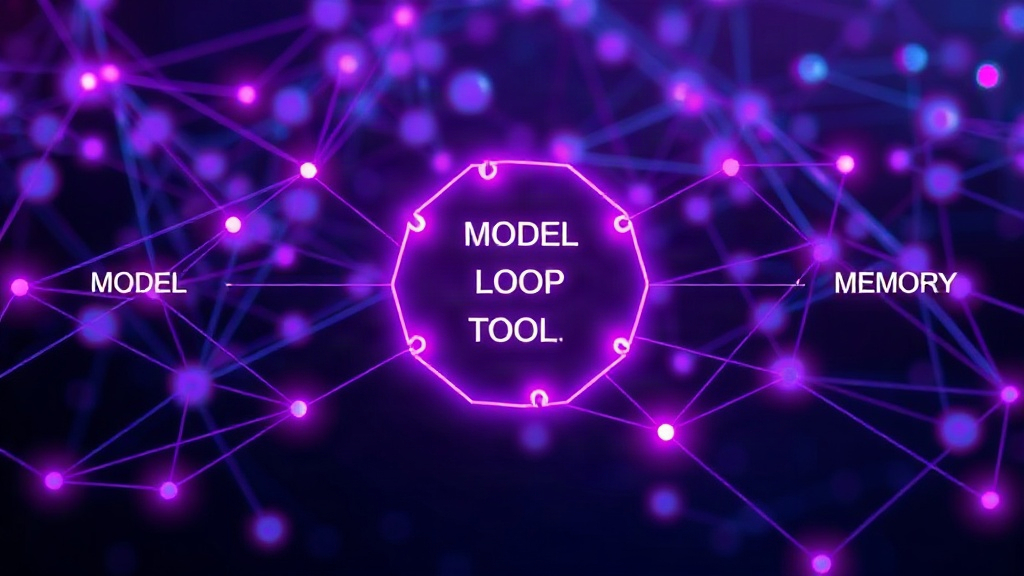
At its core, an AI agent is not a monolithic entity but a carefully orchestrated system. It comprises several key components that work in concert to enable autonomous decision-making and action. These components can be distilled into five fundamental elements: a planning model, an execution harness that manages the operational loop, a suite of tools for external interaction, a memory system for state persistence, and a trajectory that records the entire process.
Deconstructing the AI Agent's Anatomy
The foundational piece of any AI agent is the model. This is typically a large language model (LLM) responsible for reasoning, planning, and deciding the next best action. It takes the current state, the overall goal, and available information to generate a plan or a specific action. This model is the 'brain' of the agent, interpreting inputs and formulating outputs that drive its behavior.
The loop, often referred to as the execution harness or agent loop, is the engine that drives the agent's continuous operation. It’s a mechanism that repeatedly takes the agent's output, processes it, and feeds it back as input for the next iteration. This cycle allows the agent to progress through its plan, execute actions, and adapt based on feedback or new information. Without this loop, the agent would be a single-shot system, unable to perform multi-step tasks.
Tools are critical for an AI agent to interact with the external world or access specific functionalities beyond its inherent LLM capabilities. These can range from simple functions like performing a calculation or searching the web, to complex operations like interacting with a database, sending an email, or controlling hardware. Tools extend the agent's reach, enabling it to gather information, perform actions, and modify its environment, thereby making it more than just a text generator.
Memory is what allows an AI agent to maintain context and state across its operational lifespan. Unlike a standard chatbot session that might reset after a short period, an agent's memory system stores past interactions, observations, and decisions. This allows the agent to learn from its history, avoid repeating mistakes, and build upon previous successes. Memory can be short-term, holding information relevant to the current task, or long-term, accumulating knowledge over extended periods. This persistent state is crucial for complex problem-solving and maintaining coherence in long-running tasks.
Finally, the trajectory represents the complete record of the agent's execution. It is the sequence of thoughts, actions, tool calls, and observations that constitute a single run towards a goal. This log is invaluable for debugging, auditing, and understanding how an agent arrived at a particular outcome. It provides a trace of the agent's journey, highlighting its decision-making process at each step.
Human Oversight in Agentic Systems
As AI agents become more autonomous and gain access to enterprise data, systems, and tools, the need for robust governance and oversight becomes paramount. This introduces the concept of a human-in-the-loop (HITL) for multi-agent systems. However, HITL does not imply constant real-time monitoring of every agent's action. The sheer scale and speed of multi-agent operations make such direct supervision impossible.
Instead, effective HITL for multi-agent systems shifts focus towards prevention by design. The goal is to build systems where humans only need to intervene for critical errors that cannot be caught by automated safeguards. This involves grading each agent's action based on its potential damage and matching control mechanisms to that grade. For swarm-like systems where direct supervision is infeasible, the emphasis moves almost entirely to preventative measures. This includes implementing least privilege for sub-agents, assigning distinct and traceable identities, capping the system's overall blast radius, and ensuring a universal kill switch can halt all operations instantly.
The emerging M&A map for AI agentic security reflects this need for specialized control. As agents become active identities with access to sensitive resources, they require tailored permissions, monitoring, and governance. Startups positioned at these critical control points—managing agent access, monitoring behavior, or enforcing policies—are likely to find significant market opportunities. Precise positioning in this evolving landscape will be crucial for securing market share and attracting investment.
Implications for the Future
The architectural shift towards AI agents signifies a move towards more capable and autonomous AI systems. These agents can tackle complex problems that require sequential reasoning, external interaction, and persistent state management. For developers, this means building applications that are not just reactive but can actively pursue goals. This paradigm shift is akin to moving from simple scripts to sophisticated workflows that can adapt and learn.
For founders, understanding the agentic architecture is key to differentiating products. Companies that can effectively harness these agents will be able to offer more powerful, automated solutions. The security implications are also profound. As agents gain more power and access, ensuring their safe and controlled operation becomes a critical challenge, creating new markets for agentic security and governance solutions.