The Two Halves of Every Project
Every project, regardless of its domain, naturally divides into two distinct phases. The first half is characterized by discussion, ideation, and consensus-building. This involves workshops, detailed specifications, diagramming tools like Lucidcharts, and extensive documentation in platforms like Confluence. It’s a phase where broad participation is key, and collective agreement is the primary goal. Many minds can and should be in the room during this stage.
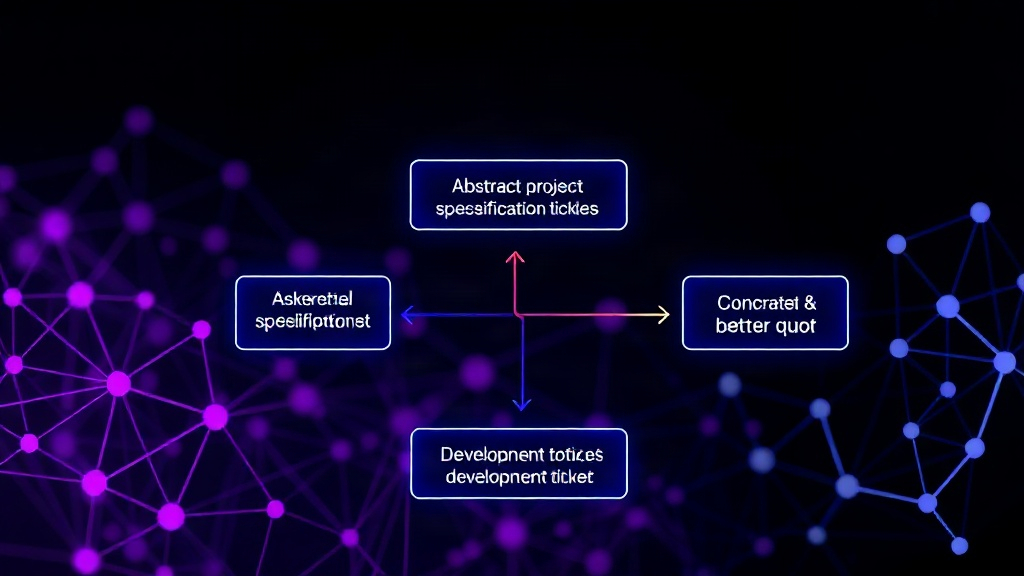
The second half, however, marks a fundamental shift. Once an agreement is reached, the abstract concepts must be translated into tangible actions. This is the phase where specifications must become concrete tasks, and those tasks must be transformed into lines of code. A spec might state, "The seller should be notified," but code requires precise instructions: who is the seller, what constitutes notification, what data triggers it, and what is the exact format of the message?
The Critical Gap: Where Quality and Speed Suffer
This transition from abstract agreement to concrete implementation is where many projects falter. The gap between the planning phase and the execution phase is fertile ground for slowdowns and quality degradation. Developers are often left to interpret vague specifications, leading to a cascade of issues. They might sit idle, waiting for clarification, or worse, proceed with an incorrect understanding of the requirements.
When questions are not explicitly asked or are poorly formulated, developers implement what they believe is correct. This often results in a product that deviates from the original intent, a suboptimal user experience, or features that require significant rework later. The cost of fixing these issues post-implementation far outweighs the cost of asking the right questions upfront. This is the point where projects often go wrong, not due to a lack of effort, but due to an inherent challenge in translating human-centric, often ambiguous, requirements into machine-executable logic.
Introducing AI Agents to Bridge the Divide
Recognizing this persistent problem, a small team experimented with a novel approach: deploying AI agents to handle the more tedious, detail-oriented aspects of project execution. Specifically, they focused on the phase where project discussions cease and actual building begins. The hypothesis was that AI, with its capacity for rapid information processing and pattern recognition, could excel in this critical transition.
The team found that agents were remarkably effective at parsing high-level specifications and generating a series of detailed, clarifying questions. These questions were not just superficial; they targeted ambiguities and assumptions inherent in the initial documentation. Think of it less like a junior developer asking for help, and more like a meticulous auditor ensuring every 'i' is dotted and every 't' is crossed before construction begins. The agents acted as a rigorous quality assurance layer at the very inception of the development process.
Asking Better Questions Than Humans
The truly surprising outcome was the quality and depth of the questions the AI agents posed. In many instances, the agents identified potential issues or edge cases that the human team members, even those with extensive experience, had overlooked. This wasn't about the agents *knowing* the right answer, but about their ability to systematically probe the requirements and expose gaps in the specification. They didn't just process the text; they simulated the consequences of different interpretations.
For example, a specification might vaguely mention user roles. A human might assume standard roles like 'admin' and 'user'. An AI agent, however, might generate questions like: "What are the specific permissions for the 'editor' role regarding content deletion?", "Does the 'viewer' role have access to historical data, and if so, what is the retention policy?", or "Are there any temporary roles required for guest access during specific events?" These are the kinds of granular questions that, when answered, prevent significant downstream problems. The agents' ability to generate these questions stems from their training on vast datasets of code, documentation, and development discussions, allowing them to recognize common pitfalls and areas of ambiguity.
The Impact on Project Velocity and Quality
By offloading the task of generating these clarifying questions to AI agents, the team dramatically improved their development workflow. The 'boring half'—the meticulous work of breaking down requirements and identifying potential ambiguities—was handled efficiently and effectively by the AI. This freed up human developers to focus on the more complex, creative aspects of coding and problem-solving, rather than getting bogged down in interpretation or waiting for answers.
The result was a noticeable increase in both project velocity and the final quality of the product. Code was written with a clearer understanding of the requirements from the outset, reducing the need for mid-development corrections. The team experienced fewer bugs related to misunderstood specifications and delivered features that more closely aligned with the initial product vision. This agentic workflow acts as a powerful filter, ensuring that only well-defined, unambiguous tasks enter the coding pipeline.
Future Implications and Open Questions
This experiment highlights a significant potential for AI agents in streamlining software development. By automating the often-arduous process of requirement clarification, teams can accelerate delivery cycles and enhance product quality. The implications extend beyond just asking questions; agents could potentially draft initial code snippets based on the clarified requirements, or even generate test cases to validate the implementation.
However, this approach also raises new questions. What happens to the developers who previously specialized in requirements analysis or technical specification? Does this shift their role towards more strategic oversight or AI prompt engineering? Furthermore, how do we ensure the AI's questions are always aligned with business goals and not just generating noise? The success of this method hinges on effective prompt design and continuous feedback loops to guide the agents. The challenge now is to scale this insight beyond small teams and into larger, more complex organizational structures, ensuring that the 'boring half' of projects is not just automated, but intelligently automated.