The Illusion of Understanding: Why AI Agent Summaries Fail
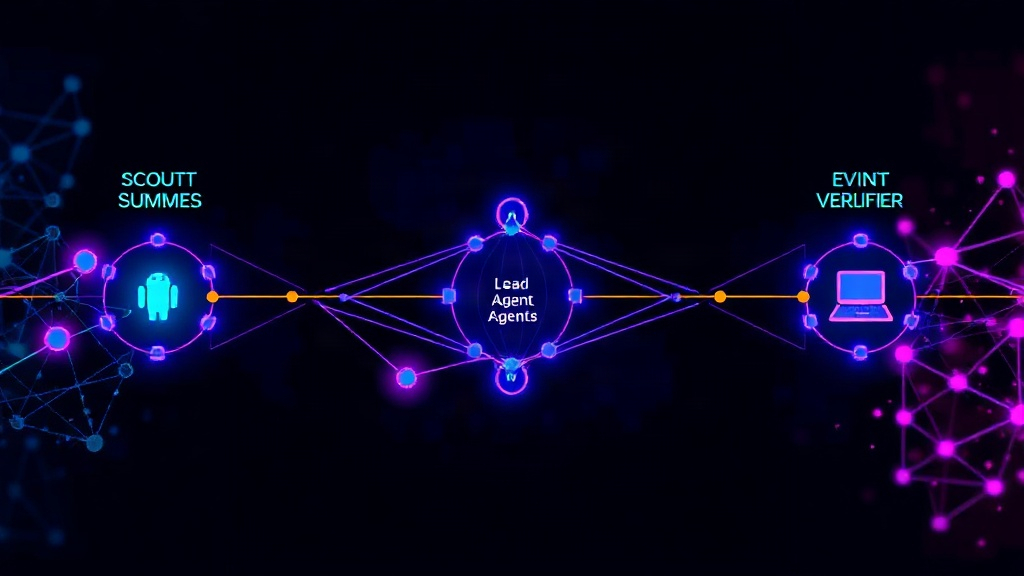
In complex AI systems, particularly those employing multiple specialized agents, a subtle yet critical failure mode is emerging: the unreliability of summaries. A recent incident within a multi-agent pipeline, involving scout, lead, and verifier agents, starkly illustrates this problem. The system faltered not due to a fundamental flaw in agent design, but because the verifier agent began to place undue trust in the summary produced by the lead agent, rather than performing its own independent verification based on the raw output.
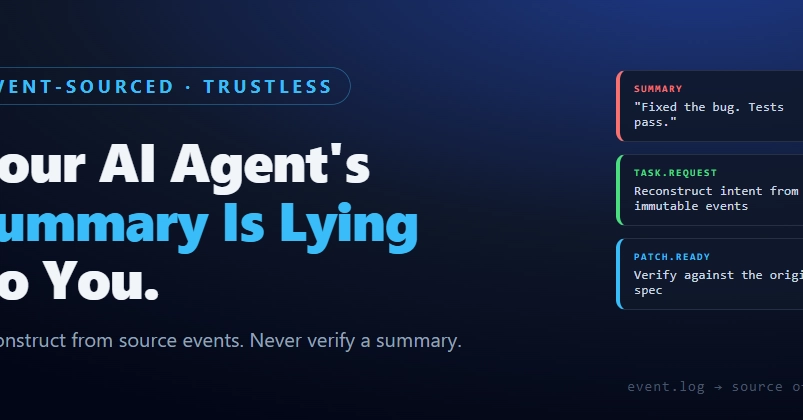
Consider an agent, let's call it Agent A, tasked with a specific objective, such as fixing a software bug. Agent A completes its task and generates a summary: "Fixed the bug. Tests pass." This summary, while concise, is a compressed representation of Agent A's observations, decisions, and actions. The inherent nature of compression means that information is lost. Critical nuances, edge cases, or the exact methodology employed might be omitted or simplified to fit the summary format.
The critical failure occurs when a subsequent agent, the verifier, relies on this summary. In the described scenario, the verifier would read Agent A's summary, execute a set of tests, and upon seeing that the tests passed, would approve the change. However, the problem was that the tests themselves were insufficient. They might have covered the most common scenarios but failed to account for an edge case introduced by Agent A's fix. The verifier, by trusting the summary's assertion that "Tests pass" without re-examining the underlying evidence or the precise nature of the fix, effectively approved a change that contained a subtle but significant flaw.
This reliance on summaries creates a brittle system. It’s akin to a manager accepting a project status report that says "Project complete. All deliverables met" without asking to see the actual deliverables or understanding the specific challenges overcome. The summary provides a veneer of confidence, but it obscures the actual state of affairs and the precise steps taken. In AI systems, where operations can be highly complex and the underlying data vast, this opacity is particularly dangerous.
The Solution: Reconstructing Intent Through Event Sourcing
The solution to this problem lies in fundamentally rethinking how agents communicate and how their work is verified. Instead of relying on high-level, compressed summaries, the system should treat every action taken by an agent as an immutable event. This approach, known as event sourcing, creates a complete, auditable log of the system's operations.
In this model, each agent's action is recorded as a distinct event. For instance, when Agent A receives a task, an event like task.request is logged. When it formulates a response, task.reply is recorded. If it generates a patch, patch.ready is logged. Every decision, every piece of data processed, and every output generated becomes a point in an immutable sequence of events.
The verifier agent, instead of reading a summary, would reconstruct the intent and the exact actions taken by reading this full chain of events. It could re-run the tests, but more importantly, it could examine the specific code changes (the patch.ready event and its associated data), analyze the reasoning that led to that patch (by tracing back through task.reply and earlier events), and compare the original request (task.request) with the final outcome. This process allows the verifier to perform true, independent validation, free from the information loss inherent in summaries.
This event-sourced approach offers several key advantages:
- Auditability: Every action is logged, providing a transparent history of system operations.
- Reproducibility: The entire state of the system at any point can be reconstructed from the event log.
- Robust Verification: Verifiers have access to the full context, enabling deeper and more reliable checks.
- Debugging: Tracing issues becomes significantly easier by examining the event sequence leading up to a failure.
The transition to an event-sourced verification process means that the verifier doesn't just check if the final state appears correct; it verifies the entire journey that led to that state. It can identify not only if a bug was introduced but also *how* it was introduced and *why* the previous verification step failed to catch it.
Broader Implications for AI Agent Systems
The failure of AI agent summaries highlights a broader challenge in building reliable autonomous systems. As AI agents become more sophisticated and are chained together to perform complex tasks, the interfaces between them become critical points of failure. Summaries, while convenient for human consumption, are poor choices for inter-agent communication when accuracy and completeness are paramount.
This incident serves as a potent reminder that in any system where correctness is vital, trusting compressed or abstracted information without recourse to the source data is a dangerous practice. It's like a doctor relying solely on a nurse's note about a patient's symptoms without ever speaking to the patient or reviewing their chart. The summary might be accurate in broad strokes, but it misses the critical details that could lead to a misdiagnosis.
The principle of "never trust a summary" extends beyond this specific multi-agent pipeline. It implies a need for more robust communication protocols and verification mechanisms in all AI systems, especially those operating in safety-critical domains or managing significant resources. Developers building or integrating with multi-agent AI frameworks should consider how they can ensure that verification steps are grounded in the raw outputs and event streams of preceding agents, rather than relying on potentially lossy intermediate representations.
The move towards event sourcing for verification is not just a technical fix; it's a philosophical shift. It prioritizes transparency, auditability, and the integrity of the process over the convenience of a simplified summary. For AI systems to mature and become truly trustworthy, they must be built on foundations that allow for rigorous, evidence-based verification at every stage.