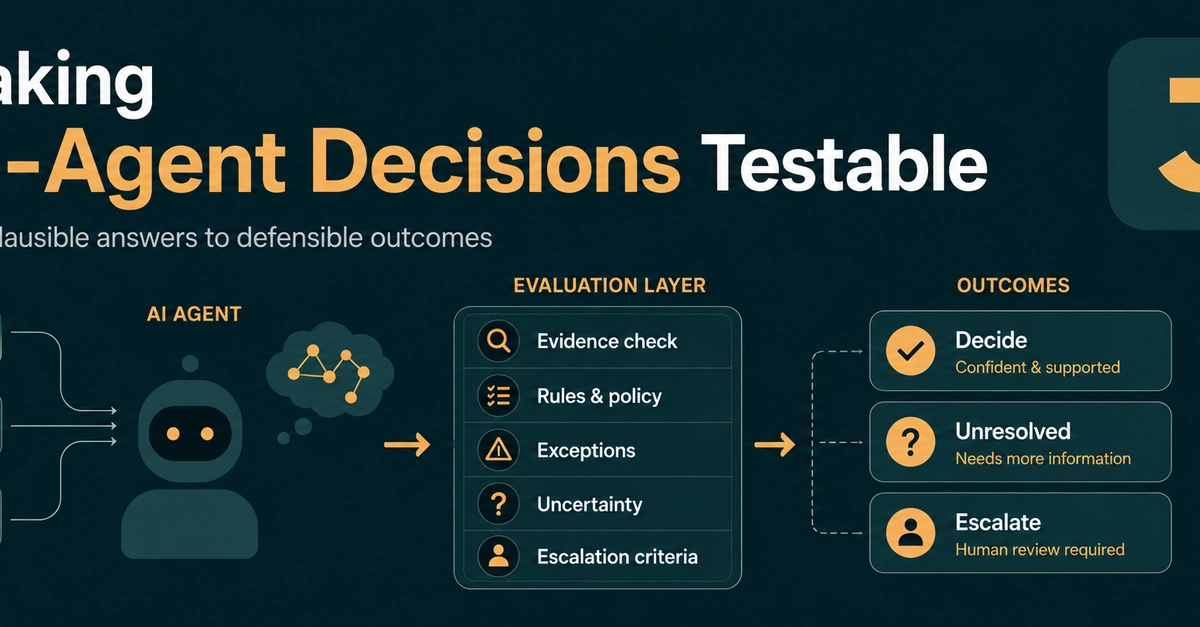
The Execution vs. Decision Divide
AI agents are rapidly advancing in their ability to interact with the digital world. They can search documents, query databases, call APIs, and orchestrate multi-step workflows. This proficiency in *execution* is crucial and has become a focal point for development. However, a critical gap persists: ensuring these agents make the *right* decisions, even when their execution capabilities are sound. Many business-critical decisions hinge on nuanced interpretation, rule application, and handling of incomplete or conflicting information—aspects often buried deep within prompts, application code, or the implicit knowledge of experienced personnel.
This opacity makes testing, reviewing, reusing, and improving the agent's decision-making process incredibly difficult. The challenge isn't about whether an agent can find a piece of information or trigger an API call; it's about whether it correctly interprets that information or decides which API call is truly appropriate given a complex set of business rules and evidence.
The Problem with Implicit Logic
Consider a loan application process. An AI agent might be able to pull credit scores, verify income documents, and check against a list of approved banks. But can it determine which specific piece of evidence is most critical for approving or denying a loan in a borderline case? Can it identify when a specific regulatory exception applies? What happens when the submitted evidence is contradictory or incomplete? These are not execution problems; they are complex decision-making problems.
Currently, much of this decision logic resides in unstructured text—policy documents, lengthy prompts, or even the tacit understanding of human experts. This is akin to trying to debug a complex software system by only reading its user manual and asking senior engineers to recall their thought processes from years ago. It’s prone to error, difficult to scale, and nearly impossible to verify systematically.
The author's experience highlights this disconnect. The agent could successfully retrieve a policy and initiate a workflow, yet the final decision was incorrect. This isn't a failure of the agent's tools or its ability to follow instructions; it's a failure in the underlying reasoning or the application of rules to the specific context. The problem is that the critical decision-making pathways are not explicitly defined or testable.
Towards Testable Decision Frameworks
Making AI agent decisions testable requires a shift from focusing solely on execution to explicitly defining and isolating the decision logic. This involves several key areas:
Formalizing Rules and Policies
Business rules, legal compliance requirements, and operational policies that govern an agent's decisions need to be expressed in a structured, machine-readable format. This could involve:
- Decision Tables: Explicitly mapping conditions to outcomes. For instance, a decision table could outline loan approval criteria based on credit score, debt-to-income ratio, and loan amount.
- Business Process Model and Notation (BPMN): For more complex workflows where decisions trigger different process paths.
- Rule Engines: Dedicated systems designed to manage and execute complex sets of business rules.
By externalizing these rules from monolithic prompts or application code, they become auditable, modifiable, and, crucially, testable. An agent could then be tasked with identifying the relevant rule and applying it, rather than having the rule implicitly embedded in its instructions.
Evidence Management and Validation
A significant part of decision-making involves assessing the quality, relevance, and completeness of evidence. Testable systems need mechanisms to:
- Define evidence requirements: What types of evidence are needed for specific decisions?
- Validate evidence: Is the evidence authentic, up-to-date, and from a trusted source?
- Handle missing or conflicting evidence: Define clear protocols for escalation or alternative actions when evidence is insufficient or contradictory.
This moves beyond simple data retrieval to a more sophisticated understanding of data provenance and reliability, which is essential for high-stakes decisions.
Structured Reasoning Traces
To enable effective testing and debugging, agents should be able to provide a clear, step-by-step trace of their reasoning process. This is more than just a log of API calls; it should detail:
- The specific evidence considered.
- The rules or logic applied at each step.
- The intermediate conclusions reached.
- The justification for the final decision.
Such traces allow developers and auditors to pinpoint exactly where a decision went awry, whether it was a misinterpretation of evidence, an incorrect rule application, or a logical fallacy.
The Unanswered Question: Agent Autonomy vs. Control
As we move towards making AI agent decisions more testable, a fundamental tension emerges. How much autonomy should an agent have in interpreting and applying rules before requiring human oversight? If we formalize every decision point, we risk creating agents that are brittle and incapable of handling novel situations. Yet, without formalization, we are left with opaque systems that cannot be reliably audited or trusted for critical business functions. Finding the right balance between agent flexibility and explicit, testable control mechanisms is the next frontier.
Implications for Development and Deployment
The path to testable AI agent decisions suggests a future where agents are not just executors of commands but sophisticated reasoning engines whose logic is transparent and verifiable. This requires a paradigm shift in how we build, deploy, and manage AI agents. It means investing in formal methods for rule definition, robust evidence validation, and detailed reasoning logging. For developers, this means learning new frameworks for expressing logic and integrating with decision engines. For organizations, it means re-evaluating their AI governance strategies to ensure that agents making consequential decisions can be reliably tested and audited.