%22%20%2F%3E%0A%20%20%3C%2Fsvg%3E)
The Invisible Workforce: A Proliferation Problem
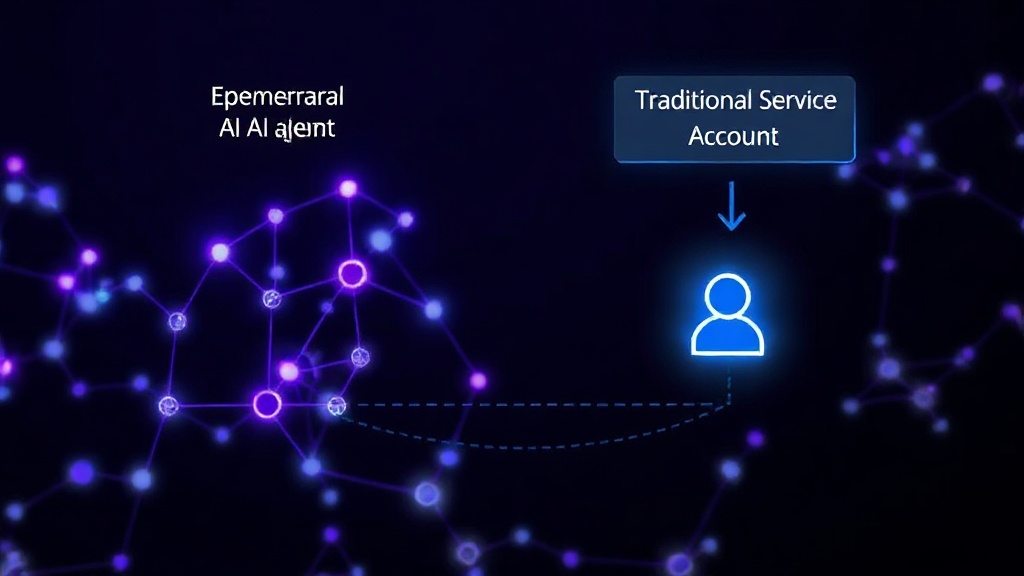
The digital landscape is rapidly evolving, not just with human users and traditional service accounts, but with a new, ephemeral workforce: AI agents. These autonomous entities, designed to perform specific tasks, are increasingly being deployed across organizations. However, a critical challenge has emerged: keeping track of them. What was once a manageable number of servers and user accounts has ballooned into a complex ecosystem where AI agents can spin up, execute tasks, and disappear without a trace, leaving IT and security teams in the dark.
The problem, as highlighted by a recent discussion on r/artificial, is the sheer difficulty in identifying and managing these non-human identities. Unlike service accounts with defined lifecycles and audit trails, or API keys that, while numerous, are at least cataloged, AI agents operate with a fluidity that defies traditional inventory methods. This lack of visibility is more than an inconvenience; it’s a significant security and compliance risk.
Consider the analogy of a bustling city. Traditional IT management could track permanent residents (users) and businesses (service accounts). Now, imagine thousands of temporary workers, day laborers, and even automated delivery drones appearing and disappearing throughout the day, all performing tasks that impact the city's infrastructure. Without a central registry or tracking system, it’s impossible to know who is working, what they’re doing, or if they pose a risk.
Security and Compliance Under Siege
The implications for security are profound. Every AI agent, regardless of its origin or intended purpose, represents a potential attack vector. If an agent is compromised, it could be leveraged to access sensitive data, disrupt operations, or launch further attacks. Without a comprehensive inventory, security teams cannot effectively:
- Monitor for malicious activity: If you don't know an agent exists, you can't monitor its behavior for anomalies.
- Enforce access controls: Principle of least privilege becomes impossible when you don't know what identities need access to what resources.
- Conduct incident response: Identifying the scope of a breach involving compromised AI agents is exponentially harder if their existence and interactions are unknown.
- Ensure compliance: Regulations like GDPR, CCPA, and various industry-specific mandates require strict data handling and access logging. Unaccounted-for agents operating with access to sensitive information create significant compliance gaps.
The ease with which AI agents can be spun up, often leveraging cloud platforms and sophisticated orchestration tools, exacerbates this problem. Developers might deploy agents for specific, short-term tasks without a formal process for registering them. These agents might use credentials, access sensitive APIs, or interact with data stores, creating a hidden web of operational activity. When the task is complete, the agent is terminated, but the access it had, or the data it processed, remains a question mark.
Operational Headaches and Cost Overruns
Beyond security, operational management suffers. Teams struggle to understand the true resource utilization of their environments. Are the cloud bills higher than expected because of legitimate workloads, or are there hundreds of forgotten AI agents consuming compute power? Debugging performance issues or application failures becomes a nightmare when the underlying cause might be an ephemeral agent interacting with a critical system in an unforeseen way.
The lack of a unified view also hinders effective resource allocation and cost management. Organizations risk over-provisioning resources to compensate for unknown demands, or conversely, under-provisioning and impacting the performance of critical applications. Furthermore, the absence of clear ownership for these agents means that when issues arise, it's unclear who is responsible for troubleshooting or remediation.
The Unanswered Question: How Do We Track the Ephemeral?
What remains to be seen is how organizations will fundamentally adapt their IT and security frameworks to account for this new class of non-human identities. Traditional identity and access management (IAM) solutions are largely built around human users and static service accounts. While efforts are underway to extend IAM to machine identities, the specific challenge of ephemeral, task-specific AI agents requires novel approaches. Will new tooling emerge specifically for agent lifecycle management and observability? Or will existing platforms need radical overhauls to accommodate this dynamic workforce? The current approach, often described as “winging it,” is unsustainable.
Towards a Solution: Visibility and Governance
Addressing this challenge requires a multi-pronged strategy focused on visibility and governance:
- Centralized Agent Registry: Implement a system, whether a dedicated tool or an enhanced IAM solution, to log the creation, purpose, access rights, and termination of all AI agents. This acts as a single source of truth.
- Automated Discovery and Monitoring: Utilize cloud provider tools, network traffic analysis, and endpoint detection and response (EDR) solutions to discover and monitor the behavior of unknown agents.
- Policy-Driven Deployment: Establish clear policies and automated workflows for deploying AI agents, ensuring that every agent must be registered and approved before operation. This includes defining their scope, duration, and required permissions.
- Regular Audits and Attestation: Conduct periodic reviews of all registered agents, verifying their necessity, permissions, and adherence to security policies.
- Developer Education and Training: Ensure developers understand the security and operational implications of deploying AI agents and are trained on the established governance processes.
The rise of AI agents is an undeniable trend, bringing significant efficiency gains. However, without a concerted effort to manage these non-human identities, organizations risk creating massive blind spots that compromise their security posture, operational stability, and compliance efforts. Proactive management and robust governance are no longer optional; they are essential for navigating the AI-driven future.