The Growing Power of AI Agents
Artificial intelligence agents are rapidly evolving from simple chatbots to sophisticated tools capable of interacting with the real world. They can now read files, execute commands, call external APIs, and connect to Machine Control Protocol (MCP) servers. These capabilities are combined and orchestrated under natural-language instructions, allowing for complex workflows and automation. This expansion of agent capabilities means they are becoming powerful components in software development, system administration, and numerous other technical domains.
However, the way these powerful new capabilities are integrated and managed introduces significant security vulnerabilities. The very mechanisms that grant agents their power – their "skills" and their "MCP configurations" – are often implemented with a surprising lack of security rigor, akin to leaving the keys to the kingdom in a publicly accessible file cabinet.
Vulnerabilities in Agent Skills and MCP Configurations
Currently, agent skills are frequently installed in a manner similar to simple documentation. In many projects, a skill is nothing more than a Markdown file, a script, or a reference to a URL. This file, however, can contain far more than just instructions. It can embed executable scripts, patterns for accessing sensitive credentials, network requests, and even instructions designed to override the agent's intended behavior or security protocols. This makes the skill file itself a potential attack vector.
Similarly, MCP configurations, which govern how agents interact with critical infrastructure or services, are also often deployed without adequate security checks. These configurations can dictate sensitive parameters, authentication methods, and communication protocols. If compromised or maliciously crafted, they can grant unauthorized access or disrupt operations.
The core problem is that these skills and MCP configurations are increasingly becoming essential dependencies for AI agent functionality. Yet, they lack the fundamental protections we expect from standard software dependencies. This oversight creates a critical security gap. We do not see standard security practices applied to these assets, which is a dangerous oversight given the increasing power and autonomy of AI agents.
Missing Security Fundamentals
The lack of security in agent skills and MCP configurations manifests in several critical ways:
- No Lockfile Recording: Unlike package managers that create lockfiles to record the exact versions and sources of installed dependencies, agent skills and configurations often lack this traceability. This means it's difficult to know precisely what code or configuration was active at any given time, making audits and incident response challenging.
- No Stable Content Digest: Standard dependencies typically have stable content digests (like SHA-256 hashes) that verify their integrity. This ensures that the file hasn't been tampered with since it was installed or published. Agent skills and configurations often lack this, making it impossible to cryptographically verify their authenticity and detect malicious modifications.
- No Publisher Verification: In the software development world, there are mechanisms to verify the identity of publishers or maintainers of libraries and packages. This helps build trust and identify legitimate sources. For agent skills and MCP configurations, there is often no such verification, making it easy for malicious actors to distribute harmful code under a seemingly legitimate name.
- No CI Gate for High-Risk Configurations: Continuous Integration (CI) pipelines are standard practice for merging code. They include gates that can prevent high-risk changes from entering the main codebase. Agent skills and MCP configurations, despite their potential impact, often bypass these CI gates, allowing potentially dangerous settings or code to be merged without review or automated security checks.
These missing fundamentals are not minor oversights; they are basic security hygiene that is being neglected. This is akin to allowing any script to be run on a production server without review, simply because it's delivered in a `.md` file or a configuration string.
Introducing AgentWarden: A Security Gate for Agent Assets
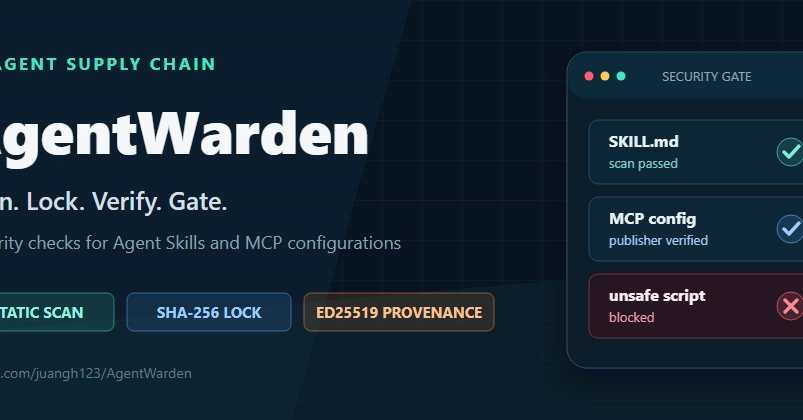
AgentWarden aims to address this critical security gap by acting as a static security gate for agent skills and MCP configurations. The goal is to introduce a layer of automated security analysis before these assets are deployed or integrated into an agent's workflow. This tool is designed to scan these assets for known vulnerabilities, malicious patterns, and risky configurations.
By implementing a static analysis tool like AgentWarden, developers and organizations can gain visibility into the security posture of their AI agent dependencies. This allows for the identification and mitigation of potential threats, such as:
- Scripts designed for privilege escalation.
- Hardcoded credentials or sensitive information leakage.
- Malicious network requests to unauthorized endpoints.
- Commands that could lead to data deletion or system compromise.
- Configuration settings that weaken agent security policies.
The integration of such a security gate is crucial for responsible AI development. As agents become more autonomous and integrated into critical systems, ensuring the security of their components is paramount. This shift requires treating agent skills and configurations with the same security diligence as any other piece of code or critical infrastructure configuration.
The Path Forward: Securing the AI Agent Supply Chain
The analogy here is to the software supply chain. Just as the security of open-source libraries and dependencies is critical for traditional software, the security of agent skills and MCP configurations is vital for the AI agent ecosystem. Without robust security gates, we are building powerful AI systems on a foundation that is inherently fragile and susceptible to attack.
The development and adoption of tools like AgentWarden represent a necessary step towards maturing the AI agent landscape. It forces a consideration of security from the outset, rather than as an afterthought. If you are developing AI agents, or integrating them into your infrastructure, it is imperative to understand the risks associated with unvetted skills and configurations. Implementing automated security checks, similar to those found in CI/CD pipelines for code, is no longer optional – it is a fundamental requirement for secure and reliable AI deployment.
What remains to be seen is how quickly the broader AI development community will embrace these security practices. Will it take a major breach involving a compromised agent skill to spur adoption, or will proactive measures become the norm?