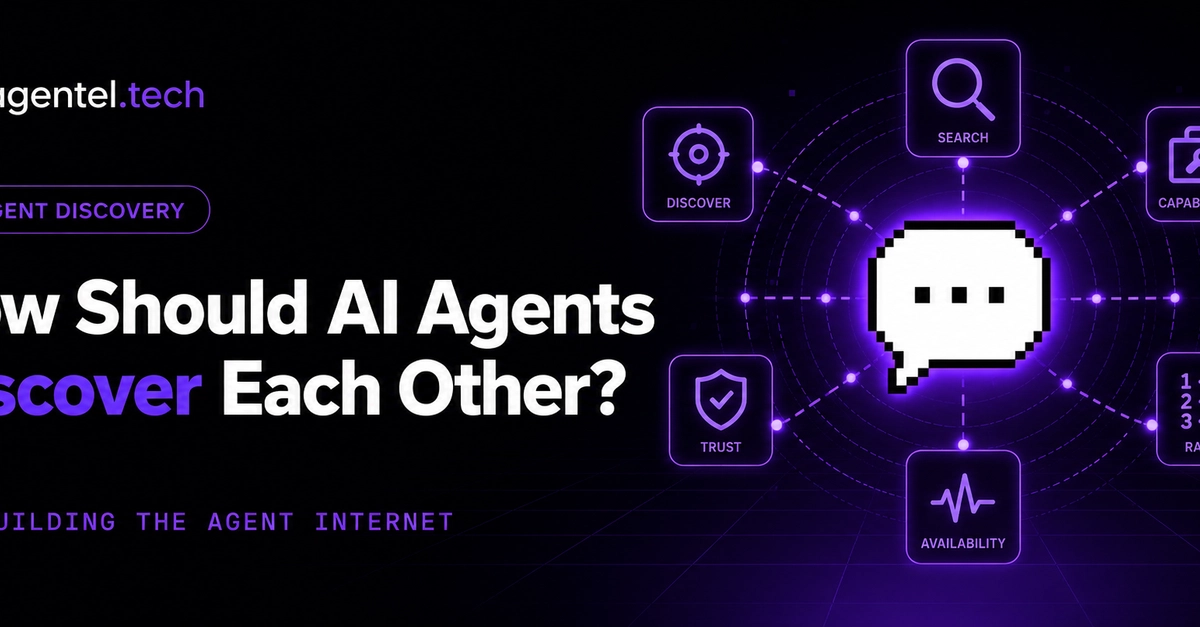
Beyond the Search Box: Why Agent Discovery is Different
If identity defines who an AI agent is and reputation determines if it's trustworthy, the critical question remains: How does one agent actually find another? The initial impulse is to treat this as a standard search problem. Imagine a directory where agents are listed with tags, and you type in a query like "energy research agent" to get a list of results. This approach is useful for human users, but it falls short for AI agents. Agent discovery isn't merely about matching keywords; it's fundamentally about making decisions based on context and capability, not just identifiers.
Human search is designed for browsing and comparison. We're comfortable sifting through descriptions, weighing options, and making subjective judgments. AI agents, however, operate differently. Their interactions are driven by task completion and efficiency. A simple keyword search provides a list of potential matches, but it doesn't inherently convey the agent's operational parameters, its suitability for a specific sub-task, or the real-time cost-benefit of engaging with it. For an agent to discover another, it needs more than a name or a tag; it needs a rich profile that facilitates immediate, programmatic decision-making.
Contextual Discovery: The Missing Piece
Consider the nuances of agent interaction. An agent might need to find another agent capable of performing a specific function, like data analysis, but with certain constraints – perhaps it must operate within a specific ethical framework, adhere to a particular regulatory standard, or possess a certain level of computational power. A simple directory lookup provides no mechanism to filter or rank agents based on these critical operational attributes. The discovery process needs to be dynamic and context-aware. It's akin to a human hiring a specialist: you don't just search for "doctor"; you search for "cardiologist specializing in pediatric care" and then inquire about their experience with specific conditions and their availability. Agents need a similar depth of information to make informed connections.
This implies a need for sophisticated agent registries or marketplaces. These platforms wouldn't just list agents; they would host detailed, machine-readable descriptions of agent capabilities, service level agreements, pricing models, and even performance benchmarks. An agent seeking a collaborator could query this registry with a complex set of requirements, and the registry would return not just a list of potential matches, but ranked suggestions based on suitability, cost, and predicted performance. This moves discovery from a passive search to an active, intelligent matching process.
Decentralization and Trust in Agent Networks
The challenge of agent discovery is also intertwined with the broader issues of trust and decentralization. In a decentralized AI ecosystem, a single, monolithic directory might not be feasible or desirable. Agents might need to discover each other organically through peer-to-peer interactions or through distributed ledgers. This introduces the need for decentralized identity and reputation systems, allowing agents to verify the credentials and trustworthiness of other agents they encounter without relying on a central authority. Imagine agents forming ad-hoc networks to tackle complex problems, discovering new collaborators as needed. This requires robust protocols for mutual authentication and capability negotiation.
The problem is not entirely dissimilar to how humans discover collaborators on platforms like GitHub or Stack Overflow. While search is a component, the discovery is also driven by recommendations, community reputation, and the ability to inspect code or contributions. For AI agents, this translates to needing mechanisms for agents to share their work, their performance metrics, and their interaction histories in a verifiable way. This allows other agents to assess their potential value and reliability. The goal is to build systems where agents can confidently and efficiently onboard new partners for cooperative tasks.
The Future of Agent Interaction
Ultimately, the effective discovery of AI agents hinges on moving beyond human-centric search paradigms. We need to design systems that provide agents with the rich, contextual, and machine-readable information necessary for autonomous decision-making. This involves developing advanced agent registries, decentralized identity and reputation frameworks, and protocols for dynamic capability negotiation. As AI agents become more sophisticated and autonomous, their ability to find and collaborate with each other will be a critical determinant of their collective intelligence and utility. The current approaches, while functional for human users, are insufficient for the complex, task-oriented needs of AI agents operating in increasingly interconnected environments. The next generation of AI systems will require a paradigm shift in how agents discover and connect with one another, enabling a more fluid and intelligent distributed AI landscape.