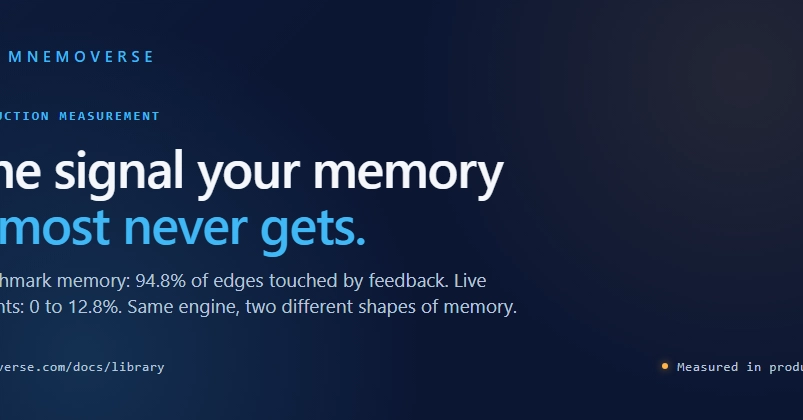
The Feedback Dilemma in AI Agent Memory
The promise of AI agents is simple: the more you use them, the smarter they get. This improvement is intrinsically tied to their memory systems, which are designed to learn and adapt. However, a fundamental flaw exists in how these memory engines are trained and utilized in real-world applications. The mechanism intended to drive the most significant learning – feedback – is conspicuously absent from the vast majority of production traffic. Agents might read their memories millions of times, but they almost never report back on whether those memories were actually helpful or accurate. This disconnect represents a critical bottleneck, preventing AI agents from reaching their full potential.
The core of this problem lies in the reinforcement-aware memory engine. Associations within these engines strengthen through distinct events: writes, reads, and feedback signals. A write operation establishes co-occurrence evidence by linking concepts stored within a memory. At this stage, there's no direct outcome or evaluation. A read operation creates a weak co-activation between the query and the retrieved memory. This signal is intentionally kept faint, serving as an exploration signal. The idea is that simply retrieving a memory shouldn't immediately entrench it as highly valuable or correct. This deliberate damping is a safeguard against premature optimization based on incomplete information.

The Weight of the Feedback Signal
The crucial element, the signal that carries the most weight in reinforcing or correcting an agent's memory, is the feedback event. This is where the agent explicitly indicates whether a retrieved memory was useful, accurate, or led to a successful outcome. This signal is orders of magnitude stronger than a mere read. It's the difference between a librarian noting which books were requested and a librarian noting which books were requested and found to be exactly what the patron needed for their research, leading to a satisfied patron.
In a typical reinforcement learning setup for memory, a positive feedback signal might increase the strength of the association between the query and the retrieved memory. Conversely, negative feedback would weaken it, or perhaps even trigger a search for alternative memories or a re-evaluation of the current memory's relevance. This explicit feedback loop is what allows the memory engine to refine its understanding of which information is truly valuable in different contexts. It’s how the agent learns to distinguish between merely retrieving information and retrieving the *right* information.
The Production Traffic Gap
The startling reality, as observed in production systems, is that this high-weight feedback signal is almost never generated. While agents are constantly reading memories – sometimes millions of times a day – the mechanism to report back on the utility of those memories is rarely triggered. This gap is not a minor oversight; it's a systemic failure in the feedback loop that is essential for effective learning. The numbers are stark: for every million reads, perhaps only a handful, or even zero, are accompanied by the crucial feedback signal.
This means that the agent's memory is primarily being shaped by the weak signals of writes and reads, with the powerful corrective force of feedback being largely absent. Imagine trying to train a dog using only occasional pats on the head (reads) and never using treats or scolding (feedback). The dog might learn some associations, but its understanding of what actions are truly desired or undesired would be severely limited. The AI agent’s memory operates under a similar handicap. It’s like trying to navigate a complex city with only a vague sense of direction (reads) and no feedback on whether you’ve reached your destination or gotten lost.
Implications for Agent Performance
The consequences of this feedback dilemma are profound. AI agents that appear to be learning and improving might actually be plateauing, or their improvements might be superficial. Without robust feedback, the memory system cannot effectively prioritize relevant information, discard outdated or incorrect associations, or adapt to nuanced user needs. This leads to agents that can retrieve information but struggle to consistently provide the *most useful* or *correct* information in a given situation.
This can manifest in several ways: agents might frequently retrieve irrelevant or outdated memories, leading to suboptimal responses. They might fail to adapt to changes in user behavior or domain knowledge because the feedback mechanism that would flag these changes is inactive. The agent’s understanding of context becomes brittle, relying on general co-occurrence rather than validated utility. This feedback deficit directly impedes the agent's ability to become truly context-aware and personalized, a core promise of advanced AI systems.
The Path Forward: Re-engineering Feedback
Addressing this feedback dilemma requires a deliberate re-engineering of how AI agents interact with their memory systems in production. It's not enough to simply build a sophisticated memory engine; developers must ensure that the learning mechanisms are actively engaged. This could involve several strategies:
- Explicit Feedback Triggers: Designing specific user interactions or system states that prompt explicit feedback. This might include asking users directly if a response was helpful, or having the agent self-evaluate its confidence in a retrieved memory based on downstream task success.
- Implicit Feedback Analysis: Developing more sophisticated methods to infer feedback from user behavior. For example, if a user immediately refines a query after a memory retrieval, this could be interpreted as a weak negative signal for the previous retrieval. Conversely, if a user proceeds with a task after a retrieval, it could be a positive signal.
- A/B Testing Memory Strategies: Continuously testing different memory retrieval and feedback weighting strategies in production to identify what truly leads to better outcomes.
- Data Augmentation for Feedback: Artificially generating synthetic feedback data during training, mimicking real-world scenarios where feedback might be sparse.
The challenge is significant because collecting explicit feedback can be intrusive for users and computationally expensive for systems. However, the alternative is agents that are fundamentally limited in their ability to learn and adapt, failing to live up to their potential. The future of truly intelligent agents depends on closing this feedback gap, transforming memory systems from passive repositories into active learning partners.