The Problem: Agents That Don't Learn
Artificial intelligence agents are rapidly advancing. They can execute complex sequences of tasks: reading support tickets, modifying code, opening pull requests, querying APIs, and sending emails, all to achieve a defined goal. This capability allows them to automate intricate workflows that were once the exclusive domain of human professionals. However, a critical limitation persists in many current agent designs: they do not learn from their experiences. After completing a task, the agent's memory of the process is wiped clean. The next time a similar problem arises, the agent starts from scratch, repeating the same steps and making the same potential mistakes. This lack of persistent learning means agents cannot optimize their performance over time, fundamentally limiting their utility and potential for true intelligence.
A truly useful AI agent should not merely execute commands. It must actively accumulate knowledge, refining its approach and increasing its efficiency with each task. This accumulated wisdom should enable the agent to tackle future problems more effectively, more quickly, and with fewer errors. The current paradigm of task completion without knowledge retention is a significant bottleneck, preventing AI agents from reaching their full potential as intelligent, adaptive partners.
The Solution: Agent Loops Meet Graph Memory
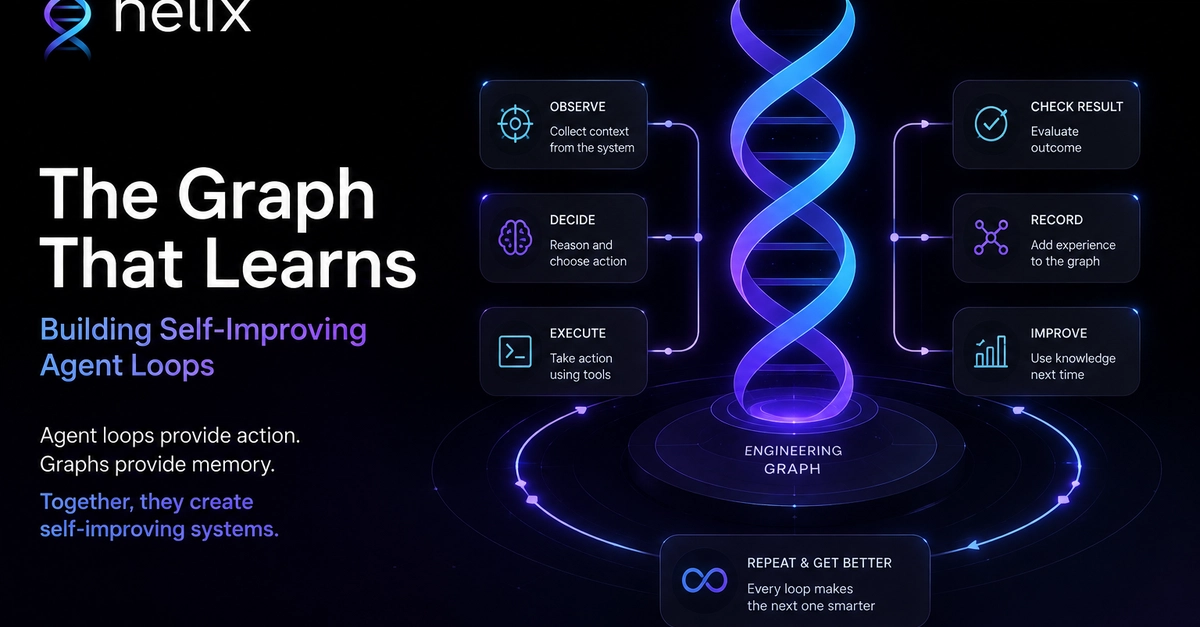
To address this fundamental limitation, a powerful synergy emerges from combining two distinct concepts: agent loops and graph-based memory. Agent loops provide the mechanism for action and execution. They define the sequence of steps an agent takes to interact with its environment and accomplish a goal. This is the "doing" part of the agent's operation. Think of it as the agent's "hands" and "feet" – the ability to act and move within the digital or physical world.
Graphs, on the other hand, provide memory. Specifically, knowledge graphs or similar graph structures can store information about the agent's experiences, the relationships between different pieces of information, and the outcomes of various actions. This is the agent's "brain" – its ability to recall, connect, and reason about past events. Unlike simple linear logs or databases, graphs excel at representing complex, interconnected relationships. This allows an agent to not only recall that an action was taken but also to understand why it was taken, what its consequences were, and how it relates to other knowledge it possesses.

Building a Self-Improving System
The true innovation lies in how these two components interact. When an agent's loop is designed to update the graph with its experiences, a feedback mechanism is established. As the agent performs tasks, it records the actions taken, the data processed, and the results achieved in the graph. This isn't just passive logging; the agent actively analyzes these experiences to identify patterns, successful strategies, and common pitfalls. This analysis informs updates to the graph, effectively teaching the agent about its own performance.
For instance, if an agent repeatedly struggles with a specific type of API error, it can record each instance, the context, and the eventual workaround. Over time, the graph can represent a network of knowledge about this error: its common causes, the specific API endpoints affected, and the most efficient resolution strategies. The next time the agent encounters a similar error, it can query its graph memory. This query might not only identify the error type but also directly suggest the most effective solution, bypassing the trial-and-error process that would have occurred in a non-learning agent. This is the essence of a self-improving system: the agent doesn't just perform; it reflects, learns, and adapts, becoming demonstrably better at its tasks over time.
The Implications for AI Development
This paradigm shift moves AI agents from being mere task executors to becoming intelligent systems capable of continuous growth. This has profound implications across various domains. In software development, agents could learn to debug more efficiently, write more robust code, and optimize deployment pipelines based on past performance metrics. In customer support, agents could develop deeper understandings of user issues and company policies, providing more accurate and empathetic assistance. In scientific research, agents could learn from experimental data, identify novel hypotheses, and design follow-up experiments more intelligently.
The core benefit is the creation of AI that gets progressively more valuable. Instead of a static tool, you have a dynamic partner that evolves with every interaction. This self-improvement loop is akin to how humans learn. We try things, observe the outcomes, store that information, and use it to make better decisions in the future. By imbuing AI agents with this capability, we unlock a new level of autonomy and intelligence. The challenge now shifts to building robust, scalable graph structures and efficient learning algorithms that can manage and leverage this accumulating knowledge effectively. What remains to be seen is how these self-improving agents will be integrated into existing workflows, and what new human-AI collaboration models will emerge as agents become more capable and autonomous.