The Knowing-Doing Chasm in Language Models
Language models, despite their impressive fluency and apparent understanding, are fundamentally text-in, text-out systems. Ask a sophisticated model to book a restaurant reservation, and it won't pick up the phone or click a button. Instead, it will eloquently describe the process of making such a reservation, often with a convincing air of authority, before stopping dead. This is the critical gap between 'knowing' how to do something and 'doing' it. This limitation is not a bug; it's a feature of their design. They produce text, and that text cannot directly interact with the real world, execute commands, or manage state across time. The leap from a conversational AI to a functional AI agent requires more than just a smarter model; it demands a surrounding architecture that grants it agency.
An AI agent, therefore, is not merely an enhanced language model. It is a composite system. This system comprises the language model itself, augmented by a collection of specialized components that compensate for its inherent inabilities. These components enable actions like interacting with external tools, remembering past interactions, seeking human approval, and persisting information. Crucially, these parts must be orchestrated by a robust framework. This framework is the often-overlooked engine that wires these disparate elements together, manages their execution, and allows the agent to perform complex, multi-step tasks. Many explanations of AI agents focus solely on listing the components, leaving the vital connective tissue—the framework—as an afterthought. This article aims to rectify that by detailing both the essential parts and the mechanism that brings them to life.
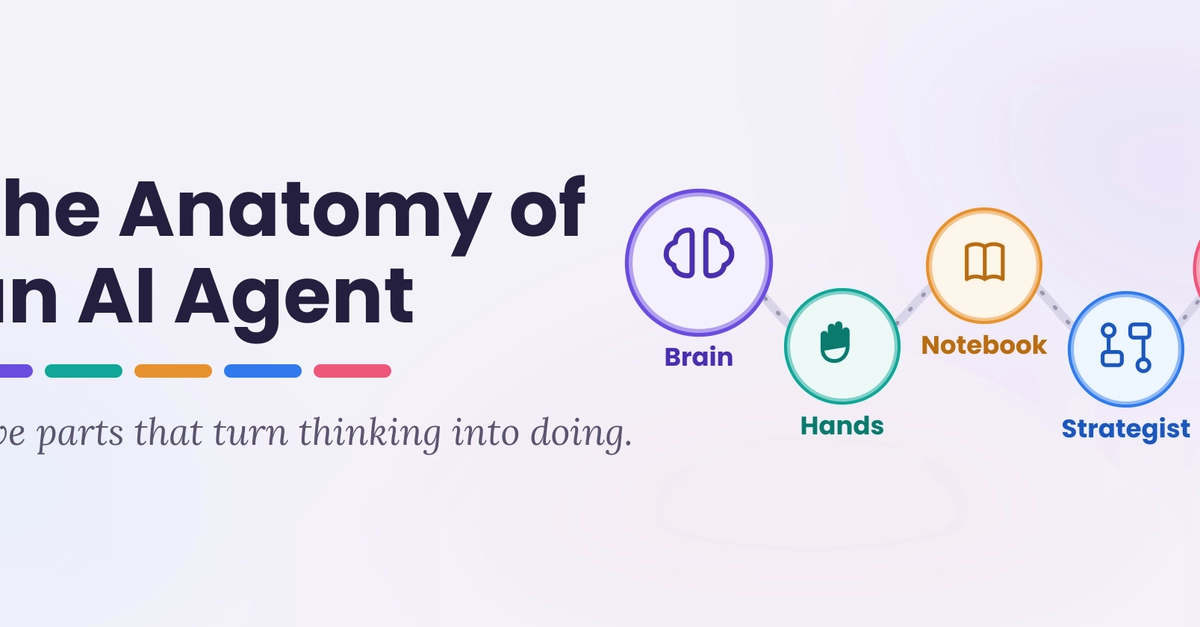
The Five Pillars of AI Agency
To understand how an AI agent moves from abstract knowledge to concrete action, we must first dissect its constituent parts. These five components work in concert, each addressing a specific functional requirement:
1. The Language Model (LM) Core
This is the brain of the operation. The Large Language Model (LLM) provides the agent's reasoning, understanding, and ability to process natural language input. It interprets user requests, breaks down complex tasks into smaller steps, and generates the text that dictates the agent's next move. Its role is primarily analytical and generative: understanding what needs to be done and formulating a plan or response.
2. The Memory Component
Human agents remember. They recall past conversations, learned facts, and previous experiences. An AI agent needs a similar capability to maintain context and learn over time. Memory can be structured in several ways:
- Short-Term Memory: This is akin to a scratchpad, holding recent interactions, current task status, and intermediate results. It allows the agent to keep track of the immediate conversation and ongoing processes.
- Long-Term Memory: This component stores accumulated knowledge, user preferences, past task outcomes, and learned strategies. It enables personalization and more efficient future operations by drawing on a history of experiences. Vector databases and knowledge graphs are common technologies for implementing long-term memory.
3. The Tool Use Module
This is where the agent gains its ability to 'do'. The tool use module provides access to external functionalities. This could include anything from calling an API (like a calendar API to book meetings, or a weather API to fetch forecasts) to running code, searching the web, or interacting with other software. The LM decides which tool to use, and this module handles the execution and retrieval of results.
4. The Planning and Reasoning Engine
While the LM provides the raw reasoning capability, a dedicated planning engine refines this into actionable sequences. It takes the LM's understanding of a task and orchestrates the use of memory and tools. This engine is responsible for: breaking down complex goals into sub-goals, sequencing operations, handling dependencies between steps, and adapting the plan if an intermediate step fails or produces unexpected results. It's the conductor that ensures all instruments play in harmony.
5. The Action Executor
This is the final step in the chain, translating the decisions made by the planning engine and LM into concrete actions. It takes the output from the tool use module or other decision-making processes and executes them. This could involve sending a command to an external system, updating a database, or generating a final response to the user. It is the agent's 'hands' and 'feet' in the digital world.
The Framework: The Nervous System of the Agent
Listing these five parts is only half the story. The real magic, and the most complex engineering challenge, lies in how they are connected and orchestrated. This is the role of the framework. Think of the framework as the agent's nervous system, transmitting signals, coordinating responses, and managing the flow of information between the brain (LM), memory, and limbs (tools and executors).
A robust agent framework must handle several critical functions:
- Task Decomposition and Orchestration: Receiving a high-level user request and systematically breaking it down into smaller, manageable steps.
- State Management: Keeping track of the current state of the agent's progress on a task, including intermediate results and context.
- Tool Selection and Invocation: Determining which tools are relevant for a given step and invoking them with the correct parameters.
- Error Handling and Recovery: Managing situations where a tool fails, an API returns an error, or the LM's plan needs adjustment. This often involves re-planning or seeking user clarification.
- Contextual Awareness: Ensuring that the LM has access to relevant information from memory and the current task state to make informed decisions.
- Feedback Loops: Incorporating feedback from tool execution or user interaction to refine future actions and learn.
Popular frameworks like LangChain, LlamaIndex, and AutoGen provide abstractions and pre-built components to simplify the creation of these agentic systems. They offer modules for prompt engineering, memory management, tool integration, and agent execution loops, allowing developers to focus on the unique logic and capabilities of their specific agents rather than reinventing the underlying infrastructure.
The Emergent Power of Agentic Systems
The true power of an AI agent lies not in any single component but in the emergent capabilities that arise from their integration within a well-designed framework. This architecture transforms a passive language model into an active participant capable of executing complex, real-world tasks. By bridging the 'knowing-doing' gap, AI agents unlock a new generation of applications, from sophisticated personal assistants and autonomous software agents to automated workflows and complex data analysis pipelines. As these systems mature, the distinction between simply processing information and actively acting upon it will become increasingly blurred, redefining our interaction with artificial intelligence.