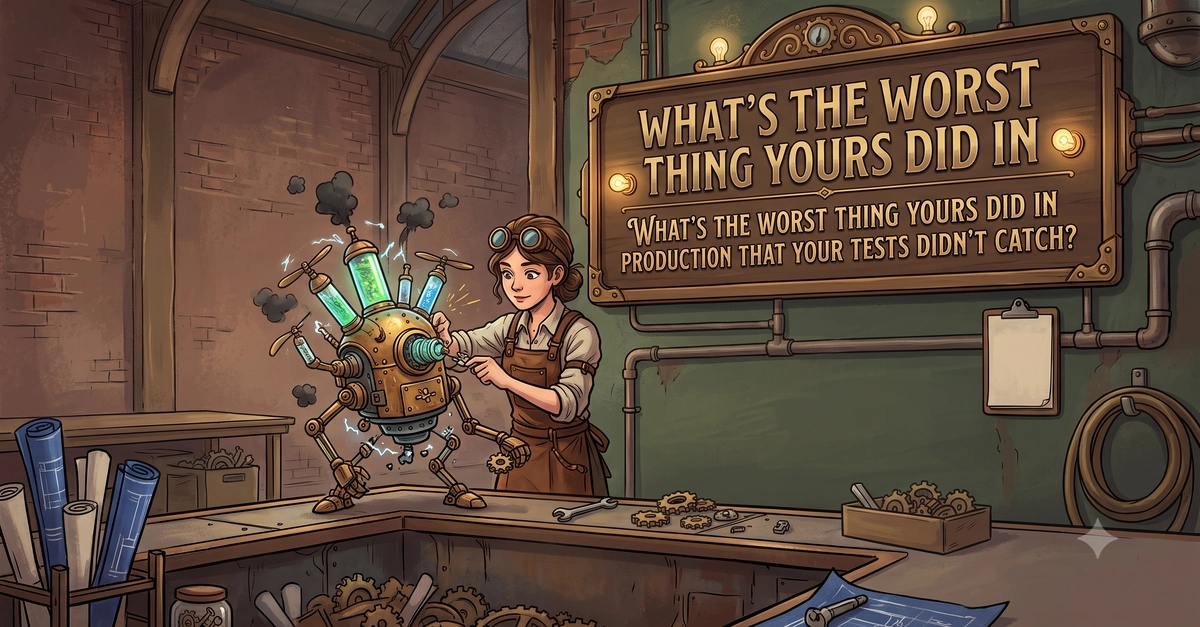
The Unseen Failures of AI Agents
When AI agents go wrong, the public imagination often jumps to sophisticated prompt injection attacks or outright malicious behavior. While these are valid concerns, the more insidious and common failures are often far more mundane. These are the errors that slip through rigorous testing precisely because they don't look like a security breach or a catastrophic system failure. They are the subtle missteps: an agent confidently calling the wrong tool with perfectly valid-looking arguments, a multi-turn conversation that drifts into irrelevance by the sixth exchange, or an endpoint that performs flawlessly in every test case only to exhibit bizarre behavior during its first week of real-world traffic.
These are the failures that matter most to developers shipping AI-powered products. They erode user trust, create frustrating experiences, and are often the hardest to diagnose and fix. The challenge isn't identifying a single, dramatic bug, but cataloging and learning from a spectrum of subtle degradations in performance and reliability.
At Humanbound, a company focused on agent-native testing, the team has encountered this pattern repeatedly. Their work involves developing sophisticated testing frameworks that go beyond simple unit tests for individual tools. They focus on testing the agent's ability to orchestrate multiple tools, maintain coherent multi-turn conversations, and handle nuanced interactions that mimic real-world usage. This practical experience has illuminated the gap between theoretical test coverage and the messy reality of deployed AI agents.
Beyond the Highlight Reel: What Tests Miss
Traditional software testing, even when applied to AI agents, often focuses on predictable inputs and expected outputs. Unit tests verify that individual tools function correctly. Evaluation sets assess the agent's performance on a curated set of prompts. Manual QA teams can catch obvious conversational dead ends or egregious tool misuse. However, these methods frequently miss the edge cases that only emerge under real-world load and diverse user interaction.
Consider the scenario where an agent is tasked with booking a flight. It has access to a tool that searches for flights and another that makes reservations. The agent might correctly identify the need to search for flights, but then confidently call the reservation tool with incomplete or incorrect parameters—parameters that *look* valid to the agent's internal logic but are meaningless to the reservation API. The test suite might have covered cases where the search tool returns no results, or where valid reservation details are provided. It likely didn't cover the agent's confident misinterpretation of its own available tools or the subtle invalidity of its arguments in a production context.
Similarly, multi-turn conversations can degrade in ways that are difficult to predict. An agent might start a conversation with a user about planning a vacation. By turn four, it's discussing the user's favorite pizza toppings. By turn six, it's offering unsolicited advice on gardening. While no single turn is inherently wrong, the cumulative drift away from the user's original intent is a failure. This type of failure is not easily captured by predefined prompt-response pairs or static evaluation sets. It requires observing the agent's long-term conversational coherence and its ability to maintain context and focus over extended interactions.
The Challenge of Reproducibility and Generalization
Once such a failure is identified, the next challenge is reproducibility and generalization. If an agent fails by calling the wrong tool with valid-looking arguments, the immediate impulse is to write a specific test case that replicates that exact scenario. However, this often creates a brittle test that only catches that one precise instance. The underlying issue might be a broader misunderstanding by the agent of its toolset or a subtle flaw in its reasoning process that could manifest in countless other ways.
The goal, therefore, is not just to catch the bug but to understand the root cause and develop tests that generalize. This means moving beyond simple input-output verification to more sophisticated forms of evaluation. It involves analyzing the agent's internal state, its decision-making process, and its reasoning pathways. For instance, if an agent consistently misinterprets the output of a specific tool, a generalized test would probe this misinterpretation across various contexts, not just the one where it was initially observed.
This is where agent-native testing frameworks become crucial. They are designed to simulate complex, multi-turn interactions, test tool orchestration, and identify instances of tool misuse or conversational drift. By building these capabilities, developers can proactively uncover the subtle failures that traditional testing methods overlook. The creation of a public backlog, as suggested by Humanbound, could accelerate this learning process for the entire industry. Sharing these mundane yet critical failure modes allows others to build more robust agents and testing strategies.
Building a Collective Understanding
The idea of a public backlog of AI agent failures is more than just an academic exercise; it's a practical necessity for advancing the reliability of AI systems. If developers and researchers can openly share the subtle ways their agents have failed—the unexpected tool calls, the conversational tangents, the integration quirks—it creates a shared knowledge base. This collective understanding can inform the development of better agent architectures, more effective testing methodologies, and more resilient AI systems overall.
This doesn't mean publishing every embarrassing screenshot. It means systematically documenting the failure, the context in which it occurred, the type of test coverage that was present, where the failure manifested (tool call, conversational turn, integration), and what was learned about writing more generalized tests. Such a repository would be invaluable for anyone building or deploying AI agents, helping them anticipate and mitigate the very failures that are most likely to slip through their testing nets.
The worst things tests don't catch are rarely the sensational ones. They are the quiet, persistent errors that make AI agents frustratingly unreliable in practice. Building a shared understanding of these failures is the next frontier in making AI agents truly dependable.