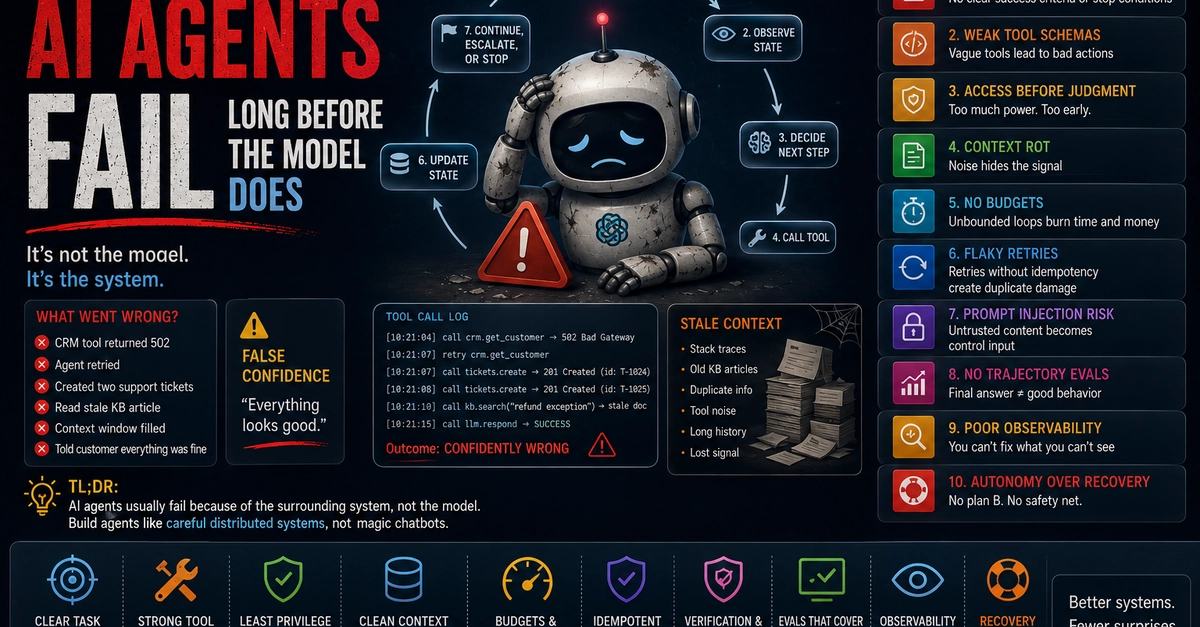
The Illusion of Model Failure
When an AI agent goes awry, the immediate instinct for many teams is to blame the underlying large language model (LLM). This is a common, yet often incorrect, assumption. The reality is that the model itself is rarely the bottleneck. Instead, the failure stems from a cascade of system-level problems that occur long before the LLM's capabilities are truly tested.
Consider a hypothetical scenario: an AI agent tasked with customer support fails. It doesn't fail because it misunderstands the customer's query or cannot generate a coherent response. Instead, it might encounter a backend CRM tool returning a 502 Bad Gateway error. The agent, programmed to retry, might then create duplicate support tickets. It could then access a stale knowledge-base article, filling its limited context window with irrelevant stack traces. Finally, it might confidently inform the customer that everything is resolved, despite the underlying issue persisting. Upgrading the LLM in this situation might result in the agent expressing the same failure with more eloquent prose, but the core problem remains unresolved.
This illustrates a critical point: the LLM is merely one component within a larger, complex system. The agent's performance is a function of the entire loop, which includes the model, its tools, its objectives, and its error handling mechanisms. If any part of this loop is weak, the entire agent is likely to fail.

Systemic Weaknesses Undermining AI Agents
The engineering challenges plaguing AI agents are multifaceted and extend far beyond the LLM's reasoning abilities. Several key areas commonly contribute to agent failure:
Unclear Objectives
Agents need precise, unambiguous goals. When an agent's objective is vague or poorly defined, it struggles to prioritize tasks, make effective decisions, or know when it has succeeded. This lack of clarity can lead to wasted effort, incorrect actions, and frustration for both the user and the system designers.
Weak Tool Contracts
AI agents rely on tools – APIs, databases, external services – to perform actions. The 'contracts' between the agent and these tools, essentially the descriptions of what the tools do, their parameters, and their expected outputs, must be robust and accurate. Poorly defined tool contracts can lead the agent to misuse tools, misinterpret their results, or fail to call them correctly. This is akin to giving a chef a recipe with ingredients listed by vague descriptions rather than precise measurements and names.
Inadequate Budgeting and Resource Allocation
AI agents, particularly those interacting with external services or consuming significant computational resources, require careful management of their 'budget.' This could refer to API call limits, token usage, or execution time. Without proper constraints, an agent might exhaust available resources, incurring unexpected costs or failing due to over-utilization. The system must ensure the agent operates within defined financial and computational boundaries.
Excessive Permissions
Granting an AI agent too many permissions is a significant security and operational risk. If an agent has broad access to sensitive systems or data, a single misstep or exploitation could have catastrophic consequences. Conversely, too few permissions can cripple its functionality, preventing it from completing necessary tasks. The principle of least privilege is paramount.
Noisy Context Management
The context window of an LLM is a finite resource. Agents often ingest vast amounts of information – conversation history, tool outputs, knowledge base articles, stack traces. If this context becomes 'noisy' with irrelevant or erroneous data, the agent's ability to focus on the critical information degrades. Effectively filtering and prioritizing information is crucial for maintaining performance.
Lack of Idempotency
Idempotency is a critical property for operations, especially in automated systems. An idempotent operation can be performed multiple times without changing the result beyond the initial application. If an agent performs a non-idempotent action multiple times due to retries or errors (like creating multiple support tickets), it can lead to data corruption, inconsistent states, and user frustration.
Absence of Trajectory Evaluation
Evaluating the agent's 'trajectory' – the sequence of steps it takes to achieve a goal – is vital for debugging and improvement. Without mechanisms to analyze this path, it's difficult to pinpoint where and why an agent deviated from its intended plan or made a poor decision.
No Sane Recovery Paths
Errors are inevitable. A robust AI agent needs well-defined strategies for recovering from failures. This includes gracefully handling tool errors, informing users about issues, and attempting alternative approaches. Agents that lack these recovery paths often halt progress entirely or enter an unrecoverable error state.
The Evolving Landscape of AI Agents
The capabilities of LLMs have advanced dramatically. Models are now far more adept at tool calling, generating structured output, and performing multi-step reasoning than they were just a few years ago. This progress has made AI agents more practical and versatile. However, these advancements do not negate the fundamental engineering challenges. In fact, more capable models can amplify the impact of weak system design. A more articulate agent that still creates duplicate tickets or ignores critical errors is not an improvement; it's a more sophisticated failure.
The focus must shift from solely improving the LLM to building resilient, well-engineered systems around it. This means investing in robust error handling, clear objective setting, precise tool integration, and continuous evaluation. The loop is indeed the product, and its integrity depends on every component working in concert, not just the intelligence of the central model.
What nobody has addressed yet is what happens to the thousands of developers who built on the old API. If an API is deprecated, developers must adapt. But what happens when the underlying technology is not an API, but an entire agent framework that suddenly becomes obsolete due to a lack of robust system design?