The Context Window Crisis: Tool Overload in AI Agents
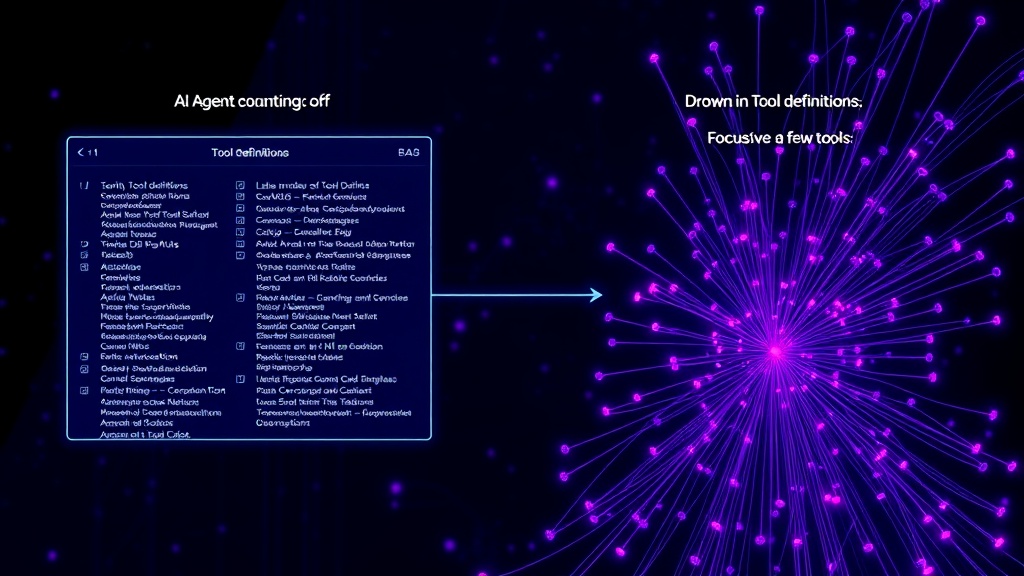
Modern AI agents, particularly those built on frameworks like the Model Context Protocol (MCP), offer immense power by connecting to a vast array of tools. However, this power comes with a significant drawback: tool overload. When an AI agent's context window is packed with thousands of tool definitions – each including parameters, descriptions, and type information – it consumes tens of thousands of tokens before the agent even begins processing the user's actual request. This leaves the agent in a state of paralysis, effectively drowning in irrelevant data and unable to focus on the task at hand.
Imagine a scenario with 50 MCP servers, each defining 10 to 20 tools. This quickly escalates to 500 to 1,000 tool schemas. Dumping all of this into an agent's context window can easily consume 50,000 tokens. The agent, designed to be intelligent and responsive, is instead bogged down by the sheer volume of potential actions it *could* take, rather than focusing on the specific actions it *needs* to take for the current query. This is not a problem of the AI's intelligence but a fundamental issue of resource management within its operational constraints.
The Illusion of All-Tools-Available
The core issue stems from the assumption that an AI agent requires access to its entire toolkit at all times. Frameworks like MCP are powerful precisely because they enable dynamic tool integration. However, the default implementation often loads all available tools into the agent's memory or context. This is analogous to a chef having every single ingredient and utensil in the kitchen laid out on the counter for every meal, regardless of whether they are preparing a simple salad or a complex multi-course dinner. It's inefficient and counterproductive.
Consider a developer debugging a CSS layout. Their immediate needs involve tools for inspecting HTML structure, applying styles, and potentially running a local development server. They do not need tools for database administration, sending emails, or generating complex reports at that moment. Yet, under a naive implementation, all these tools might be loaded, consuming valuable context tokens and potentially confusing the agent about the primary objective.
Progressive Routing: A Focused Approach
The solution lies in a paradigm shift from static, all-encompassing tool loading to dynamic, context-aware tool selection. This is where concepts like Progressive Routing become critical. Instead of presenting the AI agent with a monolithic list of every possible tool, Progressive Routing intelligently selects and presents only the most relevant tools for the current task. This is achieved through semantic matching and a more sophisticated understanding of the user's intent.
With Progressive Routing, the process looks drastically different. When a user poses a query, the system first analyzes the intent. Based on this analysis, it identifies a small subset of highly relevant tools. For instance, if the user asks to separate vocals from an instrumental track, the system would identify and load only the specific audio processing tools capable of this task. Instead of 50,000 tokens of tool definitions, the agent might only receive 1,500 tokens representing perhaps three carefully selected tools. This dramatically preserves the context window, allowing the agent to dedicate its processing power to understanding and executing the user's request accurately.
The Mechanics of Semantic Tool Selection
Implementing Progressive Routing requires a mechanism to understand the semantics of both the user's query and the available tools. This can involve several techniques:
- Vector Embeddings: Both the user's prompt and the tool descriptions (including their parameters and functionalities) can be converted into vector embeddings. The system can then perform similarity searches to find tools whose embeddings are closest to the prompt's embedding.
- Keyword Matching and Ontologies: More traditional keyword matching, combined with domain-specific ontologies, can also help categorize and select tools. For example, if the prompt contains terms like "song," "vocals," and "instrumental," the system can infer a need for audio manipulation tools.
- Hierarchical Routing: Tools can be organized in a hierarchy. The system first identifies the broad category of the task (e.g., "audio processing") and then drills down to specific functions within that category (e.g., "vocal isolation").
The surprising detail here is not the complexity of the AI models themselves, but the elegantly simple, yet often overlooked, problem of efficiently communicating available capabilities to them. The focus shifts from