The Problem with 'Vibe Coding'
The current landscape of AI-assisted software development is often characterized by what's termed 'vibe coding.' This approach involves developers prompting Large Language Models (LLMs), reviewing the output, and then pushing it directly to production. While seemingly efficient, this method collides hard with enterprise realities. Systems are becoming increasingly complex, security audits demand rigorous justification, and the cost of subtle, undetected errors—silent hallucinations in generated code—is prohibitively high. The experimental phase of AI code generation is yielding to the demand for reliable, production-grade software delivery. To bridge this gap, engineering teams must fundamentally shift their mindset. The focus needs to move from an output-first approach to an intent-first methodology: Spec-Driven Development (SDD).
Introducing Spec-Driven Development (SDD)
Spec-Driven Development (SDD) offers a structured pathway to leverage AI effectively in software engineering. It transforms natural language requirements into executable, machine-readable specifications. This methodology is not about replacing developer creativity but about providing a robust framework that ensures clarity, traceability, and verifiability throughout the development lifecycle. The core principle is to define the 'what' and 'why' before the 'how,' ensuring that AI agents are guided by explicit intent rather than vague prompts. This shift is critical for teams operating in regulated industries or building mission-critical systems where accountability and auditability are paramount.
The Architecture of AI-Powered SDD
Implementing SDD with AI agents requires a specific architectural approach. At its heart, this system involves several key components working in concert:
1. Requirement Elicitation and Specification Generation
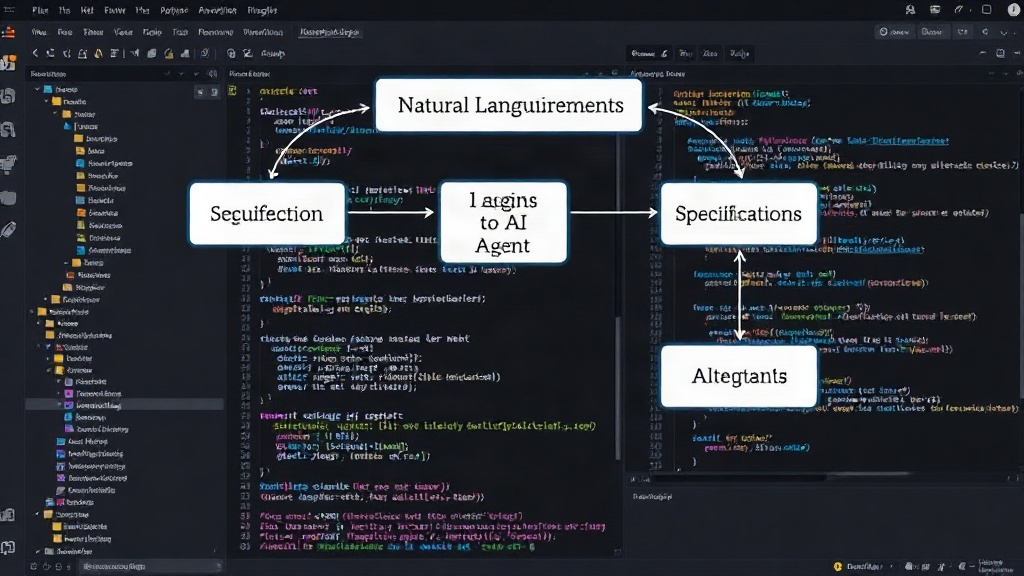
The process begins with clear, unambiguous natural language requirements. These are fed into an AI agent, often an LLM fine-tuned for this task, which translates them into a formal, machine-readable specification. This specification acts as the single source of truth, detailing the intended behavior, data structures, and expected outcomes. Think of this specification not as a static document, but as a highly detailed blueprint that an AI construction crew can directly interpret and verify against.
2. Data Contracts and Schemas
Integral to SDD are robust data contracts and schemas. These define the precise structure, types, and constraints of data exchanged between different components or services. AI agents can assist in generating these contracts based on the formal specifications, ensuring consistency and preventing integration issues. This layer is crucial for enabling deterministic validation and for clearly defining the boundaries and expectations of each software module.
3. Deterministic Validation Loops
The cornerstone of traceable code delivery is the deterministic validation loop. Once code is generated (whether by AI or human developers) based on the specification, it must be rigorously tested against that specification. This involves automated checks that compare the actual behavior and output of the code against the defined requirements. These validation loops are designed to be deterministic, meaning they produce consistent results given the same inputs and specifications. Any deviation flags an issue, providing a clear audit trail and pinpointing where the code diverges from its intended purpose.
4. Traceability and Auditability
A key benefit of the SDD approach with AI agents is enhanced traceability. Every piece of code can be linked back to the specific requirement and specification it fulfills. This creates an auditable history of development decisions, making it easier to understand the rationale behind code changes, perform impact analyses, and satisfy compliance requirements. The AI agent's role extends to maintaining these links, ensuring that the connection between intent and implementation remains unbroken.
Moving Beyond the Hype
The practical application of AI agents in development requires moving past the initial excitement and focusing on building reliable, repeatable processes. SDD provides the framework for this transition. It emphasizes that AI should augment, not replace, the disciplined engineering practices necessary for robust software. By grounding AI-assisted development in explicit specifications and deterministic validation, teams can achieve a level of confidence and traceability that was previously unattainable with ad-hoc prompting. This approach transforms AI from a potential source of unpredictable output into a powerful tool for building verifiable, production-ready software. The future of AI in software development is not about generating code from vague prompts, but about using AI to meticulously translate clear intent into reliable execution.