
Introduction
AI agents are rapidly becoming a central topic in technology discussions. You might hear claims that these agents can write code, browse the web, debug software, distill complex documents, devise strategies, or even execute entire projects autonomously. At first glance, this capability can seem almost magical.
However, AI agents are not a product of sorcery. They are sophisticated software systems designed to understand a given objective, strategize the necessary steps, leverage available tools, observe the outcomes of their actions, and iteratively refine their approach to achieve a desired end state. The true power of an agent lies in its ability to seamlessly integrate reasoning, memory, tool utilization, and feedback loops into a cohesive workflow. This article aims to provide a clear, beginner-friendly explanation of what AI agents are, the mechanisms that drive their operation, and their growing significance in the technological landscape.
What Is an AI Agent?
At its core, an AI agent is a software system endowed with the capacity to pursue a specific goal with a notable degree of autonomy. Unlike conventional AI chatbots, which typically operate on a turn-based interaction model—receiving a prompt, generating a response, and then awaiting the next input—an AI agent can initiate actions and manage processes without constant human supervision.
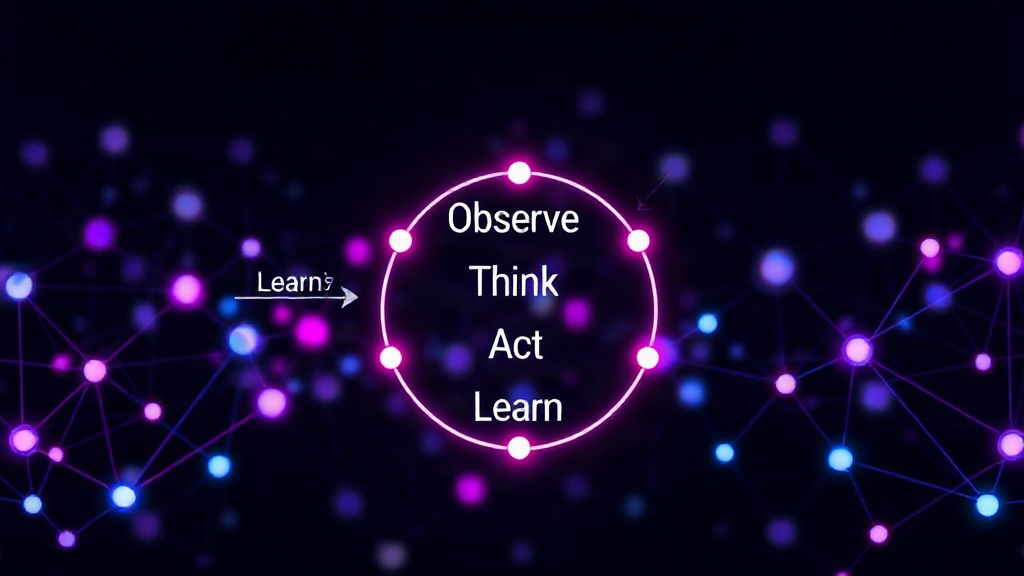
Consider the difference between a helpful assistant who waits for instructions and a proactive project manager who identifies tasks, delegates, and monitors progress. An AI agent functions more like the latter. It possesses a defined objective and the capability to break down that objective into smaller, manageable tasks. For each task, it can select appropriate tools—whether that's a web search engine, a code interpreter, a database query tool, or an API call—execute the tool, analyze the results, and then decide on the subsequent action. This continuous cycle of planning, acting, observing, and adapting is what distinguishes an AI agent from simpler AI models.
The Core Components of an AI Agent
Several key components work in concert to enable an AI agent's functionality. Understanding these elements is crucial to demystifying their capabilities.
Reasoning Engine
The reasoning engine is the brain of the AI agent. It's responsible for interpreting the overall goal, breaking it down into actionable sub-tasks, and deciding which tools to use and in what sequence. This often involves sophisticated techniques like Chain-of-Thought (CoT) prompting, where the agent is encouraged to articulate its thought process step-by-step, much like a human would when solving a complex problem. This explicit reasoning helps the agent navigate ambiguity and make more informed decisions.
Memory
Memory is vital for an AI agent to maintain context and learn from past experiences. This isn't just about recalling previous prompts. Agents employ different forms of memory:
- Short-term memory (Context Window): This refers to the information the agent can access during a single interaction or task execution, typically limited by the underlying language model's context window.
- Long-term memory: This allows the agent to store and retrieve information across multiple sessions or tasks. Techniques like vector databases are often used to create a searchable repository of past interactions, insights, and learned behaviors. This persistent memory is what enables agents to build upon previous work and avoid repeating mistakes.
Tools
Tools are the agents' hands and feet—the mechanisms through which they interact with the digital world and execute tasks. These tools can be incredibly diverse:
- Search Engines: For gathering real-time information from the internet.
- Code Interpreters: For executing code, performing calculations, and analyzing data.
- APIs: For interacting with other software services, such as sending emails, managing calendars, or accessing databases.
- Databases: For retrieving and storing structured information.
- File Systems: For reading, writing, and manipulating local files.
The agent's ability to select and effectively use the right tool for a given sub-task is a critical determinant of its success. This often requires the agent to understand the input and output formats of various tools and to dynamically adapt its strategy based on tool capabilities.
Feedback and Learning
Crucially, AI agents are designed to learn from their actions. After executing a tool or a series of steps, the agent observes the outcome. This observation serves as feedback. If the outcome is positive and moves the agent closer to its goal, the strategy is reinforced. If the outcome is negative or leads to an error, the agent uses this feedback to adjust its plan and try a different approach. This iterative process of action, observation, and adjustment is fundamental to the agent's ability to handle complex or unforeseen challenges.
How AI Agents Work: A Workflow Example
Let's illustrate the process with a hypothetical scenario: An agent is tasked with researching the market trends for sustainable packaging in the European Union and summarizing the findings in a report.
- Goal Understanding: The agent receives the prompt: "Research market trends for sustainable packaging in the EU and create a summary report."
- Planning: The reasoning engine breaks this down:
- Identify reliable sources for market research data (e.g., industry reports, market analysis firms).
- Search for recent data on sustainable packaging market growth, key drivers, and challenges in the EU.
- Analyze identified trends and synthesize key information.
- Draft a summary report.
- Tool Selection and Execution (Step 1): The agent decides it needs to search the web. It uses its web search tool to find reputable sources on EU sustainable packaging market trends.
- Observation and Feedback: The search yields several promising reports. The agent notes the URLs and brief descriptions.
- Tool Selection and Execution (Step 2): The agent might then use a tool to access and read the content of these reports, or refine its search queries based on initial findings. If a search yields irrelevant results, the agent adjusts its search terms.
- Information Synthesis: Once sufficient information is gathered, the agent uses its language model capabilities to synthesize the data, identify recurring themes, and extract key statistics.
- Report Generation: Finally, the agent uses its writing capabilities to draft the summary report based on the synthesized information.
- Iteration (if needed): If the initial draft is incomplete or misses key aspects, the agent might loop back to gather more information or refine its analysis based on self-critique or specific feedback.
This step-by-step process, driven by reasoning, memory, and tool use, allows the agent to tackle complex tasks that would typically require significant human effort.
Why AI Agents Matter
The emergence of AI agents signifies a shift from passive AI assistants to active, autonomous problem-solvers. For developers, this means new possibilities for automating complex workflows, building more intelligent applications, and enhancing productivity. Imagine agents that can manage your CI/CD pipelines, proactively identify and fix security vulnerabilities, or autonomously onboard new team members by gathering necessary information and setting up accounts.
For businesses, agents offer the potential to streamline operations, reduce costs, and unlock new levels of efficiency. They can handle customer support inquiries, manage data analysis tasks, automate research, and even drive sales processes. The ability for an agent to operate with a degree of independence means that human resources can be focused on higher-level strategic tasks, rather than getting bogged down in repetitive or time-consuming operational duties.
However, it's important to acknowledge that AI agents are not infallible. They are still systems built on current AI technology, which has limitations. Misinterpretation of goals, errors in tool usage, or flawed reasoning can lead to incorrect outcomes. The development and deployment of AI agents require careful consideration of their capabilities, limitations, and the potential for unintended consequences. As these systems become more capable and integrated into our workflows, understanding their inner workings—that they are not magic but complex systems—is essential for harnessing their power responsibly and effectively.