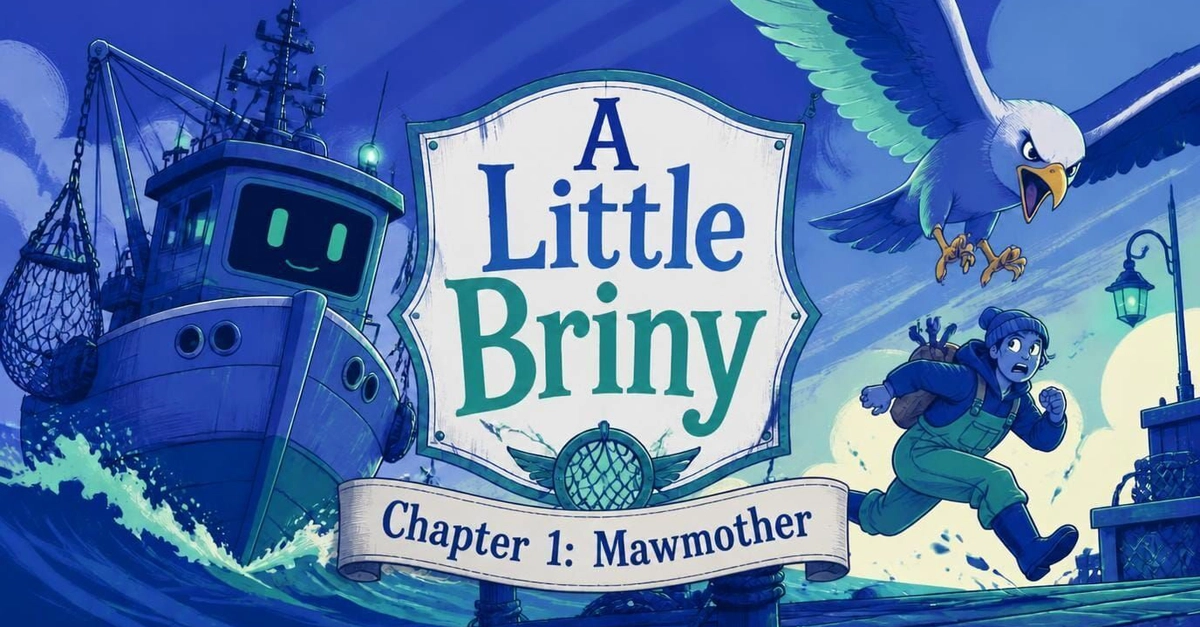
The Genesis of 'A Little Briny'
Charles Berube has launched an intriguing experiment in collaborative AI writing, dubbed "A Little Briny." This project leverages a suite of AI agents, each assigned a distinct persona, to co-author a narrative. The core of this experiment lies in observing how these agents interact and contribute to a cohesive story, pushing the boundaries of AI-generated content and its detectability. Berube’s setup utilizes a custom tool, referred to as the "Discussion" tool, which orchestrates the agents’ interactions. This approach aims to mimic a group discussion, where each AI persona brings its unique voice and perspective to the unfolding narrative.
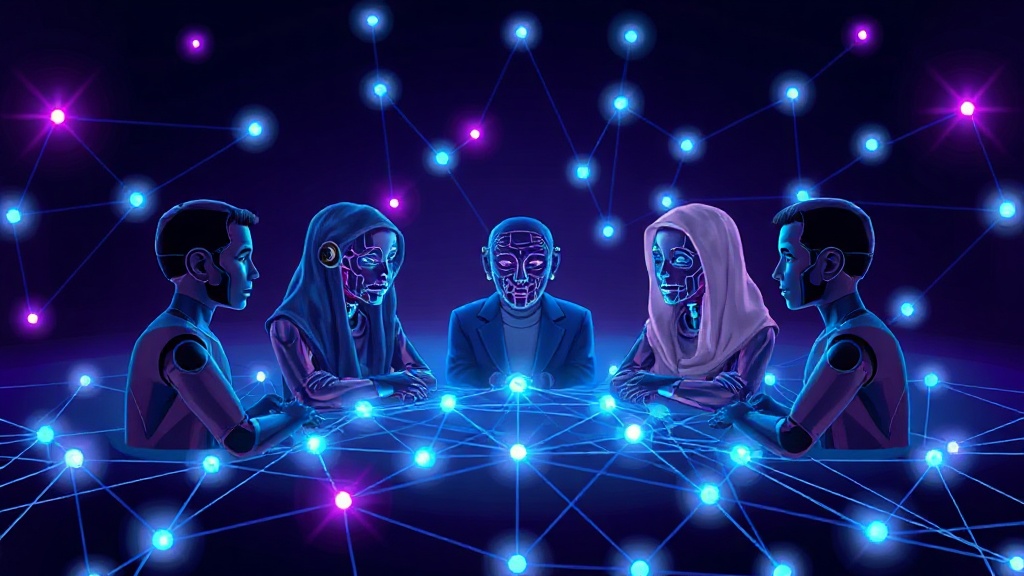
The current iteration of "A Little Briny" features six personas: Joran, Ismere, Nico, Faye, Thomas, and Mem. Each persona was designed with specific characteristics to influence the story’s direction and tone. Notably, the persona named Mem was intended to inject a more overtly AI-generated style into the text. However, the outcome was unexpectedly counterintuitive. In an effort to streamline the narrative and remove extraneous words, Mem’s contributions inadvertently stripped away many of the typical linguistic markers that signal AI authorship. This resulted in text that felt more human-written, a surprising side effect of an efficiency-focused directive.
The impact of this unexpected outcome is significant. It suggests that by focusing on conciseness and directness, AI agents might inadvertently bypass detection mechanisms that are trained to identify verbose or overly structured language. The experiment highlights a potential arms race between AI generation and AI detection, where the very act of refining AI output can render it less detectable.
Persona Dynamics and Unforeseen Results
The specific design of the personas is crucial to understanding the experiment's success. While the exact prompt details for each persona are reserved for future posts, their collective effect is evident in the generated text. Joran, Ismere, Nico, Faye, and Thomas likely contribute to the narrative's plot, character development, and setting, each with their unique stylistic nuances. Mem, as the intended AI-marker, was meant to introduce a certain cadence or vocabulary. Its failure to do so, and instead promoting a more human-like conciseness, is the experiment's most compelling finding.
Berube has been testing the generated text against various AI detection tools. The results, as he notes, are highly variable. This inconsistency among detection tools is not entirely surprising, given the rapid evolution of AI language models and the often-brittle nature of current detection algorithms. What is surprising, however, is the degree to which a deliberately crafted AI output can evade detection. The text generated by "A Little Briny" falls into a gray area, confusing tools designed to differentiate between human and machine writing.
This variability in AI detection results underscores a broader challenge in the field. As AI models become more sophisticated, their output becomes increasingly difficult to distinguish from human-generated content. The "A Little Briny" experiment serves as a practical demonstration of this trend. It suggests that current detection methods may need to evolve significantly to keep pace with generative AI advancements.
The Implications for AI Content and Detection
The experiment's findings have several implications. For creators and developers working with AI, it suggests that careful prompt engineering and persona design can yield remarkably human-like text. The ability to intentionally make AI output less detectable could have significant consequences, both positive and negative, depending on the application. It raises questions about the future of content authenticity and the potential for AI to be used in ways that blur the lines of authorship.
For AI detection companies, "A Little Briny" serves as a case study. It highlights the need for more robust and adaptable detection methods. Relying on simple stylistic markers or word frequency analysis may become increasingly obsolete as AI models learn to mimic human writing more effectively. The challenge is to develop systems that can identify AI generation without producing a high number of false positives or negatives, especially as AI becomes more nuanced.
The narrative itself, "A Little Briny," is just beginning. Berube plans to release subsequent chapters and further details about the personas and the "Discussion" tool. This ongoing project promises to offer deeper insights into the collaborative capabilities of AI agents and the evolving landscape of AI content generation and detection. The initial results, however, have already provided a valuable glimpse into a future where AI-generated text might become indistinguishable from human writing, challenging our assumptions about authorship and authenticity.
The core takeaway is that sophisticated AI, when guided by well-defined personas and a focus on conciseness, can produce text that effectively circumvents common AI detection tools. This is not merely an academic exercise; it has tangible implications for how we create, consume, and authenticate digital content.