AI Integration Breakthrough for .NET Workflow Engines
Integrating AI coding agents with complex software systems has hit a significant hurdle: the human element. Previously, asking AI models like Codex, Claude, or Cursor to wire a workflow library into a .NET service often resulted in code that looked syntactically correct but called non-existent methods. Even if the AI navigated these initial errors, it would typically halt at steps requiring human interaction, such as obtaining a license key from a vendor via a web form and email confirmation. This manual gatekeeping effectively stopped AI-driven integration dead in its tracks.
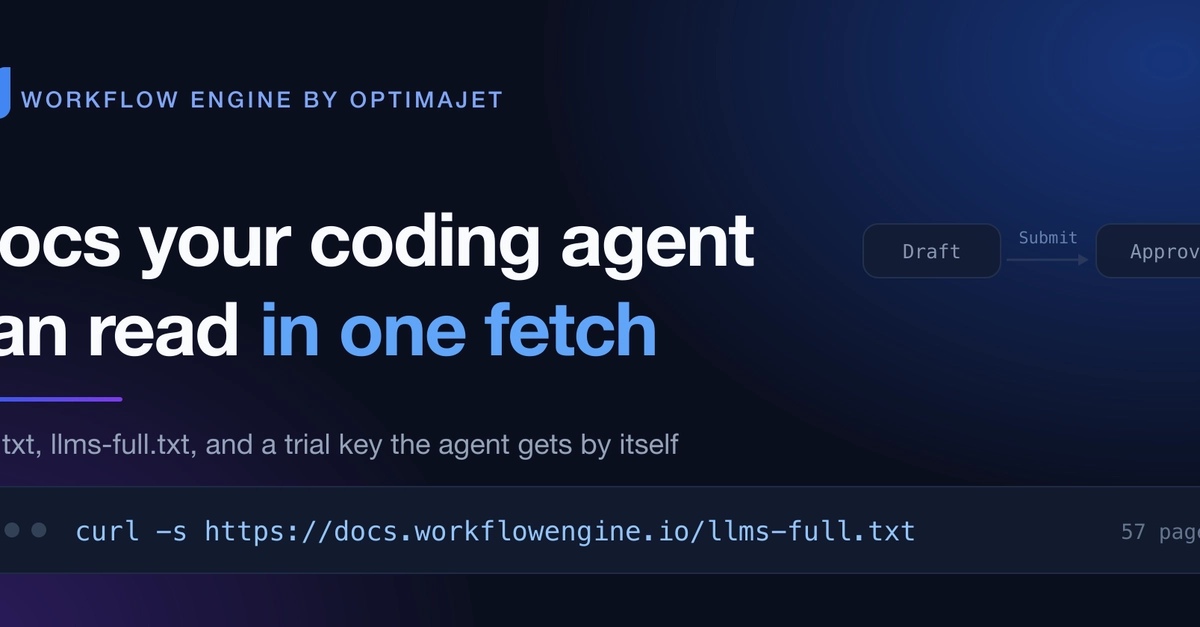
Optimajet, the team behind the Workflow Engine, has addressed this directly with a substantial overhaul of its documentation and licensing process. The newly released primary documentation, available at docs.workflowengine.io, is designed for machine readability. Unlike its predecessor, which was scattered across multiple pages, the new documentation publishes its full text as a single file. This allows AI agents to ingest the entire documentation set in one request, providing a comprehensive understanding of the engine’s capabilities and integration points without the need for piecemeal requests or guesswork.
This consolidated documentation is a critical step towards enabling true AI-driven integration. By presenting all necessary information in a single, accessible format, AI models can parse and understand the API, library structure, and operational requirements more effectively. This dramatically reduces the likelihood of generating code that references phantom methods or misunderstands core functionalities.
Automating the License Key Acquisition
The most significant barrier for AI integration has been the manual process of obtaining essential credentials, such as license keys. Traditionally, this involved a human navigating a vendor’s website, filling out a form, and often verifying their identity via email. This workflow is entirely opaque to an AI agent.
Optimajet has re-architected this process. A trial key can now be programmatically obtained by an agent without human intervention. This means the AI doesn't just generate code; it can also acquire the necessary components to make that code functional, at least for a trial period. This automation is akin to giving the AI agent a key to the front door, rather than just showing it a blueprint of the building. It moves AI from a code-generation tool to an integration assistant.
This capability is not about replacing developers entirely, but about augmenting their workflows. For routine integration tasks, an AI agent can now handle the boilerplate code generation, API calls, and even the initial setup of credentials. This frees up developers to focus on more complex logic, architectural decisions, and fine-tuning the workflow engine’s behavior to meet specific business requirements. The remaining tasks, such as detailed configuration, advanced error handling, and deployment, still require human oversight and expertise. The documentation itself is extensive, covering 57 pages across four main sections, indicating the depth of the system that AI can now begin to interact with more autonomously.
What This Means for Developers and AI Agents
The implications for .NET developers are substantial. Projects that previously required significant manual effort to integrate a workflow engine can now leverage AI agents to accelerate the initial setup. This means faster development cycles, reduced time-to-market for applications requiring complex business process automation, and potentially lower development costs.
For AI agents, this represents a leap forward in their practical utility. Moving beyond generating isolated code snippets, they can now participate in a more complete integration lifecycle. The ability to ingest comprehensive documentation and programmatically acquire necessary resources signals a new era of AI as a collaborator in software development. This also sets a precedent for other software vendors: to fully leverage AI integration, documentation must be machine-readable and interactive processes, like licensing, must be automatable.
The shift is from AI as a code writer to AI as a workflow implementer. Developers can prompt their AI agents with high-level requirements, and the agent, armed with Optimajet's new documentation and automated licensing, can generate functional integration code. This reduces the cognitive load on developers, allowing them to concentrate on the strategic aspects of their applications rather than the tactical minutiae of library integration. The success of this approach hinges on the clarity and completeness of the machine-readable documentation, which Optimajet appears to have prioritized.