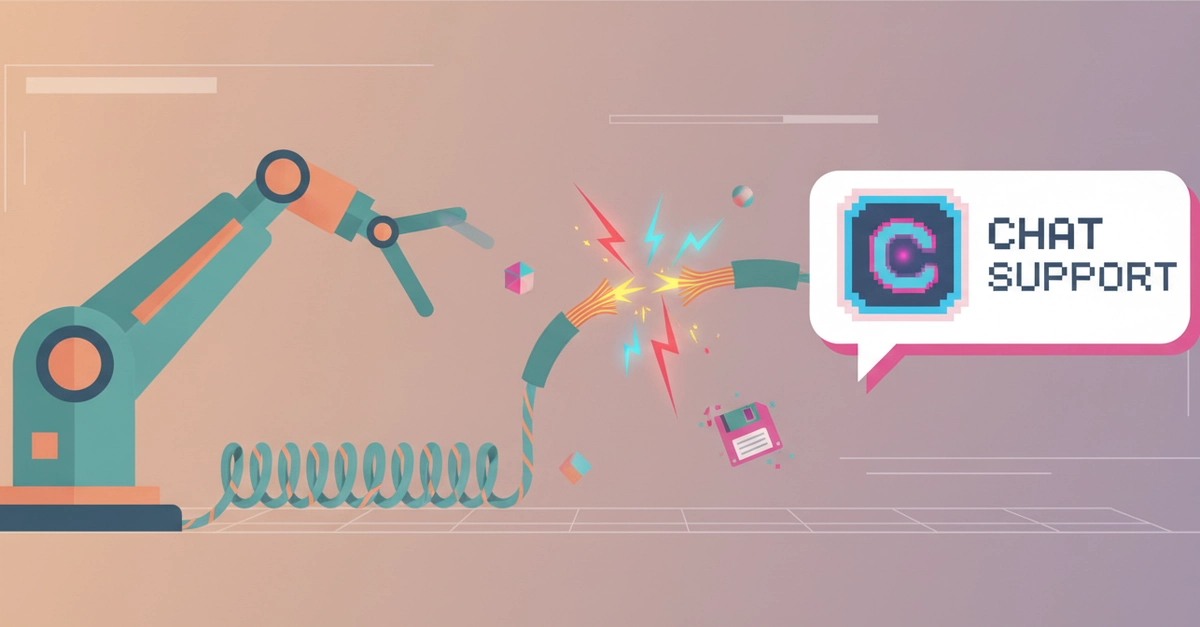
The Demo Effect: Why Prototypes Fail in Production
The gap between a polished AI agent demo and a production-ready system is vast, and it’s not primarily a coding problem. Developers often focus on architectural choices like LangGraph versus CrewAI, selecting the right vector store, or optimizing prompt chaining. While these technical aspects are important, they pale in comparison to the fundamental challenge of handling unpredictable human interaction. The core issue is that demos are built for builders, not for the general public. You, the developer, know how to talk to the agent. You phrase your requests clearly, avoid typos, ask one question at a time, and don’t leave the conversation hanging for extended periods. Real users, however, do the opposite. They ask multiple questions at once, use ambiguous language, make typos, go silent for minutes, and then expect the agent to pick up exactly where they left off, or worse, ask “idk just fix it.” This fundamental disconnect between controlled demo environments and uncontrolled user behavior is the single biggest hurdle to shipping functional AI agents.
User Expectations vs. Agent Capabilities
When users interact with AI agents, they often bring expectations shaped by human-to-human communication. They anticipate a level of understanding, context retention, and error correction that current AI agents struggle to provide consistently. A user might ask a follow-up question that implicitly relies on information from several turns ago, or they might use slang or colloquialisms that the agent’s natural language processing (NLP) hasn’t been trained to interpret. The agent’s inability to gracefully handle these nuances leads to frustration and system failure. This isn’t a bug in the prompt or a weakness in the chosen orchestration framework; it’s a limitation in the agent’s ability to model and respond to the full spectrum of human communication styles and intentions.
The Cost of Ambiguity and Silence
Real-world conversations are messy. Users don’t always provide explicit commands. They might type “idk just fix it,” leaving the agent with no clear directive. This ambiguity is a significant failure point. An agent designed for precise instructions will stall or error out when faced with such vagueness. Similarly, user silence poses a challenge. If a user steps away from the chat for ten minutes, the agent might lose context, or worse, continue to generate responses that are no longer relevant when the user returns. Maintaining state and context across prolonged periods of user inactivity is a complex problem that goes beyond typical session management. It requires sophisticated dialogue management and potentially proactive user engagement to confirm continued relevance.
Beyond Architecture: The Human Factor in Agent Design
The focus on agent architecture, while necessary, distracts from the more pressing, human-centric challenges. Building robust AI agents requires a deep understanding of user psychology and interaction design. This means implementing features like:
- Error Handling and Fallbacks: Instead of crashing, agents need intelligent fallback mechanisms. This could involve asking clarifying questions, offering a menu of options, or escalating to a human agent.
- Contextual Awareness: Agents must be able to recall and utilize information from earlier in the conversation, even if the user doesn't explicitly reference it. This requires robust memory systems and sophisticated context tracking.
- Graceful Degradation: When an agent encounters a query it cannot handle, it should fail gracefully rather than abruptly. This means acknowledging the limitation and guiding the user toward a resolution, perhaps by suggesting alternative approaches or providing contact information for support.
- Onboarding and Guidance: Users need to be guided on how to interact effectively with the agent. Clear instructions, examples, and proactive prompts can significantly reduce user error and frustration.
The Real Bottleneck: User Interface and Experience
The user interface (UI) and user experience (UX) are critical components that are often overlooked in the technical discussions surrounding AI agents. A poorly designed interface can exacerbate user confusion and lead to errors, even if the underlying agent logic is sound. For instance, if an agent requires specific formatting for input, but the UI doesn’t make this clear, users will struggle. Similarly, if the agent’s responses are too verbose or lack clear calls to action, users might disengage. Think of it less like writing code and more like designing a user-friendly appliance. You can have the most advanced engine, but if the controls are confusing and the feedback is unclear, nobody will use it effectively.
What Nobody Has Addressed: The Long Tail of Edge Cases
While developers focus on common interaction patterns, the real world is defined by its long tail of edge cases. These are the bizarre, unexpected, and often illogical queries that users will inevitably throw at the system. A customer might try to use the chatbot to order a pizza from a software company, or ask it to write a poem about their cat. These inputs, while seemingly nonsensical, are real user behaviors. Preparing for this long tail requires extensive testing with diverse user groups and building agent architectures that are resilient to nonsensical inputs, perhaps by incorporating content filters or intent recognition that can identify and reject out-of-scope requests.
The Path Forward: Prioritizing Human-Centric Design
Shipping AI agents that work means shifting the focus from purely technical architecture to a holistic approach that prioritizes user experience and human interaction design. This involves anticipating user behavior, designing for ambiguity, building robust fallback mechanisms, and creating intuitive interfaces. The success of an AI agent in the real world hinges not on its ability to execute complex chains of prompts, but on its capacity to understand and adapt to the messy, unpredictable, and often illogical nature of human communication. If you're building AI agents for actual customers, start by asking not “Can it work?” but “How will users break it?” and design for that reality from day one.