AI Agents Revolutionize Customer Support with Autonomous Resolution
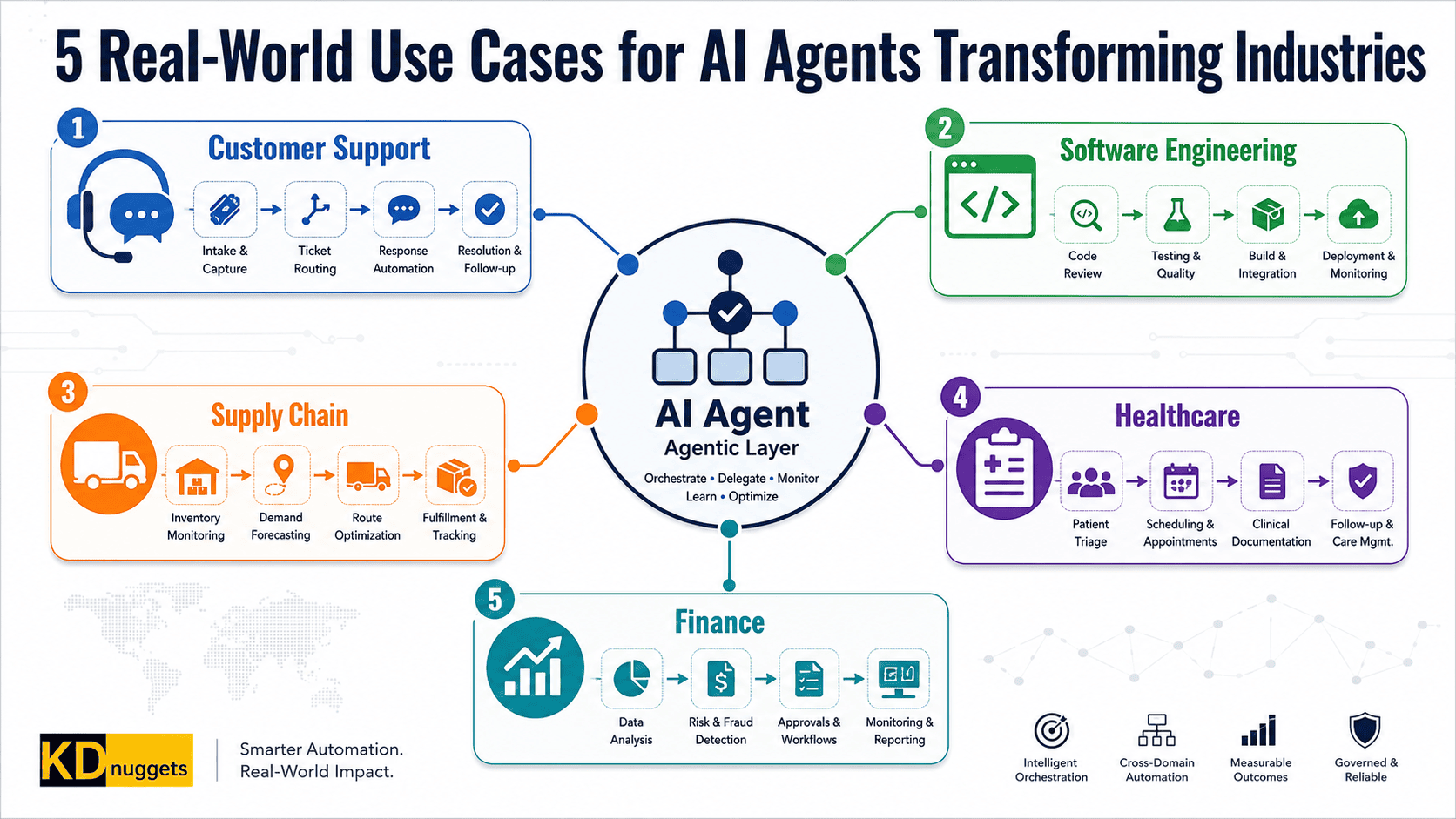
Customer support is a prime candidate for AI agent transformation. Instead of merely routing queries or providing pre-scripted answers, AI agents are now capable of understanding complex customer issues, diagnosing problems, and autonomously executing solutions. This includes tasks like troubleshooting software glitches, processing returns, and even escalating issues with full context to human agents when necessary. The key here is the agent's ability to maintain context across multiple interactions and access various internal systems (like CRM, order management, and knowledge bases) to resolve issues end-to-end. This not only speeds up resolution times but also frees up human support staff to handle more nuanced or high-stakes customer interactions, improving overall customer satisfaction and operational efficiency.
Consider an AI agent tasked with handling a billing dispute. It can access the customer's account, review past invoices, identify the discrepancy, cross-reference it with service usage logs, and then automatically issue a credit or adjustment. The entire process, from initial customer contact to final resolution, can occur without human intervention. This level of autonomy is a significant leap from traditional chatbots, which often get stuck in loops or require constant human handoffs. The agents learn from each interaction, continuously improving their problem-solving capabilities and expanding the range of issues they can address.

AI Agents Accelerate Software Development and Code Generation
The software development lifecycle is another area where AI agents are proving transformative. Beyond simple code completion tools, AI agents can now understand project requirements, generate entire code modules, write unit tests, and even refactor existing codebases. They can be tasked with specific coding challenges, such as optimizing a particular function for performance or migrating a legacy system to a modern framework. These agents can analyze code for bugs, security vulnerabilities, and style inconsistencies, acting as a tireless pair programmer. Furthermore, they can automate the deployment process and monitor applications in production, flagging and even fixing issues proactively.
For developers, this means a significant shift in workflow. Instead of spending hours on repetitive coding tasks or debugging, they can focus on higher-level architectural design, problem-solving, and innovation. AI agents can act as intelligent assistants, translating natural language descriptions of desired functionality into executable code. They can also help onboard new developers by providing context on existing codebases and suggesting relevant code snippets. The ability of these agents to understand and interact with complex code repositories, version control systems, and CI/CD pipelines marks a new era in software engineering, promising faster development cycles and higher quality software.
Optimizing Supply Chains with Intelligent, Autonomous Agents
Supply chain management, with its intricate network of suppliers, logistics, and demand forecasting, is a complex domain ripe for AI agent intervention. AI agents can monitor inventory levels in real-time, predict demand fluctuations with greater accuracy, and autonomously reorder stock or adjust production schedules. They can optimize shipping routes, identify potential disruptions (like weather events or port congestion), and reroute shipments proactively to minimize delays and costs. These agents can also manage supplier relationships, track shipments from origin to destination, and ensure compliance with regulations.
The benefit is a more resilient, efficient, and cost-effective supply chain. By analyzing vast amounts of data from sensors, market trends, and historical performance, AI agents can make informed decisions that humans might miss or take too long to process. Imagine an agent that detects a surge in demand for a specific product in a particular region and automatically triggers a production increase, arranges for expedited shipping, and updates inventory forecasts across the entire network. This level of dynamic, real-time optimization is crucial for businesses operating in today's volatile global market, helping them avoid stockouts, reduce waste, and improve delivery times.
Transforming Healthcare: From Diagnostics to Patient Care
In healthcare, AI agents are beginning to play crucial roles in improving patient outcomes and streamlining clinical operations. They can assist in medical image analysis, flagging potential anomalies for radiologists to review, thus improving diagnostic accuracy and speed. AI agents can also monitor patient vital signs remotely, alerting healthcare providers to critical changes and enabling early intervention. For administrative tasks, they can automate appointment scheduling, manage patient records, and process insurance claims, reducing the burden on medical staff. Furthermore, AI agents can personalize treatment plans by analyzing a patient's genetic data, medical history, and response to previous treatments.
The potential impact on healthcare is profound. AI agents can help democratize access to specialized medical knowledge, support overworked clinicians, and accelerate medical research by analyzing large datasets of patient information. For instance, an agent could sift through thousands of research papers to identify potential drug interactions or suggest novel therapeutic approaches based on emerging findings. While human oversight remains critical in healthcare, AI agents can act as powerful tools to augment human capabilities, leading to more precise diagnostics, more effective treatments, and more efficient healthcare systems. The surprising detail here is not just the speed of analysis, but the ability to synthesize disparate data points into actionable medical insights.
Enhancing Fraud Detection and Cybersecurity with Proactive Agents
Financial institutions and e-commerce platforms are leveraging AI agents to combat fraud with unprecedented effectiveness. These agents can analyze transaction patterns in real-time, identifying anomalies that indicate fraudulent activity far faster and more accurately than traditional rule-based systems. They can detect sophisticated fraud schemes by learning from new attack vectors and adapting their detection models continuously. Beyond financial fraud, AI agents are also being deployed in cybersecurity to monitor network traffic, detect intrusions, and even respond to threats autonomously by isolating infected systems or blocking malicious IP addresses.
The benefit is a significant reduction in financial losses and enhanced security for both businesses and consumers. AI agents can process millions of transactions per second, flagging suspicious activities that might escape human detection. They can also learn to distinguish between genuine but unusual behavior and actual fraud, reducing false positives. This proactive approach is essential in an environment where cyber threats are constantly evolving. The question that remains is how quickly these agents can adapt to entirely novel, zero-day attack vectors that have no prior data footprint.