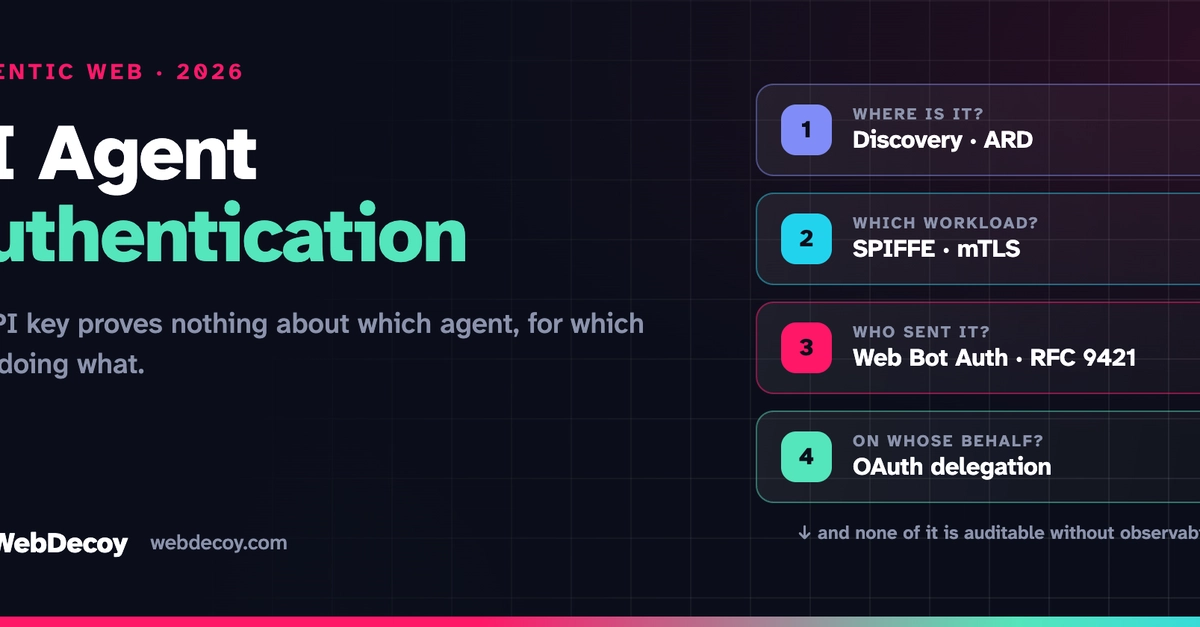
The Multi-Layered Challenge of AI Agent Authentication
AI agent authentication is not a singular protocol. It is a complex stack, addressing multiple facets of an agent's operational lifecycle. By 2026, the industry is coalescing around a set of standards and specifications that tackle these distinct needs. An agent may need to discover available tools, prove its workload identity, authenticate an HTTP request, demonstrate delegated user authority, and meticulously log its actions for auditability. Treating any single protocol as a complete solution creates critical identity gaps, leaving systems vulnerable and operations opaque.
Google's announcement of the open Agentic Resource Discovery (ARD) specification in early 2026 marked a significant step. ARD aims to standardize how agents find and verify each other's capabilities and resources. This is crucial for dynamic environments where agents need to locate and integrate with a variety of services and tools on demand. Think of ARD as the agent's intelligent GPS and a verified driver's license rolled into one, ensuring it knows where to go and that it's authorized to operate there.
Agentic Resource Discovery (ARD) Specification
The Agentic Resource Discovery specification, championed by Google, provides a standardized way for AI agents to query and understand the capabilities of other agents or services. This is not about authentication itself, but about the prerequisite for it: discovery and capability verification. Before an agent can attempt to use a tool or service, it must first be able to find it and understand what it does. ARD defines mechanisms for agents to advertise their services and for other agents to discover them in a structured, machine-readable format. This reduces the need for brittle, hardcoded integrations and enables more flexible and dynamic agent ecosystems.
This specification is critical for building robust multi-agent systems. Without a standardized discovery mechanism, agents would rely on ad-hoc methods or central registries that become bottlenecks. ARD promotes a more decentralized and resilient approach, allowing agents to discover resources dynamically as needed.
Web Bot Authentication (WebAuthn for Bots)
While ARD handles resource discovery, Web Bot Authentication, often conceptualized as an extension of WebAuthn principles to non-human entities, addresses the authentication of HTTP requests made by agents. This is essential for securing API interactions. Traditional WebAuthn is designed for user authentication, but its underlying cryptographic principles can be adapted for machine-to-machine communication. The goal is to provide strong, phishing-resistant authentication for agents making requests to services.
This involves using cryptographic key pairs associated with the agent's workload identity. When an agent makes a request, it cryptographically signs the request with its private key. The receiving service can then verify this signature using the agent's public key, confirming the origin and integrity of the request. This moves beyond simple API keys, which are often static and can be compromised, towards a more secure, dynamic, and auditable authentication mechanism. The challenge here lies in managing these keys securely for potentially thousands or millions of ephemeral agents.
OAuth 2.0 and Delegated Authority
OAuth 2.0 continues to be a cornerstone for managing delegated user authority. In the context of AI agents, this means an agent acting on behalf of a user must prove it has been explicitly granted permission to do so. OAuth flows, such as the Authorization Code Grant or the newer Proof Key for Code Exchange (PKCE) for public clients, are adapted to allow agents to obtain access tokens that represent the user's consent. This ensures that agents do not operate with excessive privileges and that their actions are traceable back to a human user's delegation.
The complexity arises when agents need to manage multiple delegations or operate in scenarios where direct user interaction for authorization is not feasible. New profiles or extensions of OAuth may emerge to handle these specific agent-centric authorization patterns. The key principle remains: explicit consent and granular scope management. An agent requesting access to a user's email, for example, must obtain a specific token for that purpose, rather than a broad token granting access to all user data.
Workload Identity and Credential Management
Underpinning these protocols is the concept of Workload Identity. This refers to the identity of the software process or agent itself, distinct from any human user. Managing credentials for these workloads is paramount. Solutions like SPIFFE/SPIRE or cloud-provider-specific workload identity services provide a framework for issuing verifiable credentials to agents. These credentials can then be used to authenticate the agent to other services, proving its identity and trustworthiness.
The IETF Internet-Draft on AI agent authentication, proposed in 2026, seeks to formalize an architecture for agent credentials, workload identity, and delegated user authority. This draft aims to unify these concepts, providing a cohesive model for how agents should manage their identities and permissions. It acknowledges that a single credential type is insufficient and proposes a layered approach, similar to the overall stack concept.
The Path Forward: Interoperability and Auditability
The convergence on ARD, Web Bot Auth principles, and robust OAuth flows, supported by strong workload identity management, signifies a maturation in AI agent security. The critical requirement now is interoperability between these components. An agent must seamlessly leverage ARD to find a service, use Web Bot Auth principles to authenticate its request, and rely on OAuth to demonstrate user delegation, all while its workload identity is securely managed. This creates a verifiable chain of trust and action. The ultimate goal is not just secure authentication but also comprehensive auditability, allowing for the reconstruction of agent actions and the attribution of responsibility.
What nobody has addressed yet is the operational overhead of managing these diverse authentication mechanisms at scale. For organizations deploying thousands of agents, the complexity of key rotation, policy management, and continuous monitoring across ARD, WebAuthn-like signatures, and OAuth token lifecycles presents a significant engineering challenge. This will likely drive the development of specialized platforms and tools dedicated to AI agent identity and access management.