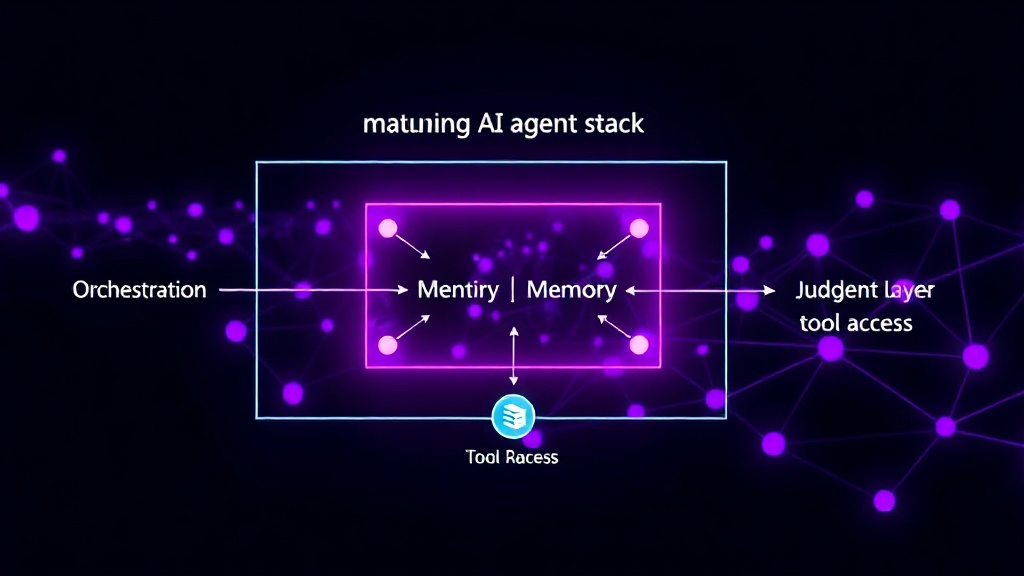
The Maturing Agent Stack
The foundational components for enterprise AI agents are rapidly solidifying. Over recent days, several seemingly disparate developments have converged, painting a clear picture of a maturing agent ecosystem. Cloudflare's open-sourcing of its internal agent workspace platform, research into the temporal challenges of agent action authorization, and a shift in enterprise AI discourse from deployment numbers to measurable value all point to a growing sophistication in how we build and deploy AI agents. This is further underscored by burgeoning infrastructure dedicated to agent identity, secure tool access, robust observability, and runtime isolation. These elements collectively form what can be considered the 'agent stack' – the essential plumbing for creating and managing autonomous or semi-autonomous AI systems within organizations.
The rapid development of this stack is akin to the early days of cloud computing. Just as developers needed reliable compute, storage, and networking before they could build complex applications, AI teams now require stable platforms for agent orchestration, memory management, and secure interaction with external tools. Cloudflare's contribution, for instance, provides a blueprint for how an organization can manage its internal AI agents, offering a potential template for others. Simultaneously, academic work on the nuances of agent decision-making under dynamic conditions highlights the deepening understanding of the complex challenges involved. This research is crucial because it addresses the very core of what makes an agent useful: its ability to act reliably in real-world, ever-changing environments.
The shift in conversation from sheer agent deployment to demonstrable value is a critical indicator of market maturity. Early enthusiasm for AI agents often focused on the novelty of autonomous systems. Now, businesses are demanding tangible ROI. This means agents must not only perform tasks but do so efficiently, accurately, and in alignment with business objectives. This demand is driving the development of more sophisticated tooling around observability and security. Teams need to understand *why* an agent made a particular decision, *what* its impact was, and *how* to prevent unintended consequences. This is where the concept of the 'judgment layer' becomes paramount.
The Unresolved 'Judgment Layer'
While the agent stack provides the infrastructure, the 'judgment layer' represents the AI's capacity for sophisticated, context-aware decision-making. This layer is responsible for evaluating situations, weighing potential outcomes, and selecting the optimal course of action. It’s the difference between an agent that can blindly execute a command and one that can intelligently adapt to unforeseen circumstances. The problem is that current AI models, while powerful, often struggle with nuanced judgment, especially when faced with ambiguity, ethical considerations, or rapidly changing state information.
Consider the research on agents authorizing actions based on state that changes before execution. This isn't a minor bug; it's a fundamental challenge in temporal reasoning and state management. An agent might decide to send an email based on information available at time T, but by the time the action is executed at time T+1, the context may have shifted entirely. Without a robust judgment layer capable of re-evaluating the decision in light of new information, the agent could perform an action that is now irrelevant or even detrimental. This is like a chef deciding to add salt based on a recipe, only to realize mid-stir that the dish already contains a high-sodium ingredient – a simple mistake for a human, but a complex failure for an unguided AI.
The current approach often relies on pre-programmed rules, extensive fine-tuning, or complex prompt engineering to guide agent behavior. However, these methods have limitations. Rule-based systems are brittle and cannot handle novel situations. Fine-tuning requires vast amounts of labeled data, which is expensive and time-consuming to create. Prompt engineering, while powerful, can be inconsistent and prone to