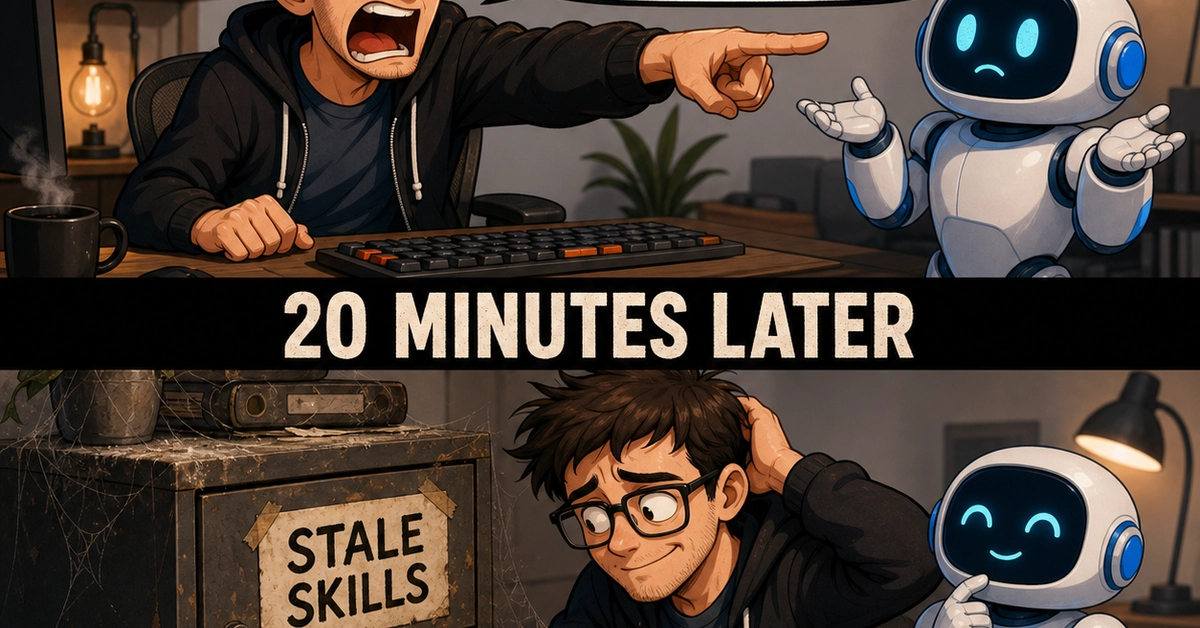
The Illusion of Model Degradation
When advanced AI models like Claude Opus 5 and GPT-5.6 roll out, developers often expect a performance boost in their AI-powered workflows. However, a common, yet counterintuitive, experience is that some custom agent workflows actually feel worse. They can become more eager, less predictable, and even appear less capable than before. The immediate, and often incorrect, conclusion is that the new models themselves have degraded in performance.
This sentiment was echoed by the author of the original piece, who initially blamed the new models for a perceived decline in their coding agents' effectiveness. This reaction, while understandable, overlooks a critical aspect of AI agent development: the dynamic nature of the underlying models and the imperative to keep custom configurations aligned with them.

Skill Stagnation: The Real Culprit
The key insight comes from observing the evolution of AI development, particularly the idea that when an agent fails, the capability likely still exists within the model. The issue often lies not with the model's fundamental intelligence, but with how we interact with it. Andrej Karpathy's commentary on the No Priors podcast highlighted this: agent failures can stem from poor instructions, insufficient memory provision, or suboptimal workflow arrangements.
This perspective prompts a crucial self-assessment: are the custom skills and prompts developed for older models still compatible with newer, more sophisticated architectures? The rapid pace of AI advancement means that prompts designed for a specific model version might contain outdated assumptions, conflicting instructions, or inefficient phrasing that newer models interpret differently, leading to suboptimal results. What was once an effective instruction can become a constraint.
Auditing Your Custom Skills
To address this, a systematic audit of existing custom skills is essential. This process involves scrutinizing each prompt and skill for:
- Stale Prompts: Instructions that were effective for older models but are now redundant or less efficient.
- Conflicting Instructions: Prompts that may contain ambiguities or contradictory directives that newer models struggle to resolve.
- Outdated Assumptions: Underlying beliefs about how the model should behave or what information it possesses that no longer hold true.
- Simplification Opportunities: Areas where prompts can be made more concise, clear, and direct for better model comprehension.
- Redundant Skills: Custom functions or logic that are now natively handled by the updated models.
Consider the prompt provided in the source material as a template for this audit:
Can you audit our custom skills against the current models? Flag stale prompts, conflicting instructions, outdated assumptions, and anything that should be simplified or removed. Then, suggest optimized versions for the latest model capabilities.
This type of meta-prompt encourages the AI itself to analyze its own operational parameters and identify areas for improvement. It’s akin to asking an experienced employee to review their own job description against current company needs.
Rethinking Agent Workflows
Beyond individual prompts, the overall workflow architecture requires re-evaluation. Newer models may have enhanced capabilities in areas like context management, reasoning, and multi-step task execution. Workflows that previously relied on breaking down complex tasks into many small, explicitly guided steps might now be achievable with more concise instructions and a greater degree of trust in the model's inherent abilities.
For instance, if an agent previously required a detailed, step-by-step prompt to generate a piece of code, a newer model might be able to produce the same output with a higher-level, more abstract instruction. The challenge then becomes understanding the new model's strengths and adapting the workflow to leverage them, rather than forcing it to operate within the constraints of an older paradigm.
The Human Element in AI Agent Development
Ultimately, the perceived