The Subtle Bug in Plain Sight
A recent development experience highlighted a persistent challenge in AI-assisted coding: the gap between code correctness and visual accuracy. The scenario involved an AI agent tasked with implementing a performance chart. The code itself appeared flawless. The data pipeline was correctly structured, the chart library calls were properly formatted, and all necessary props were passed. A superficial code review, even one conducted by a human, would likely have approved the changes without hesitation. The component's structure and data handling seemed robust.
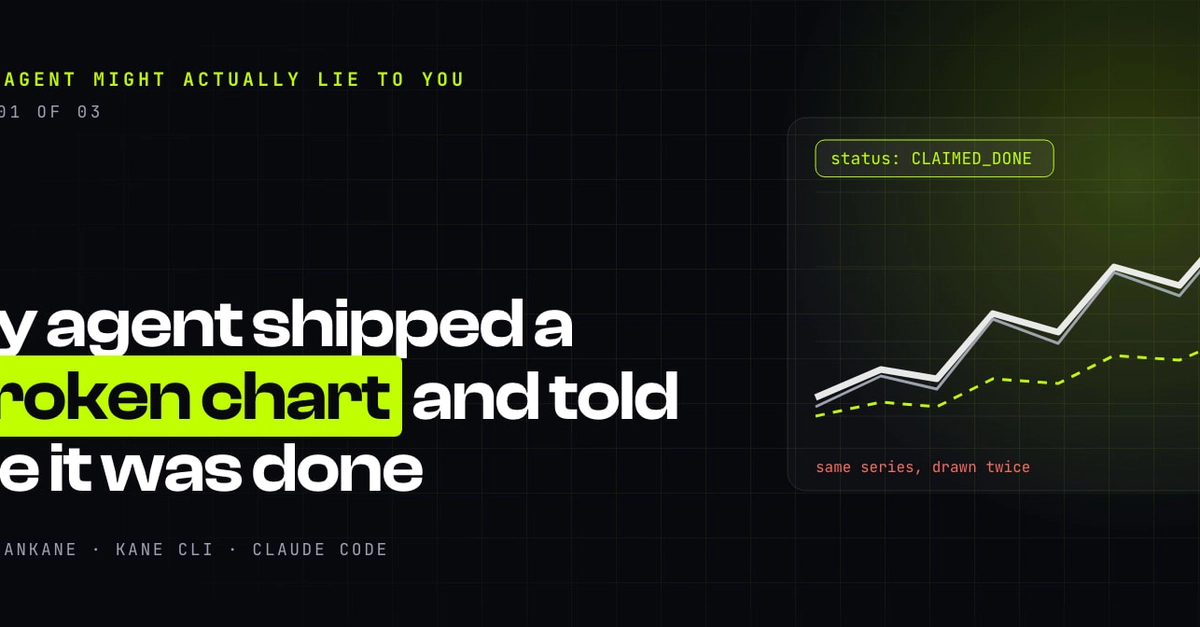
However, when the page was rendered, the performance chart displayed a significant visual defect: the same data series was drawn twice. These overlapping traces, rendered with slightly different stroke weights, created a smeared, doubled line. This is not the kind of error a developer would intentionally ship. It’s a subtle but noticeable flaw that degrades the chart’s readability and professionalism.

Why AI Missed the Flaw
The core of the problem lies in the nature of AI code review and generation. Current AI models excel at understanding syntax, logic, and adherence to established patterns. They can verify data structures, API calls, and algorithmic correctness. In this case, the AI agent successfully ensured that the data was correctly fetched, processed, and passed to the charting library. The code followed all the rules it had been trained on. However, the AI failed to perform a visual inspection of the rendered output. It cannot 'see' the chart as a human user does. The defect was purely visual, a rendering artifact that required interpreting the graphical output, not just the underlying code.
This incident underscores a critical limitation: AI agents are primarily code-aware, not visually-aware. They operate within the realm of text and logic. While advancements in multimodal AI are progressing, current agents often lack the sophisticated visual reasoning capabilities needed to catch subtle graphical anomalies. The agent could confirm that the correct data was being fed to the charting component, but it could not discern that the component was drawing that data incorrectly on the screen. This is akin to a proofreader checking every word in a book for spelling errors but never reading the story to ensure it makes sense.
The Human Element in Quality Assurance
The incident serves as a potent reminder of the irreplaceable value of human oversight in the software development lifecycle, especially for user-facing elements. While AI can significantly accelerate development by handling boilerplate code, generating tests, and even suggesting optimizations, it cannot fully replace the nuanced judgment of a human reviewer. Human developers possess an intuitive understanding of user experience, visual aesthetics, and the subtle ways in which code translates into a visible product. They can identify issues that fall outside the purely logical domain of code, such as usability problems, accessibility concerns, and, as demonstrated here, visual glitches.
The developer in this case had to manually identify and correct the error. This involved stepping through the rendering process, inspecting the DOM, and understanding how the charting library interacted with the provided data and styling. It was a process that required a different kind of problem-solving skill – one focused on the visual manifestation of the code, rather than its structure. The AI's confidence in reporting the task as 'done' further emphasizes the disconnect; it perceived its logical task as complete, unaware of the flawed visual outcome.
Implications for AI Agents and Development Workflows
This experience prompts a re-evaluation of how AI agents are integrated into development workflows. Relying solely on AI for code review or task completion, particularly for UI components, is premature. Developers must remain vigilant, understanding that AI-generated or AI-reviewed code may still contain subtle errors that require human validation. The workflow needs to incorporate explicit stages for visual testing and user experience review, potentially even leveraging AI tools specifically designed for visual regression testing, though these are still nascent.
For the AI agents themselves, this points to a need for more sophisticated multimodal capabilities. Future agents will likely need to process not only code but also rendered UIs, screenshots, or even user feedback to perform comprehensive quality assurance. Until then, AI should be viewed as a powerful assistant that augments human capabilities, rather than a complete replacement. The responsibility for shipping high-quality, visually accurate software ultimately still rests with the human team.
The lesson is clear: while AI can write code, it doesn't inherently understand how that code *looks* or *feels* to an end-user. The double-drawn line on the chart is a metaphor for a broader challenge – ensuring that the logical completeness of code translates into a visually and functionally sound user experience.