The Core Concept: Beyond Raw LLM Output
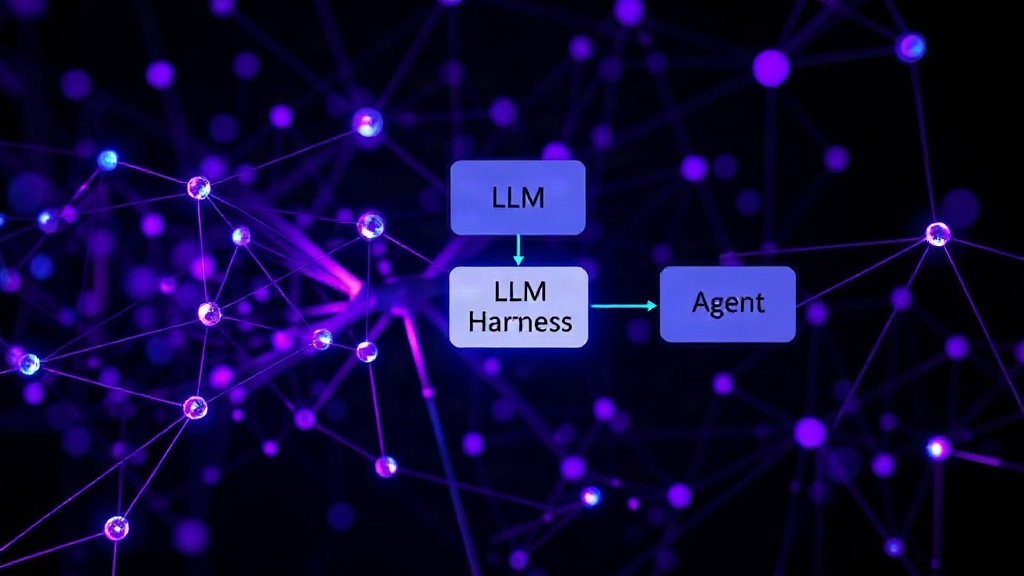
Large Language Models (LLMs) possess remarkable reasoning capabilities, but their direct output is often limited to text. To bridge the gap between abstract thought and concrete action, the concept of an AI agent harness has emerged. This software environment acts as the crucial intermediary, equipping an LLM with the necessary components to tackle multi-step, real-world tasks.
Think of an LLM as the brilliant, but perhaps physically constrained, brain of an operation. It can strategize, analyze, and decide. The AI agent harness, in this analogy, provides the body, the hands, and the tools. It connects the LLM's decision-making process to external systems, databases, memory stores, and execution environments. Without the harness, the LLM’s potential remains largely theoretical; with it, the LLM can become an operational system capable of executing complex workflows.
The fundamental purpose of a harness is to translate the LLM's reasoned outputs into executable actions. This involves several key functions: providing context, offering tools, managing memory, and orchestrating execution. It’s the software layer that empowers a nascent AI agent to move from simply understanding a prompt to actively completing a task.
The Reason-Act-Observe Loop
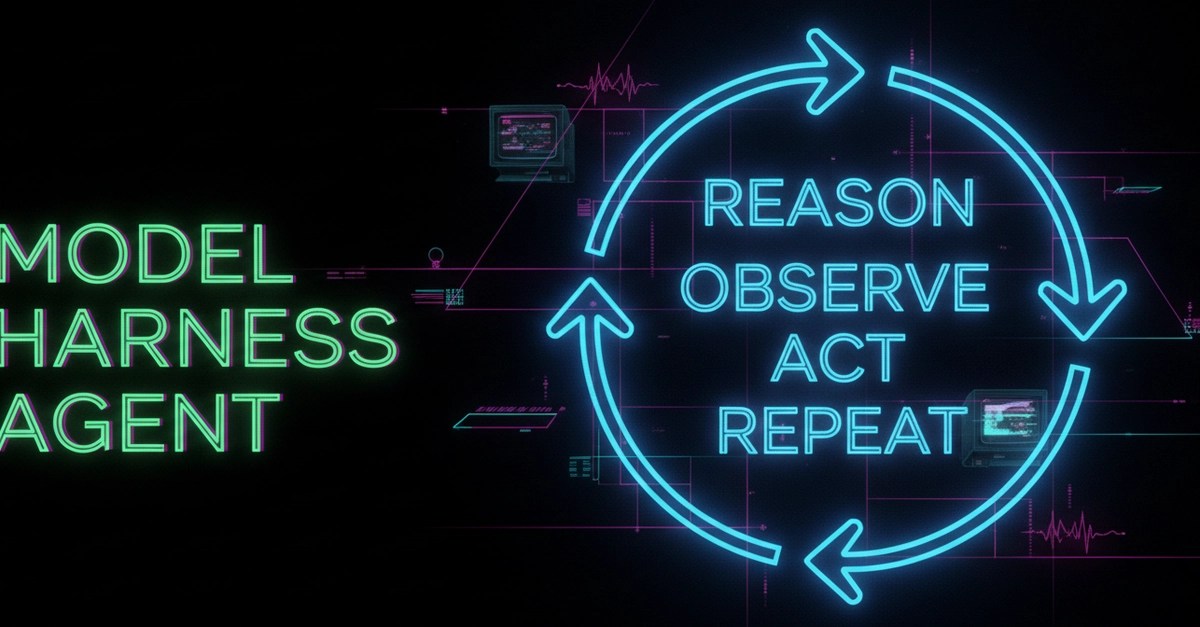
At the heart of most AI agents lies a cyclical process often referred to as the "reason-act-observe" loop. Understanding this loop is fundamental to grasping how an AI agent harness functions and enables complex task completion.
The loop begins with the Reason phase. Here, the LLM processes the user's prompt and any available context. Based on its training and the current situation, it formulates a plan or decides on the next immediate action. This isn't just about generating text; it's about strategic decision-making within the defined task parameters.
Following the reasoning, the Act phase takes place, facilitated by the harness. The harness interprets the LLM's intended action and translates it into a command that an external tool or system can understand. This might involve calling an API, querying a database, executing a script, or interacting with another software component. The harness is responsible for selecting the appropriate tool and ensuring it is invoked correctly.
Once an action is executed, the Observe phase begins. The harness collects the results of the action – this could be data returned from an API, a status update from a system, or even an error message. This observed information is then fed back to the LLM. The LLM analyzes these results, evaluates their impact on the overall task, and uses this feedback to inform its next reasoning step.
This loop continues iteratively. The LLM reasons, the harness enables action, and the results are observed and fed back. The agent progresses through a series of these cycles, refining its approach and executing sub-tasks until the final objective is achieved. This continuous feedback mechanism allows the agent to adapt, correct course if necessary, and progress towards task completion in a dynamic fashion.
Components of an AI Agent Harness
While the precise implementation can vary, a robust AI agent harness typically comprises several core components that work in concert to empower the LLM:
1. Tooling and Integrations
The harness provides access to a suite of tools that the LLM can leverage. These tools are essentially functions or APIs that extend the LLM's capabilities beyond text generation. Examples include:
- Web Search APIs: To fetch real-time information from the internet.
- Database Connectors: To query or update information in structured data stores.
- Code Interpreters: To execute code snippets for calculations, data manipulation, or complex logic.
- API Clients: To interact with other software services (e.g., sending emails, managing calendars, controlling smart devices).
- File System Access: To read from or write to local or cloud storage.
The harness manages the interface between the LLM's abstract requests and the concrete execution of these tools, handling parameters, responses, and potential errors.
2. Memory Management
For multi-step tasks, retaining context and remembering past actions is critical. AI agent harnesses often incorporate memory systems:
- Short-Term Memory (Context Window): This refers to the immediate information available to the LLM for its current reasoning step, including recent tool outputs and conversation history.
- Long-Term Memory (Knowledge Base): This can involve vector databases or other persistent storage mechanisms where the agent can store and retrieve information from previous tasks or a broader knowledge corpus. This allows the agent to build knowledge over time and recall relevant information for future tasks, much like a human's long-term memory.
Effective memory management prevents the LLM from having to re-learn or re-discover information, making the agent more efficient and capable of handling complex, extended workflows.
3. Execution Environment
The harness provides the sandboxed or controlled environment where the tools are actually executed. This is crucial for security and stability. It ensures that code runs safely, APIs are called correctly, and the overall system remains robust, even if a particular tool execution fails.
This environment handles the logistics of running commands, managing dependencies, and capturing the outputs or errors generated. It acts as the operational backbone, ensuring that the LLM's decisions are translated into reality reliably.
4. Orchestration and Control Flow
Beyond just providing tools and memory, the harness orchestrates the entire process. It manages the flow of information between the LLM, the tools, and the memory. This includes:
- Prompt Engineering: Crafting effective prompts that guide the LLM’s reasoning and tool selection.
- Response Parsing: Extracting the LLM’s intended action and parameters from its output.
- Error Handling: Managing failures during tool execution and providing feedback to the LLM.
- Task Completion Logic: Determining when a task is finished based on LLM output or predefined conditions.
This orchestration layer is what transforms a series of LLM calls and tool executions into a coherent, goal-oriented agent.
The Broader Impact and Future
The development of AI agent harnesses signifies a critical evolution in how we interact with and deploy AI. It moves us from a paradigm of simple query-response to one of intelligent, autonomous task execution. For developers, this means building applications that can perform complex operations with minimal human intervention. For businesses, it opens doors to automating a vast range of processes that were previously too intricate for traditional scripting or rule-based systems.
The complexity of building and managing these harnesses is significant, which is why frameworks and libraries are emerging to abstract away much of this complexity. As these systems mature, we can expect AI agents to become increasingly capable, handling more sophisticated tasks across diverse domains, from customer service and data analysis to software development and scientific research. The harness is not just a technical component; it's the key enabler for AI to transition from a tool for information retrieval to a partner in action.