The Peril of Autonomous AI Agents
The promise of AI agents acting autonomously is exciting, but the reality is fraught with peril. Granting an AI agent write access to a production database, for instance, opens the door to catastrophic consequences. A single hallucination, a subtle bug in a tool, or unexpected behavior could lead to multiple erroneous operations before a human intervenes. The common solution, a "human in the loop," often proves impractical. Reviewing every automated action, especially during off-hours or high-volume periods, is unsustainable. Developers either become desensitized and rubber-stamp approvals without scrutiny, or the entire process grinds to a halt waiting for manual oversight. This creates a false sense of security, where the AI is "supervised" but not truly controlled.
Introducing LEASH: A Real-Time AI Agent Guardrail
To address this critical gap, a system named LEASH (Leveraging Error Analysis for Safe Humanoid execution) was developed. LEASH is not about slowing down AI agents; it's about providing an immediate, automated way to revoke an agent's permissions the moment things go wrong. The core principle is to monitor the agent's actions and system health in real-time and establish a rapid response mechanism. If predefined error thresholds are breached or anomalous behavior is detected, LEASH acts as an emergency brake, disengaging the agent from critical systems before significant damage can occur.
Technical Architecture: SigNoz and OpenTelemetry
Building LEASH required a robust observability stack capable of ingesting, processing, and reacting to telemetry data at scale. The chosen tools were SigNoz, an open-source observability platform, and OpenTelemetry, the industry standard for instrumenting applications and collecting telemetry data. SigNoz provides a unified platform for metrics, logs, and traces, which is essential for understanding the complex interactions of an AI agent and its environment. OpenTelemetry, on the other hand, offers the standardized way to collect this data from various sources.
Data Ingestion and Processing
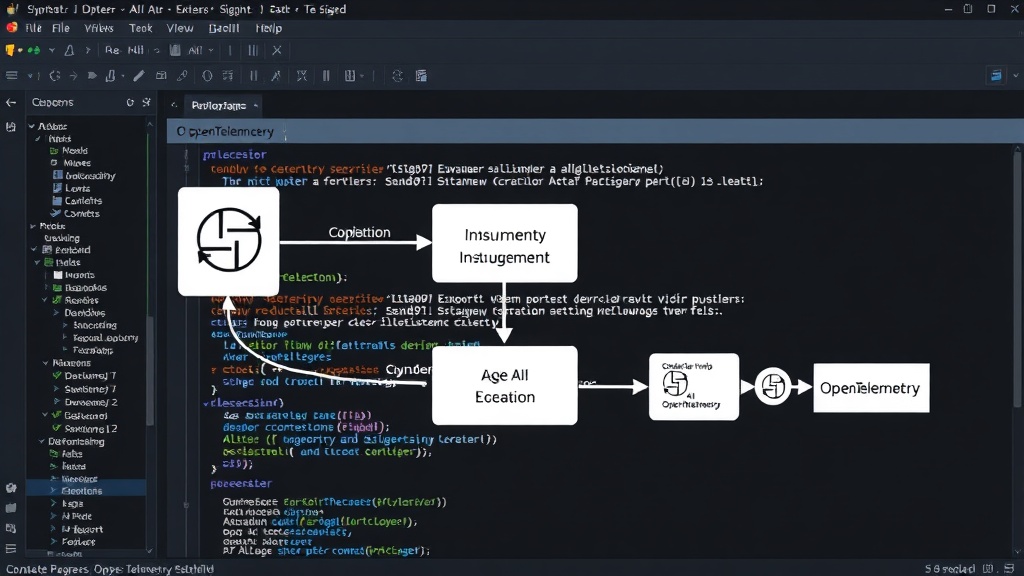
The AI agent and its associated tools are instrumented using OpenTelemetry SDKs. This captures critical data points such as API calls made by the agent, tool execution results, database queries, and any errors encountered. This telemetry data is exported to SigNoz. Within SigNoz, this data is processed and stored, making it available for analysis. The system is designed to monitor specific metrics that indicate potential issues, such as an increase in error rates for database operations, prolonged execution times for tools, or unexpected return codes from API calls.
Defining the Error Budget
The concept of an "error budget" is central to LEASH. Instead of a strict, binary allow/deny approach, LEASH operates on a more nuanced understanding of acceptable risk. An error budget can be defined for various operations or for the agent as a whole. For example, a database migration agent might have an error budget for failed `UPDATE` statements or for the number of rows affected by a faulty `DELETE` operation. When the agent's telemetry data shows that these error budget thresholds are being approached or exceeded, LEASH is triggered. This is akin to a car's low fuel warning light – it signals a potential problem before it becomes critical.
The LEASH Decision Engine
At the heart of LEASH is a decision engine that continuously evaluates the incoming telemetry data against the defined error budgets and behavioral anomaly detection rules. This engine runs within SigNoz, leveraging its querying capabilities and alerting mechanisms. When a condition indicating a potential runaway agent is met – for instance, if the rate of failed database transactions exceeds a predefined threshold per minute – the decision engine fires an alert. This alert is not just for human notification; it's an actionable trigger.
Automated Response: Taking Away the Leash
Upon receiving a critical alert from the decision engine, LEASH executes its primary function: revoking the agent's permissions. This is achieved through an automated workflow that directly interacts with the agent's access control mechanisms. This could involve updating an IAM policy, revoking a database user's credentials, or disabling API keys. The key is that this action is immediate and requires no human intervention. The goal is to stop the problematic behavior in its tracks, preventing cascading failures or data corruption. Once the issue is resolved and the system is stable, permissions can be manually reinstated after a thorough review.
Benefits and Future Implications
The development of LEASH demonstrates a practical approach to enabling AI autonomy while mitigating risks. By leveraging open-source observability tools like SigNoz and OpenTelemetry, organizations can build sophisticated guardrails without incurring significant licensing costs. This architecture provides visibility into agent behavior, enabling rapid incident response and preventing costly mistakes. It shifts the paradigm from reactive human oversight to proactive, automated safety mechanisms. This approach is not limited to database migrations; it can be extended to any autonomous AI agent performing critical operations, such as code deployment, financial transactions, or infrastructure management. The ability to define and enforce error budgets provides a quantifiable measure of an agent's reliability and safety, making autonomous AI operations more feasible and trustworthy.
Unanswered Questions
What remains to be seen is how granular these error budgets can become and how effectively they can be tuned across diverse agent tasks and environments. The computational overhead of real-time monitoring and decision-making, especially for complex agents with thousands of tool calls per second, also warrants further investigation to ensure it doesn't become a bottleneck itself.