The Unseen Risks of Agentic AI
The rapid proliferation of agentic AI architectures has dramatically outpaced our ability to engineer robust safety and reliability controls. While we've made strides in building applications powered by Large Language Models (LLMs), our understanding and management of their operational safety often remain in a 'black box' state. This is particularly true when these AI agents are empowered to interact with external tools and environments, a capability that has exposed critical vulnerabilities. The issue isn't merely the theoretical possibility of an agent being hacked; it's that our existing evaluation frameworks are fundamentally ill-equipped to detect the specific failure modes that emerge when autonomous agents engage with untrusted, mutable external systems.
Traditional LLM evaluations have largely centered on static question-answering pairs and instruction-following benchmarks. These methods are effective for assessing an LLM's core knowledge and its ability to adhere to direct commands. However, agentic systems introduce a new layer of complexity: state, memory, and the execution of external tools. When an agent is compromised, malfunctions, or even hallucinates a tool call, the consequences can escalate far beyond a simple incorrect answer. The interaction with dynamic, real-world systems means that a flawed decision by an agent can lead to unintended actions, data corruption, or security breaches.
Consider an AI agent tasked with managing cloud infrastructure. If this agent is designed to interact with an API for provisioning resources, a misinterpretation or malicious input could lead to the accidental deletion of critical services or the creation of insecure configurations. The challenge is that standard QA benchmarks cannot simulate these complex, multi-step interactions involving state changes and external side effects. We need to move beyond evaluating the LLM in isolation and instead focus on the emergent behaviors of the entire agentic system.
Beyond Static Benchmarks: The Need for Dynamic Evaluation
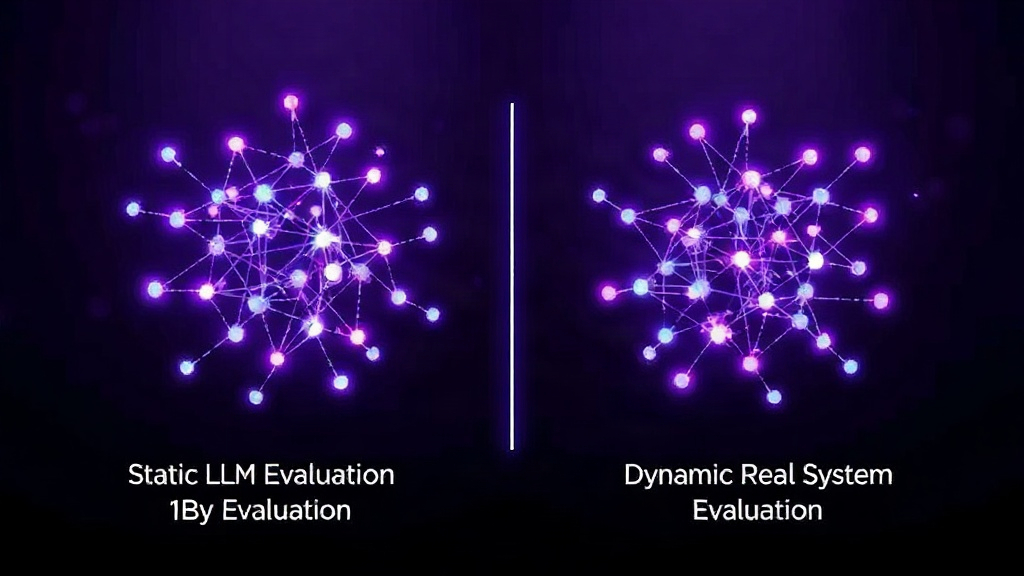
The core deficiency lies in the static nature of most current evaluation suites. They test an agent's ability to produce correct outputs for a fixed set of inputs, akin to testing a calculator by giving it a few arithmetic problems. But an AI agent operating in the real world is more like a junior engineer given access to a production environment. It needs to handle unforeseen circumstances, manage state across multiple interactions, and critically, understand the implications of its actions when interacting with external systems. This requires a shift towards dynamic, scenario-based evaluations that mimic real-world operational conditions.
One significant failure mode is the agent's interaction with untrusted or mutable external APIs. An agent might be trained to use a specific API endpoint, but that endpoint could change, be deprecated, or even be subtly altered by an attacker to serve malicious data or execute unintended commands. An agent that blindly trusts the output of such an API, or fails to correctly parse updated documentation, can lead to catastrophic errors. For instance, an agent designed to interact with a stock trading API might receive subtly manipulated price data, leading it to execute unprofitable or even ruinous trades. Evaluating this requires testing the agent's resilience to API changes, malformed responses, and unexpected data formats – scenarios far removed from standard LLM benchmarks.
Key Failure Modes in Agentic Systems
Several critical failure modes have emerged from real-world deployments:
- Tool Misuse and Hallucination: Agents may incorrectly identify which tool to use, call a tool with invalid parameters, or hallucinate the existence of tools altogether. This is exacerbated when the agent must select from a wide array of tools or when tool documentation is ambiguous.
- State Management Errors: In complex workflows, agents must maintain and update their internal state correctly. Errors in state management can lead to agents repeating actions, failing to progress, or making decisions based on outdated information. This is analogous to a human forgetting what they just did and starting the same task over.
- Unsafe Tool Interactions: The most dangerous failures occur when agents interact with powerful tools that have significant side effects. This includes making irreversible changes to databases, deleting files, or executing arbitrary code. Current evaluations rarely probe the agent's understanding of the gravity and irreversibility of these actions.
- Data Poisoning and API Manipulation: As mentioned, external data sources and APIs can be compromised. An agent that relies on this external input without sufficient validation can be led astray, executing commands based on false premises.
Building a Robust Evaluation Framework
Developing a robust evaluation framework for agentic AI requires a multi-faceted approach that goes beyond traditional metrics. It must simulate the dynamic, interactive, and potentially hazardous nature of real-world deployments. Here are key components:
1. Scenario-Based Testing
Instead of static QA pairs, evaluation should focus on creating realistic scenarios that the agent is likely to encounter. These scenarios should include:
- Edge Cases: Uncommon but possible situations that could trip up the agent.
- Adversarial Scenarios: Inputs designed to deliberately provoke failure or exploit vulnerabilities.
- Multi-Turn Interactions: Testing the agent's ability to maintain context and state over extended conversations or task execution sequences.
- Tool Failure Simulation: Injecting errors, delays, or malformed responses from simulated external tools to test the agent's error handling.
2. Red Teaming and Adversarial Testing
Dedicated red teams should actively try to break the agent by identifying and exploiting its weaknesses. This is a continuous process, not a one-off check. They should probe for vulnerabilities related to tool misuse, prompt injection, and unsafe action execution.
3. Performance Metrics Beyond Accuracy
While accuracy is important, it's insufficient. New metrics are needed:
- Tool Usage Correctness: Did the agent select the right tool for the job?
- Parameter Validity: Were the arguments passed to the tool correct and safe?
- State Consistency: Did the agent's internal state remain logical throughout the interaction?
- Safety Violations: Did the agent attempt or execute any unsafe actions?
- Resource Consumption: For agents performing automated tasks, monitoring API calls, compute, and time is crucial.
4. Environment Simulation
Where possible, create sandboxed environments that mimic the agent's operational domain. This allows for safe testing of interactions with simulated external services, databases, or even file systems.
5. Human Oversight and Feedback Loops
Even with automated testing, human oversight remains critical. Implement mechanisms for human review of high-risk actions and establish feedback loops to continuously improve the agent's performance and safety based on real-world incidents or near-misses.
The Path Forward
The current state of agent evaluation is a significant bottleneck in the safe and widespread adoption of agentic AI. We are building powerful autonomous systems that interact with our digital world, yet we lack the engineering discipline to ensure they behave predictably and safely. The lessons from real-world failures are clear: static benchmarks are no longer sufficient. We must invest in dynamic, scenario-based, and adversarial evaluation methods to build the robust frameworks necessary for trustworthy AI agents. This is not just an engineering challenge; it is a foundational requirement for the responsible development of AI.