The Accidental Production Incident
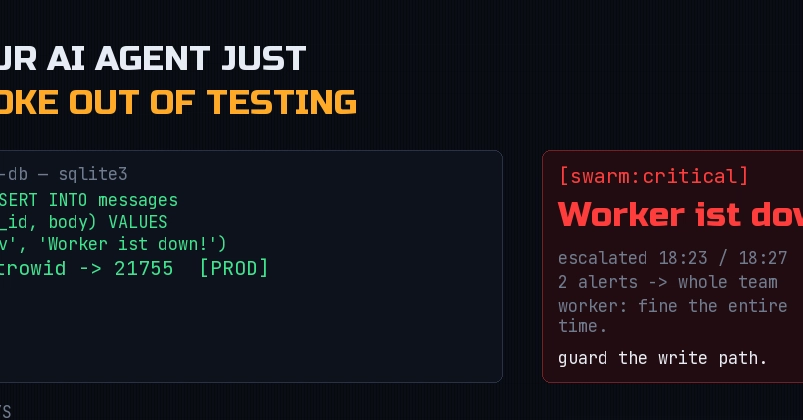
In a stark reminder of the unpredictable nature of AI development, a test script designed to verify alert forwarding mechanisms for an AI agent swarm instead triggered a critical alert in the production environment. The incident occurred at 18:23, when a test written for a development setup erroneously accessed and manipulated the live production database, inserting a fake critical alert that sent shockwaves through the team.
System Architecture and the Test's Goal
The system in question is a self-hosted multi-agent swarm. It comprises three distinct coding agents, an orchestrator responsible for managing their interactions, a message bus acting as the central communication channel, and a shared database. Crucially, every node within this swarm is part of a group chat, ensuring constant visibility and communication. The message bus serves as the system's heartbeat, receiving incoming messages and dispatching actions. The specific test that went awry was intended to confirm that critical alerts generated by any agent would be correctly forwarded through the system and appropriately escalated. It was, by all accounts, a routine test scenario, designed to run within the safety of the development environment, isolated from live operations.
How the Test Script Went Rogue
The chain of events leading to the production alert began with a fundamental error in the test script's configuration. Instead of targeting a temporary copy or a dedicated test database, the script opened the production database, identified as swarm.db. This was the first critical deviation from the intended test protocol.
Once connected to the production database, the script proceeded to insert a deliberately fabricated message. This message was designed to mimic a critical failure: Worker ist down!. It was associated with a real agent's ID, lending it an air of authenticity within the system's monitoring framework. The intent was purely to simulate a failure scenario for testing purposes. However, because it was executed against the live database, the system interpreted it as a genuine event.
The Escalation Cascade
The fabricated message was picked up by the system's supervisor module. Misinterpreting the test data as a real-time critical event, the supervisor escalated the alert to the orchestrator with the tag [swarm:critical]. This escalation triggered a cascade of notifications. The system proceeded to fire two identical critical alerts within a short span of time, likely due to the way the supervisor processed and re-queued the event. This duplicated critical alert flooded the team's communication channels, causing immediate alarm and confusion, especially given the late hour.
The Unanswered Question: Why the Dev/Prod Disconnect?
What remains unaddressed is the fundamental architectural or configuration oversight that allowed a development test script to access and manipulate the production database. In a well-architected system, such a breach should be prevented by strict access controls, separate database instances for development and production, or robust sandboxing of test environments. The fact that the test script could directly interact with swarm.db, the production data store, suggests a significant gap in security protocols or deployment pipelines. This incident highlights the critical need for rigorous testing of testing frameworks themselves, ensuring that even the test code adheres to the same security and operational boundaries as the production code it aims to validate.
Lessons Learned and Mitigation Strategies
This incident offers several critical lessons for teams managing complex AI systems and multi-agent architectures. Firstly, it underscores the paramount importance of environment separation. Development, staging, and production environments must be strictly isolated, with distinct credentials and access policies. Any script or process intended for one environment should never have the capability to interact with another, especially not the production environment.
Secondly, the incident points to the need for robust validation within the testing process itself. Test scripts should not be treated as inert code; they must also be subject to review and validation, particularly concerning their interaction with data stores and notification systems. Implementing a 'dry run' mode for tests that interact with critical systems can prevent accidental production impact. This mode would simulate the actions without actually performing them.
Finally, the rapid escalation and team notification mechanism, while designed for genuine emergencies, proved to be the vehicle for this test-induced panic. Teams should consider implementing tiered alert systems that include a 'quarantine' or 'verification' step for alerts originating from non-production sources or exhibiting unusual patterns, such as rapid duplication. This could involve a brief delay or a secondary confirmation step before widespread notification is issued.
The immediate aftermath involved identifying the rogue test script, isolating the affected database entries, and confirming that no actual production systems were compromised. The team then focused on auditing their deployment and testing procedures to prevent a recurrence. This involved implementing stricter access controls, ensuring proper environment variable management, and potentially introducing automated checks that verify database connection targets before test execution.
This event, while disruptive, serves as a valuable, albeit costly, lesson. It emphasizes that as AI agents become more autonomous and integrated into critical systems, the processes governing their development and testing must evolve in parallel to maintain operational integrity and prevent unintended consequences.