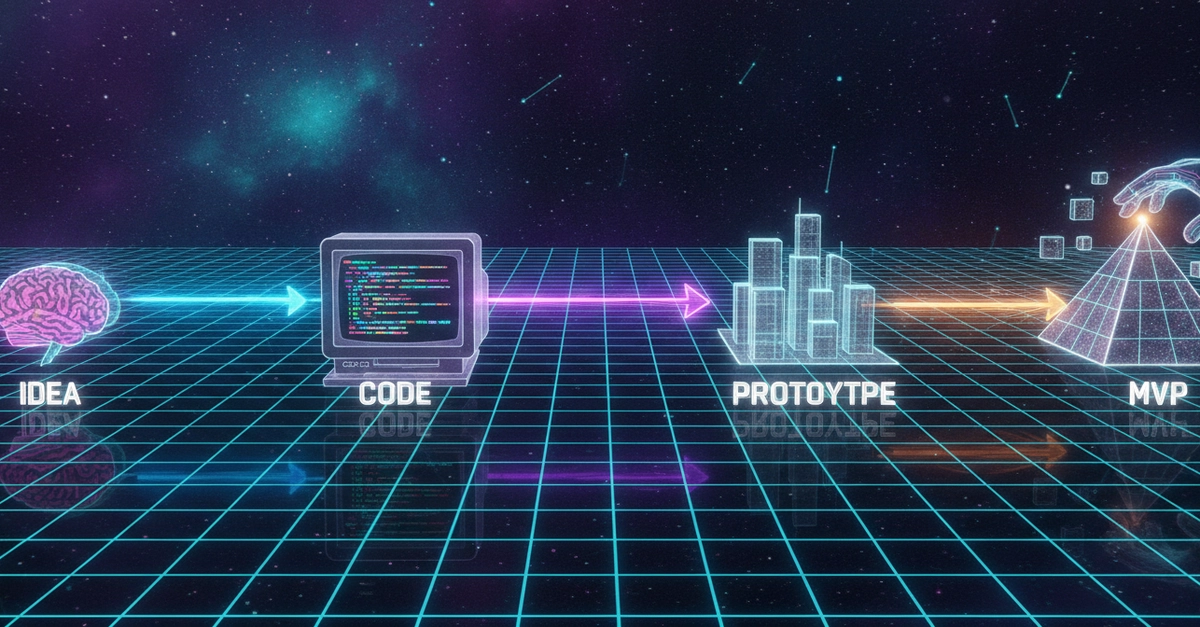
The AI-Accelerated Development Cycle
Artificial intelligence has fundamentally altered the landscape of software development. Tools powered by AI can now generate code, transform concepts into functional prototypes within hours, and automate tasks ranging from API creation and UI component design to database query writing and test case generation. Debugging assistance is also a common feature. This accessibility dramatically lowers the barrier between having an idea and deploying a working product. What once took weeks of dedicated effort to prototype can now often be realized as a Minimum Viable Product (MVP) in just a few days. The traditional development pipeline of Idea → Code → Prototype → MVP is compressed, allowing developers to iterate at unprecedented speeds.
This acceleration is not merely about writing code faster; it's about reducing the time-to-market for novel ideas and enabling smaller teams, or even individuals, to achieve what previously required larger, more established organizations. The focus is shifting from the sheer effort of implementation to the strategic decision-making process: what problems are worth solving, and what solutions will offer the most value? As AI handles more of the repetitive and boilerplate coding tasks, the premium on strategic thinking, architectural design, and understanding user needs intensifies.
Beyond Speed: The Question of Quality
While the speed advantage is undeniable, a critical question looms: are we building better software, or simply more software? The ease with which AI can generate functional code might mask underlying issues. AI-generated code, while often syntactically correct and functional, may not always adhere to best practices, exhibit optimal performance, or be easily maintainable in the long run. Developers must remain vigilant, treating AI-generated code as a draft that requires thorough review, testing, and refinement. The risk is that the pressure to ship quickly, amplified by AI's speed, could lead to a proliferation of technically debt-ridden applications.
Consider the analogy of a skilled artisan versus a high-speed production line. The artisan focuses on craftsmanship, material quality, and enduring design. The production line prioritizes output volume and efficiency. AI tools, in their current state, lean heavily towards the production line model. They can churn out components and applications rapidly, but the oversight for artistic integrity, long-term structural soundness, and nuanced user experience still rests squarely with the human developer. This means that while AI can drastically reduce the time spent on translating a design into code, it doesn't inherently improve the quality of that design or the underlying architecture.
The Evolving Role of the Developer
The advent of AI in software development is not about replacing developers but about redefining their roles. The emphasis is moving from manual code construction to higher-level tasks such as problem definition, system architecture, strategic decision-making, and rigorous quality assurance. Developers who can effectively leverage AI tools as co-pilots, guiding them and critically evaluating their output, will be best positioned for success. This requires a shift in skillset, prioritizing analytical thinking, domain expertise, and the ability to architect robust, scalable, and maintainable systems.
The challenge for development teams is to integrate AI tools thoughtfully. This means establishing clear guidelines for AI code usage, implementing robust code review processes, and ensuring that automated testing covers not just functional correctness but also performance, security, and maintainability. The speed AI offers is a powerful asset, but it must be wielded with discipline. Without this discipline, the industry risks building a vast ecosystem of software that is quick to deploy but slow to adapt and expensive to maintain.
Strategic Implications for the Industry
The implications of AI-accelerated development extend to the broader industry. Companies that can effectively harness these tools will likely gain a competitive edge, not just through faster product releases but by enabling their teams to focus on innovation and differentiation. This could lead to a market where the true competitive advantage lies in the originality and impact of the ideas being pursued, rather than the efficiency of their execution. Startups, in particular, can leverage AI to punch above their weight, rapidly iterating on product-market fit without requiring massive engineering teams.
However, this shift also raises questions about the long-term sustainability of software quality. If the primary focus becomes rapid iteration and deployment, what happens to the crucial, often unseen, work of refactoring, optimizing, and ensuring the foundational integrity of software systems? The industry must collectively address this by fostering a culture that values both speed and quality, ensuring that AI acts as an amplifier of good development practices, not a shortcut around them. The future of software development is not just about writing code faster, but about building the *right* software, better.