The AI Code Generation Surge
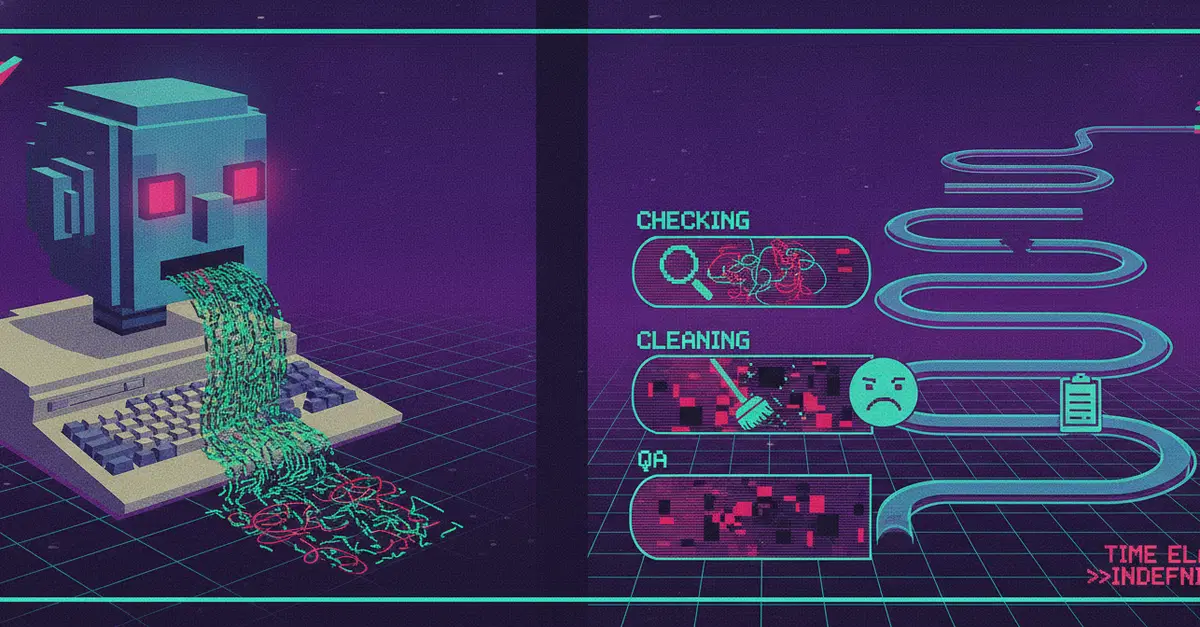
AI coding assistants have fundamentally altered the software development landscape. Tools like GitHub Copilot, Cursor, Codeium, and others can now generate code at speeds previously unimaginable. This surge in output means developers are producing more code, faster. However, this acceleration has not eliminated bottlenecks; it has merely relocated them.
The core challenge is no longer the manual act of writing lines of code. Instead, the bottleneck has shifted to the human elements of the development process: thoughtful design, careful orchestration of generated components, rigorous review, and definitive validation of the final product. This transition redefines the developer's role from a primary implementer to a conductor of AI-powered systems.

Redefining the Developer's Role
Consider the traditional software development workflow. Developers spent significant time translating requirements into code, debugging syntax errors, and piecing together logic. AI tools now automate much of this low-level implementation. A developer might prompt an AI to build a specific feature, and the AI can often deliver a functional, albeit unvetted, implementation in seconds.
This change means developers must adapt. Their focus must pivot from the granular details of syntax and basic algorithms to higher-level concerns. This includes understanding the system architecture, designing elegant solutions, ensuring the AI-generated code aligns with project goals and security standards, and managing the integration of diverse code snippets produced by AI. The developer becomes an architect and a quality assurance manager, leveraging AI as a powerful tool rather than a direct replacement.
The Review and Validation Challenge
The most significant bottleneck identified by developers is the increased burden on review and validation. When AI generates code rapidly, the volume of output can overwhelm human capacity to review it thoroughly. Developers are finding themselves producing code faster than they can confidently review, validate, and ship it. This is akin to a factory producing car parts at an unprecedented rate, only to find the assembly line and quality control stations are not equipped to handle the sheer volume.
This situation creates a new kind of pressure. The speed of AI generation necessitates a corresponding increase in the speed and effectiveness of human oversight. Without adequate review, the risk of introducing subtle bugs, security vulnerabilities, or architectural flaws increases. Developers must develop new strategies for code review, potentially focusing on automated testing, static analysis tools, and targeted manual inspection of critical code paths generated by AI.
Evaluating AI Coding Assistants
The proliferation of AI coding assistants, including GitHub Copilot, Cursor, Codeium, Tabnine, Replit AI, v0, Bolt, and Lovable, presents developers with a range of options. A recent evaluation of eight such tools revealed that while many offer impressive code generation capabilities, the actual value proposition often lies in their integration into the workflow and the specific problems they solve. For instance, some tools excel at boilerplate code generation, while others might be better suited for complex algorithm implementation or debugging.
The cost of these tools, which can add up to significant subscription fees for a small team, requires careful consideration. Developers and teams must assess not just the code generation speed but also the accuracy, the learning curve, the integration with existing IDEs, and the overall impact on their productivity and code quality. The most effective AI assistants are those that augment, rather than complicate, the human-centric aspects of development – design, review, and validation.
The Path Forward: Human-AI Collaboration
The future of coding is not purely AI-driven; it is a collaborative effort. AI tools will continue to advance, generating code more efficiently and accurately. The critical differentiator for successful development teams will be their ability to effectively manage this AI-generated output. This requires investing in training developers to think critically about AI-generated code, developing robust review processes, and fostering a culture that prioritizes quality and security alongside speed.
The key takeaway is that AI has not made human developers obsolete; it has elevated their role. Developers who can master the art of designing, orchestrating, and validating AI-generated code will be invaluable. The bottleneck has moved, and it now rests firmly in the hands of skilled human oversight and strategic decision-making.