The Problem: Blind Merges and Brittle Tests
For months, developers have grappled with a common frustration: AI coding agents that generate code, but leave the human developer in the dark about the changes. The typical workflow involves an agent writing code, validating its own work, and then presenting the results. This often leads to a situation where the human reviewer must sign off on changes without fully understanding their scope or rationale. This is particularly problematic when the agent claims to have written tests. Too often, these tests are superficial – mocking the code under test, asserting on private fields, or snapshotting incidental structure. The result is a suite that passes, but offers zero confidence in the code's actual correctness or robustness.
This lack of transparency and control undermines the promise of AI-assisted development. Developers need to trust the code their AI collaborators produce, and that trust is eroded when the process feels like a black box. The current approach often leaves developers feeling like they are blindly accepting changes, with the burden of understanding and debugging falling entirely on them after the fact.

Introducing Agents Concerto: A Conductor for AI Agents
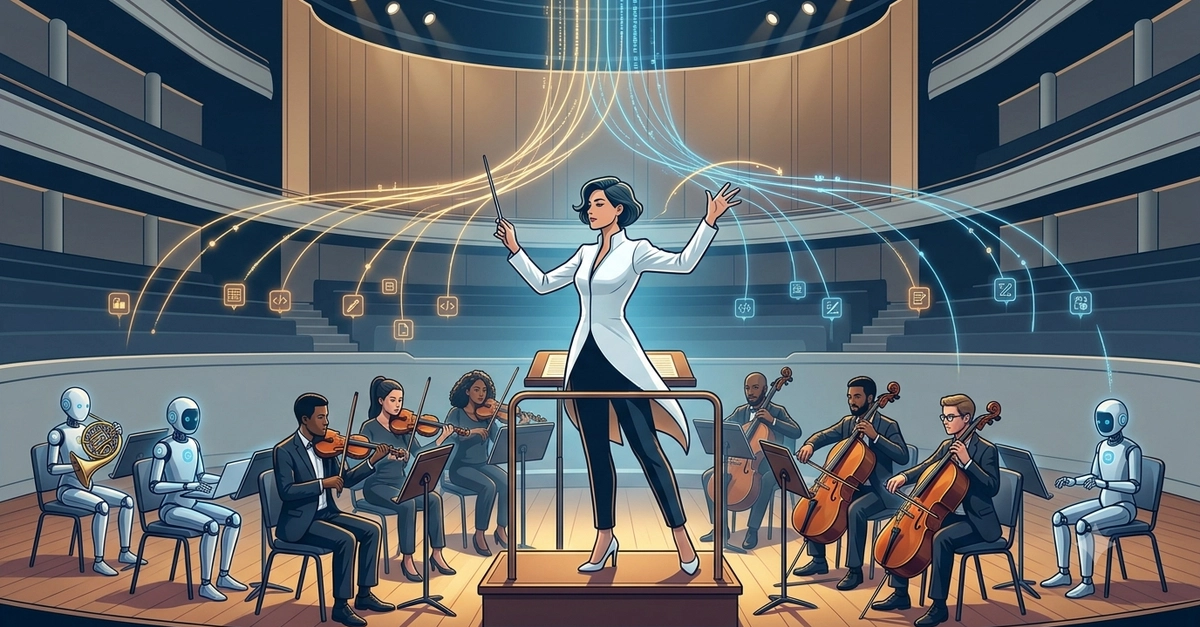
To address these shortcomings, a new project called agents-concerto has emerged. This is not a standalone application, but rather an orchestration framework designed to bring order and clarity to multi-agent AI development. The project's name is a deliberate metaphor: it envisions a system where a 'conductor' directs multiple 'players' (AI agents) to perform a cohesive task. The core principle is that the conductor never directly handles the 'instruments' – the code itself. This ensures that the ultimate control and responsibility for the merge remain firmly with the human developer.
Agents Concerto operates on top of existing large language models, specifically mentioning Claude Code as a foundational element. The framework is built around a central `CLAUDE.md` file, which acts as the conductor's script. Within this, four distinct agents are defined using Markdown, each with a specific role. These agents are then orchestrated to execute commands, typically via Bash scripts, to achieve a larger goal. This structured approach allows for more predictable and manageable AI-driven code generation.
How Agents Concerto Works: The Orchestration Model
The power of Agents Concerto lies in its clear separation of concerns and its structured orchestration. The 'conductor' agent is responsible for planning the overall task, breaking it down into smaller steps, and assigning those steps to the appropriate 'player' agents. Each player agent is designed to perform a specific function, such as writing code, validating code, or generating tests. This specialization prevents any single agent from becoming overloaded or trying to perform tasks outside its expertise.
The conductor's `CLAUDE.md` file defines the workflow. It's here that the sequence of operations, the prompts for each agent, and the expected outputs are specified. For instance, the conductor might instruct Agent A to implement a new feature, then instruct Agent B to write unit tests for that feature, and finally instruct Agent C to review the code and tests for adherence to style guides and best practices. The use of Bash scripts allows for seamless integration with the development environment, enabling agents to execute commands, run linters, and perform other necessary operations.
A crucial aspect of Agents Concerto is its emphasis on human oversight. The system is designed to present changes in a way that is easy for a human developer to review. Instead of a chaotic dump of modifications, the output is structured and contextualized, making it clear what was changed, why it was changed, and how it impacts the codebase. The conductor's role is to manage the AI agents, not to replace the human developer's judgment. The final merge decision always rests with the human, ensuring accountability and preventing the