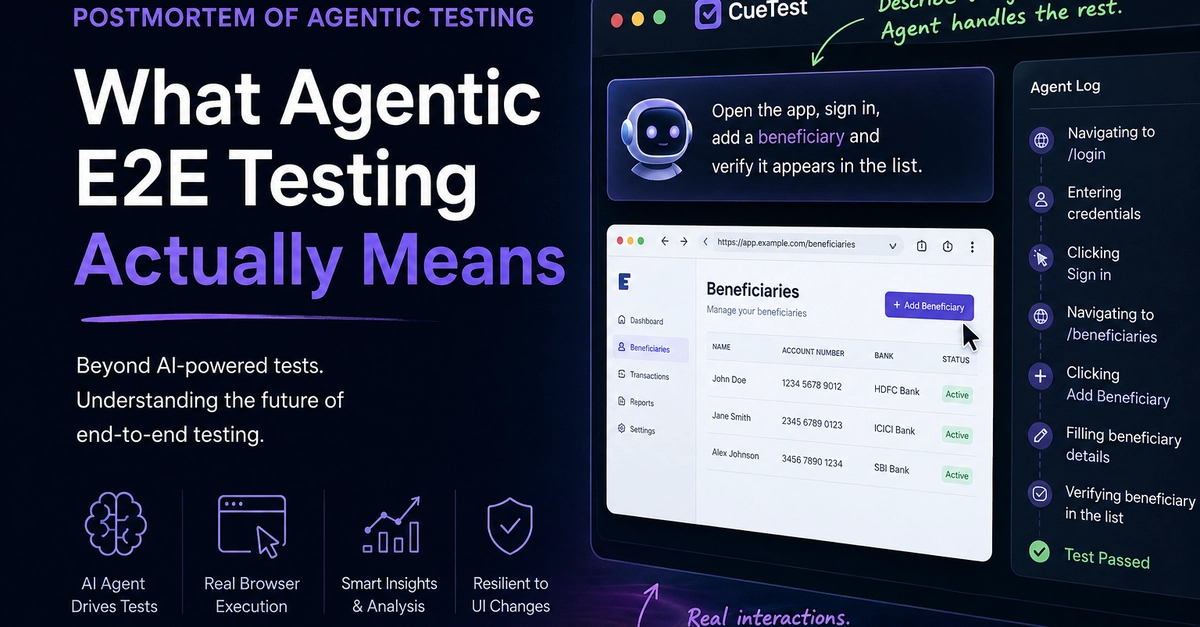
The Buzzwords: AI-Powered vs. Agentic Testing
The terms "AI-powered testing" and "agentic testing" are frequently used interchangeably, but they represent distinct concepts in the evolving landscape of software quality assurance. Understanding the difference is crucial for teams looking to leverage these advancements effectively.
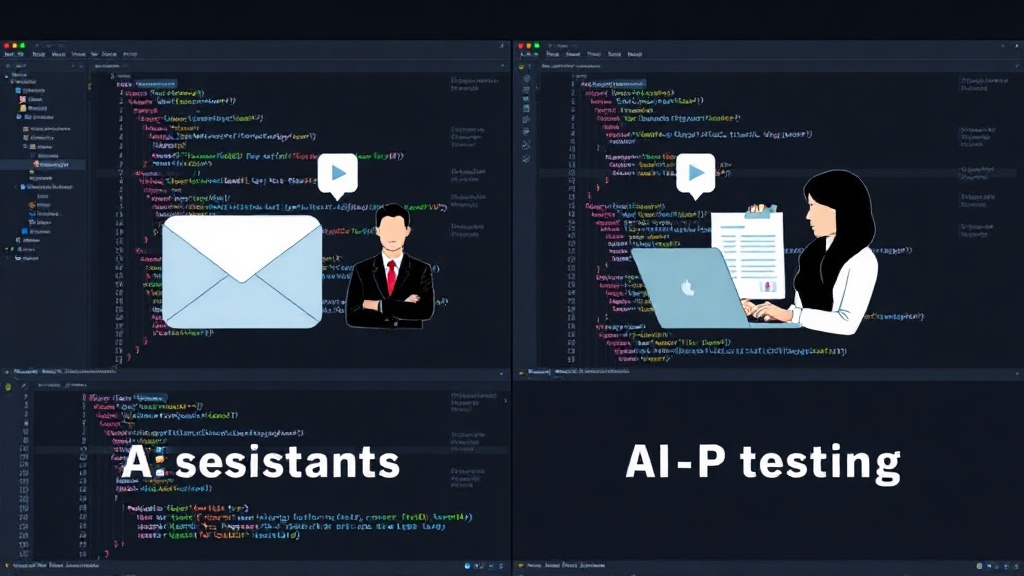
AI-powered testing typically refers to the use of artificial intelligence to augment or automate existing testing processes. This often manifests as AI models generating test scripts for popular frameworks like Playwright, Selenium, or Cypress. You provide a description of a feature, and an AI assistant, such as Claude, Codex, or Cursor, produces a test script. The output, however, remains a traditional, code-based test that requires human oversight for maintenance and execution. It's an enhancement to current workflows, not a fundamental shift in how tests operate autonomously.
What Agentic Testing Truly Entails
Agentic testing, on the other hand, moves beyond simple AI script generation. It envisions autonomous agents capable of understanding software applications, identifying potential issues, and even adapting tests as the application evolves. These agents don't just write tests; they can potentially execute them, analyze results, and learn from the outcomes to improve future testing cycles. The core differentiator is the agent's ability to operate with a degree of autonomy, making decisions and taking actions without constant human intervention.
Think of AI-powered testing like a highly skilled assistant who can draft emails for you based on your instructions. Agentic testing is more akin to a personal assistant who not only drafts the emails but also understands your calendar, anticipates your needs, and proactively schedules meetings or follows up on tasks, adapting to changes as they happen.
Beyond Script Generation: The Autonomous Agent
The promise of agentic testing lies in its potential for true end-to-end (E2E) automation. Instead of a QA engineer writing scripts that mimic user behavior, an agentic system could theoretically:
- Understand Application State: Agents could parse application code, UI elements, and even backend logs to build a comprehensive understanding of the system's current state.
- Identify Test Scenarios: Based on this understanding and defined quality goals, agents could autonomously identify new test cases or variations that traditional methods might miss. This includes exploratory testing scenarios.
- Execute Tests Dynamically: Agents could initiate test executions, adapting parameters and sequences based on real-time feedback from the application.
- Analyze and Report: They could analyze test results, pinpoint root causes of failures, and generate detailed reports, including potential fixes or suggestions for developers.
- Self-Adaptation: Crucially, agentic systems would adapt their testing strategies as the application changes. If a UI element moves or an API endpoint is updated, the agent would ideally detect this and adjust its tests accordingly, reducing the brittle nature of many current E2E tests.
The "No Hype" Reality Check
While the concept of agentic testing is powerful, the reality is that fully autonomous agents capable of sophisticated E2E testing are still largely aspirational. Current implementations often blur the lines between AI-powered assistance and true agentic behavior.
Many tools that claim to offer "agentic testing" today are primarily sophisticated AI assistants. They excel at generating code or suggesting test cases, but they still rely heavily on human engineers to define the scope, interpret results, and maintain the overall testing framework. The "agent" might be good at writing a specific test script, but it doesn't possess the broad understanding or adaptive capabilities of a truly autonomous agent.
The challenge lies in building agents that can generalize their understanding across different application components and states, learn from complex interactions, and operate reliably in dynamic environments. This requires significant advancements in areas like:
- Reinforcement Learning: For agents to learn optimal testing strategies through trial and error.
- Natural Language Understanding (NLU): To interpret complex requirements and feedback.
- Computer Vision: To understand visual elements of the UI and their context.
- Causal Inference: To accurately pinpoint the root causes of failures.
What This Means for Your Testing Strategy
For development and QA teams, the current state means focusing on the practical benefits of AI-powered tools while keeping an eye on the future potential of agentic systems.
Leverage AI for Efficiency: Utilize AI assistants to accelerate test script generation, improve test coverage by identifying edge cases, and even assist in debugging. This can free up valuable human time for more complex analytical tasks.
Understand Limitations: Recognize that AI-generated tests still require human review, maintenance, and integration into a robust testing strategy. Don't expect AI to replace the need for skilled QA engineers entirely.
Prepare for Evolution: As agentic capabilities mature, consider how truly autonomous testing agents could integrate into your CI/CD pipelines. This might involve adopting platforms that are built with agentic principles in mind or developing internal capabilities to manage and orchestrate such agents.
The "hype" around AI in testing often oversimplifies the current capabilities. While AI can significantly enhance productivity and test quality, the vision of fully autonomous, self-adapting testing agents is still on the horizon. The distinction between AI-powered assistance and true agentic autonomy is key to setting realistic expectations and building effective testing strategies for the future.