The Evolving Landscape of Production Support
Production support, a critical function for any software service, has historically relied heavily on human engineers. The typical workflow involves a reactive cycle: an alert triggers, an engineer dives into logs, searches for similar past incidents, hypothesizes a root cause, validates a potential fix, and then implements it. This process, while functional, is time-consuming, prone to human error, and creates a bottleneck that can delay critical issue resolution. The increasing complexity and scale of modern systems exacerbate these challenges, placing immense pressure on on-call engineers.
The fundamental question driving innovation in this space is whether artificial intelligence can alleviate this dependency. Can AI agents not only identify issues but also intelligently resolve them without granting them unfettered access to production environments? This is the core problem being addressed by the nascent field of Agentic AI for Production Support, exemplified by projects aiming to transition from a purely alert-driven system to one of intelligent incident resolution.
Agentic AI: A Controlled Approach to Incident Resolution
The proposed solution, termed 'Agentic Production Support,' outlines a structured flow designed to leverage AI while maintaining crucial human oversight and environmental control. Instead of feeding raw incident data directly into a large language model (LLM), the system employs a multi-stage process. This approach aims to provide the AI with the necessary context and constraints to perform its tasks effectively and safely.
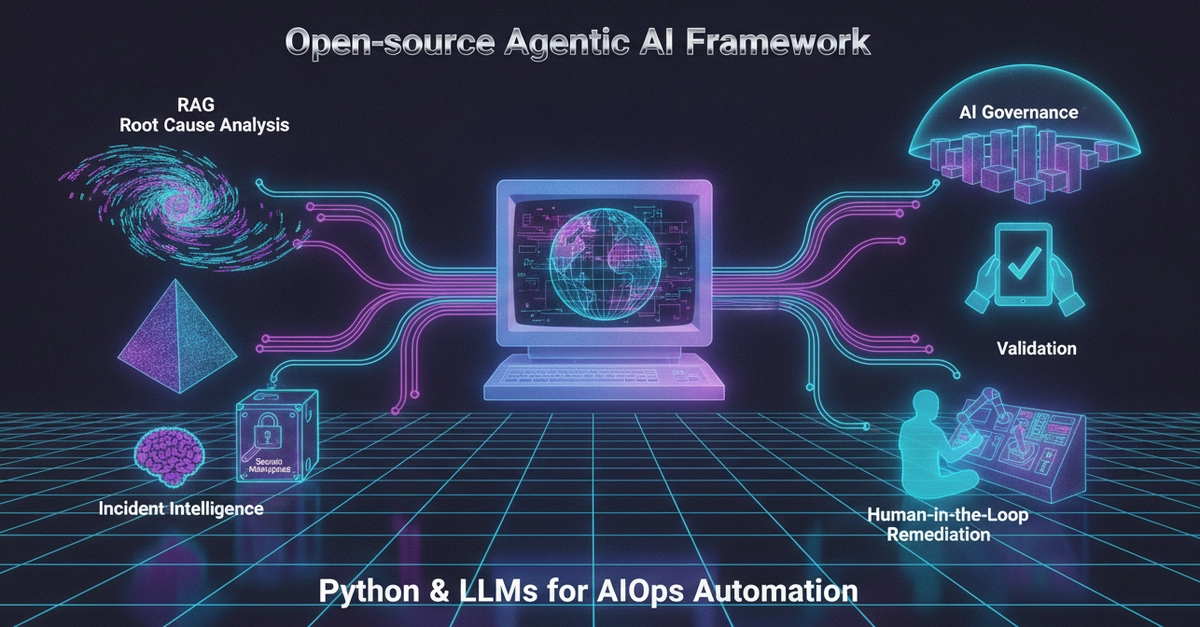
The initial phase involves an 'Incident' being detected. This triggers a 'Clean Layer' where the raw alert data is processed and standardized. Following this, a Retrieval-Augmented Generation (RAG) component comes into play. RAG is crucial for grounding the AI's responses in factual, historical data. It searches through a knowledge base of past incidents, documentation, and runbooks to find relevant information. This retrieved context is then fed into the 'AI Agent.'
The AI Agent's primary role is to analyze the incident, informed by the RAG-enhanced context, and generate a potential Root Cause Analysis (RCA). This is a significant leap from current systems that might only offer basic correlation. The AI doesn't just identify symptoms; it attempts to diagnose the underlying problem. Following the RCA generation, a 'Validation' step ensures the proposed solution is technically sound and safe. This validation could involve automated checks or cross-referencing with system health metrics.
Crucially, the process culminates in 'Human Approval' before any 'Action' is taken. This oversight step ensures that critical decisions remain in human hands, mitigating the risks associated with fully autonomous AI in production environments. The AI acts as a highly sophisticated assistant, augmenting the engineer's capabilities rather than replacing them entirely.
The Promise of Reduced Dependency and Faster Resolution
The primary benefit of this agentic AI approach is the potential to significantly reduce the dependency on human engineers for routine incident resolution. By automating the analysis and RCA process, engineers can be freed from the constant cycle of alert triage and manual investigation. This allows them to focus on more complex, strategic tasks, such as system design, proactive performance tuning, and developing new features.
Furthermore, the structured RAG and AI agent workflow promises faster incident resolution times. AI can process vast amounts of data and identify patterns far more quickly than a human. When combined with a robust knowledge base, the time from incident detection to a validated RCA and proposed solution can be dramatically reduced. This speed is critical in minimizing downtime and maintaining service level agreements (SLAs).
The 'Clean Layer' and 'Validation' steps are vital for building trust in the system. By carefully controlling the data fed to the AI and verifying its outputs, the risk of AI-driven errors is minimized. This controlled environment is essential for moving AI from experimental playgrounds into the high-stakes domain of production support. The human approval gate acts as the final safety net, ensuring that the AI's intelligence is harnessed responsibly.
Challenges and Future Directions
While the concept is promising, several challenges remain. Building and maintaining the comprehensive knowledge base required for effective RAG is a significant undertaking. Ensuring the AI agent can accurately interpret diverse and often ambiguous log data, metric anomalies, and error messages requires sophisticated natural language understanding and reasoning capabilities. The validation mechanisms need to be robust enough to catch potential errors without adding significant delays to the resolution process.
The question of 'uncontrolled access' is paramount. The proposed model attempts to mitigate this by keeping the AI agent within a defined operational boundary, processing data through controlled layers and requiring human sign-off for actions. However, as AI capabilities advance, the definition of 'controlled access' will continue to evolve. What happens to the thousands of developers who have built intricate tooling and processes around current alert and incident management systems when a new paradigm emerges?
This approach represents a shift in how we think about AI in operations. It moves beyond simple anomaly detection or automated ticketing towards a more integrated, intelligent system that actively participates in problem-solving. The success of such systems will depend on their ability to demonstrably reduce MTTR (Mean Time To Resolution), decrease alert fatigue, and provide tangible productivity gains for engineering teams, all while maintaining robust security and operational integrity.