Navigating the Rapidly Evolving AI Landscape
The field of Artificial Intelligence is expanding at an unprecedented rate. For developers, founders, and practitioners, keeping pace with new concepts, tools, and techniques can feel like trying to drink from a firehose. It's common to encounter terms and ideas without a clear understanding of their context or how they fit into the broader AI ecosystem. This knowledge gap, often summarized as "you don't know what you don't know," presents a significant hurdle for anyone looking to level up their AI skills.
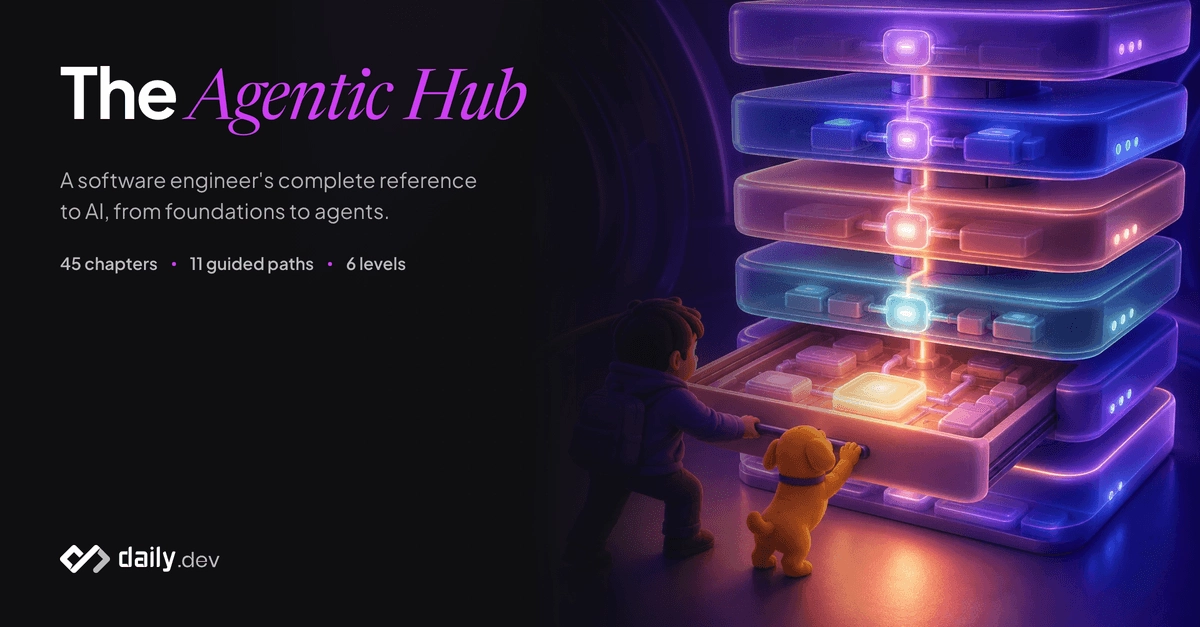
Recognizing this challenge, the Agentic AI Hub has launched as a free, no-signup resource designed to provide a structured roadmap for AI learning. It aims to demystify complex AI concepts and guide users from foundational knowledge to advanced application, specifically focusing on the burgeoning area of agentic AI.
From Foundational Concepts to Agentic Systems
The Agentic AI Hub is built around the idea of guided paths, each designed to address specific questions or learning objectives. These paths start with fundamental concepts, such as defining what a "token" is in the context of large language models, and progress systematically towards more complex topics, like the architecture and deployment of autonomous AI agents. This approach ensures that learners build a solid understanding layer by layer, rather than encountering advanced topics without the necessary prerequisites.
The hub curates and sequences insights from prominent figures in the AI community. By drawing on the work of experts like Dan Shapiro, Simon Willison, Addy Osmani, Thorsten Ball, Andrej Karpathy, and Peter Steinberger, the hub doesn't reinvent the wheel but rather organizes existing knowledge into a coherent and actionable learning journey. This curation is crucial in an era where information is abundant but often fragmented.
Each learning path is framed as a journey starting from a specific question. This question-driven approach makes the learning process more engaging and goal-oriented. For instance, a path might begin with the question, "How do I get started with LLM prompts?" and then guide the user through prompt engineering techniques, contextual understanding, and eventually to more sophisticated applications.
Key Areas Covered by the Hub
The Agentic AI Hub focuses on several key areas critical for understanding and building with modern AI, particularly agentic systems:
- Foundational AI Concepts: Understanding core terminology, the basics of machine learning, and how large language models (LLMs) function at a high level. This includes topics like tokens, embeddings, and the transformer architecture.
- Prompt Engineering: Mastering the art and science of crafting effective prompts to elicit desired outputs from LLMs. This covers techniques such as few-shot prompting, chain-of-thought prompting, and structured output generation.
- LLM APIs and Tooling: Learning to integrate LLMs into applications using various APIs and SDKs. This includes understanding rate limits, model selection, and cost management.
- Agentic AI Architectures: Exploring frameworks and patterns for building autonomous AI agents. This involves concepts like planning, memory, tool use, and multi-agent systems.
- Deployment and Production: Strategies for deploying AI agents and applications into production environments, including monitoring, scaling, and ethical considerations.
The hub's design emphasizes practical application. Learners are encouraged to not just understand concepts theoretically but to actively engage with them, whether by experimenting with prompts, exploring code examples, or understanding architectural patterns.
The Value Proposition: Free, Accessible, and Expert-Curated
A significant aspect of the Agentic AI Hub is its accessibility. It is entirely free to use and requires no signup, removing common barriers to entry such as registration forms or subscription fees. This open approach democratizes access to structured AI education, making it available to anyone with an internet connection and a desire to learn.
The decision to curate and organize existing knowledge, rather than generating entirely new content, leverages the vast amount of high-quality AI research and discussion already available. By providing a clear, structured path, the hub helps users navigate this information landscape efficiently. It acts as a compass for those lost in the dense forest of AI development, pointing them toward key resources and concepts in a logical sequence.
The inclusion of insights from recognized experts lends credibility and depth to the learning paths. Users can trust that the information presented has been vetted and validated by thought leaders in the field. This curated approach saves learners countless hours of research and helps them avoid common pitfalls or misconceptions.
What's Next for AI Learning Resources?
The launch of the Agentic AI Hub signals a growing trend towards structured, curated learning experiences in rapidly evolving technological domains. As AI continues to advance, the need for clear, guided pathways will only increase. The model employed by the hub—leveraging existing expertise, focusing on practical application, and prioritizing accessibility—sets a strong precedent for future educational resources in AI and other complex fields.
The success of such initiatives will likely depend on their ability to adapt to the constant flux of the AI landscape. Keeping learning paths updated with the latest breakthroughs and best practices will be crucial for maintaining their relevance and value. For developers and enthusiasts eager to master AI, resources like the Agentic AI Hub offer a vital starting point and a continuous guide.