%22%20%2F%3E%0A%20%20%3C%2Fsvg%3E)
The Problem with Static Agent Context
Traditional AI agents often rely on flat markdown files or even more structured knowledge graphs like GraphRAG to provide context. While these methods improve an agent's understanding, they falter when a sequence of actions breaks. Debugging becomes a black box; pinpointing the exact step that failed and understanding why is nearly impossible. This lack of explainability not only hinders rapid iteration and improvement but also caps the agent's ultimate performance ceiling.
A developer working on an AI agent recently encountered this limitation. The agent, tasked with a series of actions, showed promise but struggled with error recovery and iterative improvement. The static nature of its knowledge base meant that when a multi-step process failed, the agent could not backtrack effectively or learn from the specific failure point. This led to slow convergence on complex tasks and an inability to break through performance plateaus.
Introducing the POMDP State-Action Graph
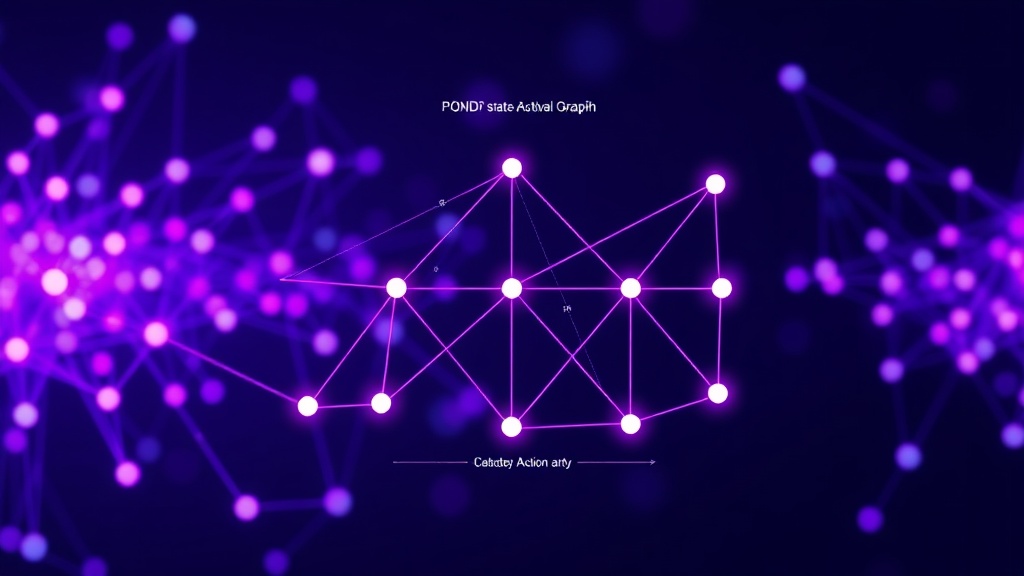
To address these issues, the developer reframed the agent's decision-making process. Instead of a static knowledge file, the agent's policy was modeled as a Partially Observable Markov Decision Process (POMDP). In this framework, states that the agent can observe become nodes in a graph. Actions that transition between these states are represented as edges. Crucially, each edge is weighted with key metrics: the probability of success for that action, its token cost, and its potential outcome.
Think of this less like a static instruction manual and more like a dynamic, probabilistic map. The agent doesn't just read the instructions; it navigates the map. It explores paths through the graph, using the edge weights to guide its decisions. Once it has explored enough to understand the landscape of possibilities, it begins to exploit the graph, choosing the most promising sequence of actions to achieve its goal, much like standard Reinforcement Learning (RL) agents do.
Empirical Results: A Significant Leap in Performance
The developer ran a comparative test using the same batch of tasks. Three configurations were tested: a standard flat markdown file, a GraphRAG knowledge base, and the new POMDP state-action graph. The tests were conducted across two powerful language models: Claude Opus 4.8 and Codex GPT-5.5. The results were striking.
The average success rate for tasks using the flat file was approximately 0.78. The GraphRAG approach showed marginal improvement. However, the POMDP-style graph propelled the average success rate to around 0.95. This represents an improvement of 16 to 20 percentage points, a substantial leap in reliability and effectiveness.
Beyond the dramatic increase in task success, the POMDP approach also proved more efficient. The total token cost for completing tasks using the graph was lower than that of the flat markdown file. This suggests that the agent's more directed, probabilistic exploration and exploitation led to fewer wasted computations and more efficient pathfinding through the problem space.
Implications for Agent Development and Explainability
This shift from static context to a dynamic, probabilistic graph has profound implications. Firstly, it introduces a level of explainability previously missing. When an agent fails, the graph structure allows developers to trace the execution path, identify the specific edge (action) with a low success probability that was taken, or pinpoint nodes (states) that were poorly understood. This makes debugging and fine-tuning significantly more tractable.
Secondly, it unlocks higher performance ceilings. By treating actions as probabilistic transitions with associated costs and outcomes, the agent can engage in more sophisticated planning and decision-making. This is akin to how experienced human operators or pilots might mentally model complex systems, weighing risks and probabilities before committing to a course of action. The ability to explore and then exploit this structured knowledge allows agents to tackle more complex, multi-step tasks with greater confidence.
The success of this POMDP-style graph approach opens up new avenues for agent architecture. It suggests that moving beyond simple context retrieval towards explicit modeling of state-action dynamics, including uncertainty and cost, is a critical next step for building more robust, reliable, and understandable AI agents. The question now is how widely this paradigm will be adopted and what further optimizations can be derived from this structured approach to agent policy representation.
Future Directions and Open Questions
The initial success is promising, but several questions remain. How does this scale to extremely large and complex task spaces with millions of states and actions? What are the optimal algorithms for constructing and updating these POMDP graphs dynamically, especially in environments where the success probabilities of actions can change over time? Furthermore, while this approach offers better explainability than flat files, how can the insights derived from the graph traversals be most effectively presented to human developers for even faster debugging and learning?
The developer behind this work is curious to see if others in the AI community have explored similar state-action graph representations for agent policies. This exploration into POMDPs for agent control signifies a move towards more sophisticated internal modeling, moving beyond simple prompt engineering towards deeper, more structured representations of agent capabilities and decision-making processes.