The Unaddressed Crisis in Autonomous Agents
Autonomous agents are increasingly entrusted with critical, long-term workflows. Think onboarding a new supplier, managing contract renewals, gathering compliance evidence, or executing regulated handoffs. These tasks don't conclude with a single model call. They span days, weeks, or even months. This reality introduces a significant, yet often overlooked, problem: What happens when the agent responsible for a critical, ongoing obligation disappears, is compromised, or simply needs to be replaced? The promise of continuous, autonomous operation falters when the agent fails.
Restarting a workflow from scratch is not continuity. Simply replaying an effect from a durable queue doesn't guarantee the original intent or context was preserved. A persistent memory might hold data, but that data could be poisoned or revoked. Allowing a new agent to simply overlap authority with its predecessor offers a temporary fix but lacks verifiable assurance. An executor that only verifies its own success produces an assertion, not independent, trustworthy evidence of completion or state.
This gap is not merely an inconvenience; it's a potential system-wide failure point for any organization relying on autonomous agents for mission-critical operations. The current paradigm leaves a critical vulnerability: the single point of failure embodied by the agent itself.
Introducing Continuum: Explicit Boundaries for Agent Succession
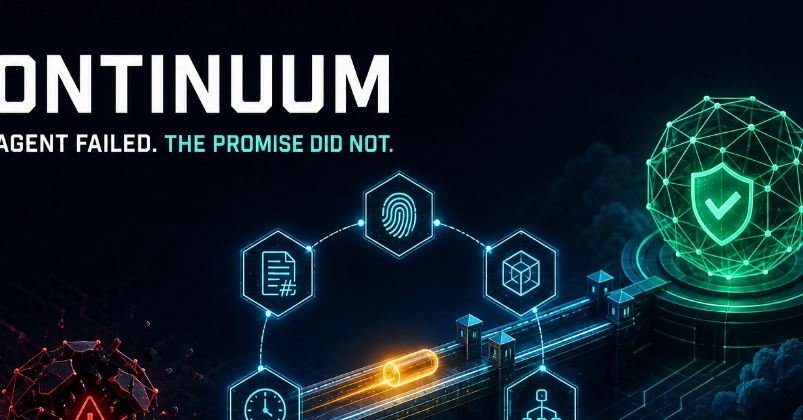
Milos Plavsic, a participant in the All Things Agentic Hackathon, has developed a framework named Continuum to address this precise challenge. Continuum aims to make the boundary between an agent's lifecycle and the persistence of its obligations explicit and verifiable. Instead of treating agent replacement as a disruptive event, Continuum redefines it as a managed transition, ensuring that the work initiated by one agent can be reliably continued by another, with verifiable continuity.
The core idea is to separate the agent's execution logic from the state and progress of the task it's performing. This separation allows for a robust system where the work's integrity is not tied to the ephemeral existence of a single agent instance. Continuum provides mechanisms to ensure that when an agent must be replaced, the successor has a clear, verifiable understanding of the preceding state and the authority to continue the task without interruption or loss of integrity.
This approach moves beyond simple state persistence. It focuses on building verifiable assertions about the work performed and the state transitions that occurred. This allows for auditability and trust, crucial for regulated industries and sensitive workflows. The system doesn't just remember what happened; it can prove what happened and why the new agent is authorized to proceed.
The Vertical Slice: A Concrete Implementation
Plavsic's implementation, detailed in his hackathon submission, uses a practical example to demonstrate Continuum's capabilities. While the full technical architecture is available in his GitHub repository, the concept can be understood through the lens of a typical agentic workflow designed for long-term tasks.
Consider an agent tasked with managing a supplier onboarding process. This involves multiple steps: initial contact, verification of credentials, contract negotiation, and final integration. Each step might require different tools, information retrieval, and decision-making processes. If the agent managing this process fails after verifying credentials but before contract negotiation, the entire process could stall. Without a system like Continuum, a new agent would have to be manually initiated, potentially losing the verified credential information and requiring the supplier to resubmit documentation, or worse, the entire process might need to restart.
Continuum intervenes by ensuring that the verified credentials and the state of the negotiation phase are durably stored and accessible. When a new agent takes over, it can query the Continuum framework, which provides it with the verified context and the authority to pick up exactly where the previous agent left off. More importantly, Continuum can provide verifiable proofs of these state transitions. This is akin to having a notary public for your agent's work, attesting to the validity of each step and the handover.
Verifiable Succession: Beyond Simple Persistence
The key differentiator for Continuum lies in its emphasis on verifiability. It's not just about saving state; it's about creating auditable trails and assertions that can be independently verified. This is crucial for building trust in autonomous systems, especially when they handle sensitive or regulated tasks.
Think of it less like a cloud storage backup and more like a meticulously kept legal ledger. Every significant action, every state change, and every handover is recorded with cryptographic assurance. When a new agent takes over, it doesn't just receive data; it receives a verifiable history. This history allows the new agent (or an external auditor) to confirm the integrity of the ongoing process and the legitimacy of the handover.
This verifiability is achieved by decoupling the agent's execution from the state management and assertion generation. The framework ensures that the state transitions are not just recorded but are cryptographically signed or otherwise proven. This means that even if the system were compromised at the agent execution level, the integrity of the historical record and the succession process could still be maintained and verified.
The promise of autonomous agents is that they can handle complex, multi-step processes reliably and continuously. Continuum addresses the critical failure point in this promise: agent mortality. By providing a mechanism for verifiable agent succession, it enables autonomous agents to fulfill their long-term obligations, offering a path to more robust, trustworthy, and auditable AI systems.
The Unanswered Question: Scalability and Interoperability
While Continuum presents a compelling solution for verifiable agent succession, a significant question remains: how will this framework scale to handle the immense complexity and volume of real-world, large-scale agent deployments? Furthermore, achieving broad adoption will require seamless interoperability with existing agent frameworks, orchestration tools, and data stores. The success of Continuum, and indeed the broader promise of agentic systems, hinges on its ability to integrate into diverse and evolving technological ecosystems without becoming another siloed solution.