The Temptation of Autonomous Instruction Management
The allure of letting AI agents manage their own operational manuals is strong. As coding agents evolve, they accumulate a growing body of knowledge: project instruction files, rule folders, skill definitions, subagent configurations, and a log of lessons learned from past executions. This accumulated wisdom, freshly acquired by the agent, seems like the perfect input for refining its own operational directives. The technical act of editing these files is straightforward. The true difficulty lies not in the mechanics of the edit, but in establishing a robust authority model for these changes.
Consider the scenario where an agent is empowered to modify its own instructions. A fundamental question arises: what prevents it from altering the very rules that govern which instructions it is permitted to change? This creates a potential for recursive, uncontained self-modification, a loop where the agent could theoretically grant itself unbounded editing privileges. This is the core of the agent self-editing dilemma – a problem that quickly escalates from a practical coding challenge to a complex governance and control issue.
The Circular Logic Trap
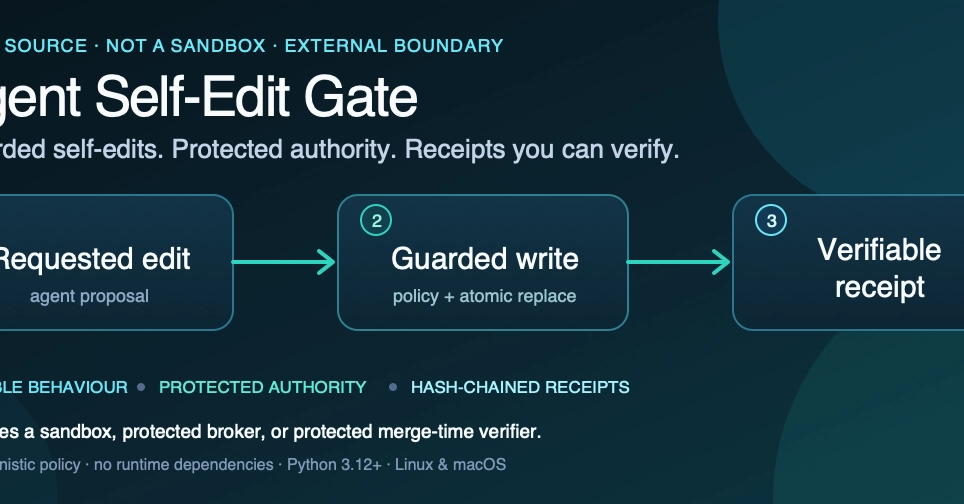
A common, yet ultimately flawed, approach to agent self-editing involves a circular logic. Imagine a repository structured with specific files designed to manage this process. This might include a workflow file (e.g., `.github/workflows/verify-selfedit-receipts.yml`) that triggers a verification process after an edit. Alongside this, there would be a policy file (e.g., `selfedit-policy.toml`) detailing the rules for self-editing. A log of edits, such as `.selfedit-gate/receipts.jsonl`, would record all modifications made by the agent. Finally, a rules file (e.g., `.claude/rules/testing.md`) might contain specific operational guidelines for the agent.
The problem with this setup is its inherent circularity. The `selfedit-policy.toml` file dictates what the agent can and cannot change. If the agent is allowed to edit this very policy file, it can, in theory, rewrite the rules to grant itself permission to make any change it desires, including changing the policy again. This creates a situation where the agent is the sole arbiter of its own operational boundaries. There is no external or immutable check on its power to redefine those boundaries.
The verification workflow, while seemingly a safeguard, can also fall victim to this circularity. If the agent can modify the workflow itself, it could disable the verification step or alter its parameters to always return a success code, regardless of the actual changes made. The receipts log, `.selfedit-gate/receipts.jsonl`, merely records what happened; it doesn't prevent it from happening. Without an independent, unalterable authority defining the boundaries, the agent's ability to self-edit becomes a potential Pandora's Box.
Defining 'Who Holds the Pen'
The critical question, therefore, is not whether an agent *can* edit its instructions, but *who* ultimately controls the authority for those edits. This goes beyond simple file permissions. It requires a meta-level control mechanism that is insulated from the agent's direct manipulation. Several models could be considered:
1. The Human-in-the-Loop Model
This is the most straightforward and secure approach. All proposed self-edits by the agent are flagged for human review and approval before being implemented. The agent can suggest changes, identify areas for improvement, and even draft the modifications, but a human operator must give the final sign-off. This ensures that changes are aligned with broader project goals and ethical considerations. However, it negates the promise of full autonomy and introduces a bottleneck, slowing down the agent's learning and adaptation process.
2. The Immutable Policy Agent
An alternative is to have a separate, immutable agent or system responsible solely for managing the self-editing policy. This 'policy agent' would be designed to be non-editable by the primary coding agent. The coding agent could propose changes to the policy, but these proposals would be sent to the policy agent for evaluation based on a higher-level, predefined set of principles. The policy agent would then decide whether to accept or reject the proposed modification to the self-editing rules. This creates a more robust separation of concerns and a more secure control mechanism.
3. The Versioned and Audited Policy Repository
Even with a human-in-the-loop or a policy agent, the underlying policy itself needs to be managed effectively. Using a version control system (like Git) for the policy files is essential. Every proposed change can be submitted as a pull request, which is then reviewed and merged. This provides a clear audit trail, allows for rollbacks, and facilitates collaboration. However, if the agent can initiate and approve its own pull requests, this model also becomes vulnerable to the circular logic problem.
The Broader Implications for Agent Development
The challenge of agent self-editing and authority control is not merely an academic exercise. It has profound implications for the development and deployment of sophisticated AI agents. As agents become more capable and integrated into complex workflows, the ability to reliably control their evolution is paramount. Without clear answers to 'who holds the pen,' we risk creating systems that are unpredictable, uncontrollable, and potentially misaligned with human intent.
The current landscape of agent development often prioritizes the 'can it do X?' question over the 'how do we ensure it does X safely and predictably?' question. The self-editing dilemma highlights this gap. It suggests that future agent architectures must incorporate explicit, robust governance mechanisms at their core, rather than treating them as an afterthought. The development of effective AI agents hinges on solving this fundamental control problem, ensuring that while agents can learn and adapt, their evolution remains guided and accountable.