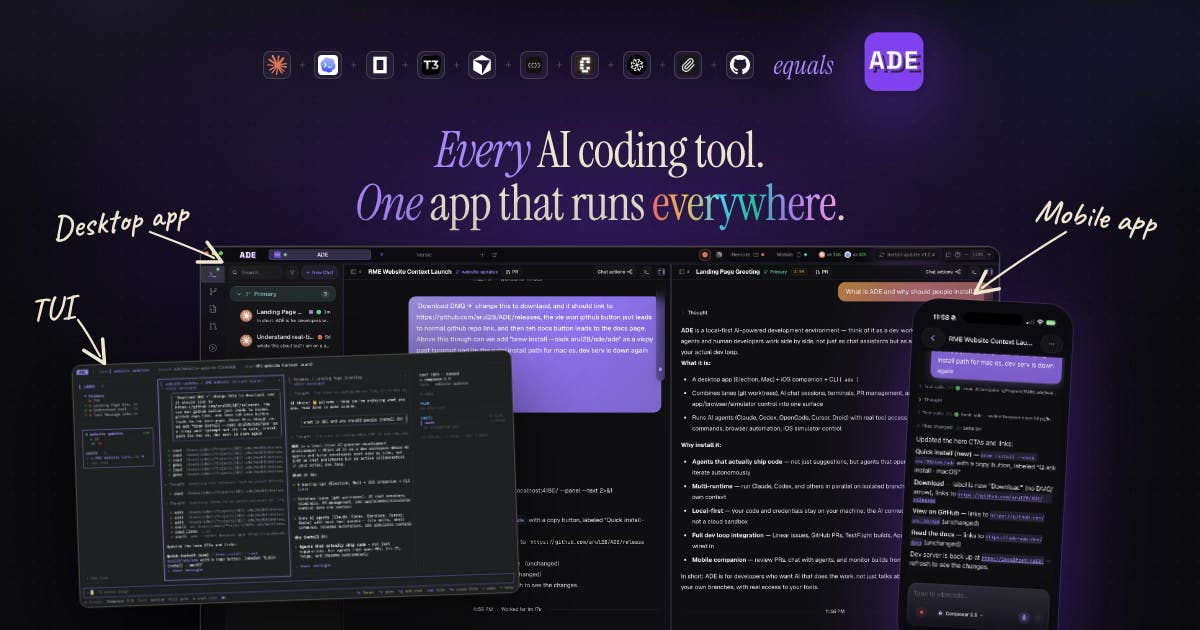
Introducing ADE: A Unified Environment for AI Coding Agents
The proliferation of AI coding assistants has created a fragmented landscape for developers. Each agent, while powerful in its own right, operates in a silo, leading to duplicated efforts, inconsistent codebases, and a steep learning curve to manage multiple tools. ADE (Agentic Development Environment) emerges to address this challenge by providing a singular, synchronized platform for all your coding agents. The core promise of ADE is to bring order to the chaos of AI-assisted development, making it more efficient and accessible.
At its heart, ADE functions as a central hub where various AI coding agents can be integrated and managed. This means that instead of switching between different applications or interfaces for different tasks – perhaps one for code generation, another for debugging, and a third for documentation – developers can access and command all their agents from a single, cohesive environment. This unification is key to unlocking a more fluid and productive AI-powered development workflow. The platform emphasizes synchronization, ensuring that the state of your development projects, including code, configurations, and agent interactions, is consistent across all devices and sessions.
Key Features and Functionality
ADE's value proposition rests on several foundational pillars designed to streamline the developer experience. Firstly, the platform offers universal synchronization. This feature ensures that no matter where a developer is working or which device they are using, their coding agents and project states are always up-to-date. This eliminates the common frustration of losing progress or encountering discrepancies when moving between different workstations or even different IDEs.
Secondly, ADE focuses on agent interoperability. The goal is to allow different AI coding agents to work together seamlessly. This could mean an agent that writes initial code can pass its output to a debugging agent, which in turn informs a refactoring agent, all within the ADE ecosystem. This collaborative potential between AI agents, orchestrated by a human developer, promises to accelerate complex development tasks significantly.
A third critical aspect is ADE's commitment to being a persistent development environment. Unlike ephemeral sessions that might be lost, ADE aims to preserve the context and history of development work. This persistence is crucial for long-term projects and for developers who need to revisit past decisions or code iterations. It's akin to having a digital workshop that remembers every tool you used, every material you cut, and every design change you made, ready for you to pick up exactly where you left off.
Furthermore, ADE is positioned as a free-forever platform. This pricing model aims to democratize access to advanced AI-assisted development tools, removing a significant barrier for individual developers, small teams, and startups. By offering its core functionality without charge, ADE seeks to foster a broad user base and encourage rapid adoption.
The Problem ADE Solves: Fragmentation in AI Development
The current state of AI-assisted coding tools is analogous to a toolbox filled with specialized, single-purpose wrenches, each requiring a different grip and fit. Developers often find themselves juggling multiple AI tools, each with its own interface, learning curve, and integration challenges. This fragmentation leads to several inefficiencies:
- Context Switching Overhead: Constantly switching between agents and their interfaces consumes valuable cognitive load and development time.
- Inconsistent Workflows: Different agents might have conflicting assumptions or output formats, requiring manual reconciliation.
- Knowledge Silos: The insights and outputs from one agent are often not readily available to another, preventing synergistic development.
- Scalability Issues: Managing a growing number of specialized AI tools becomes increasingly complex and difficult to scale as projects grow.
ADE directly confronts these issues by creating a unified layer that abstracts away the underlying complexities of individual agents. It allows developers to think at a higher level of abstraction, focusing on the problem to be solved rather than the mechanics of managing their AI assistants. The platform's design prioritizes a user experience where AI agents are extensions of the developer's own capabilities, rather than separate entities to be managed.
Implications for the Future of Software Development
The introduction of ADE signals a potential shift towards more integrated and intelligent development workflows. By bringing AI coding agents under a single roof, ADE could pave the way for more sophisticated AI-driven development processes. Imagine agents that can not only write code but also autonomously manage dependencies, optimize deployment pipelines, and even self-heal from common errors, all orchestrated through a single interface. This level of automation and integration could drastically reduce the time and effort required to bring software products to market.
For developers, this means a future where their primary role shifts from writing boilerplate code to architecting solutions and guiding intelligent agents. The ability to synchronize and manage multiple agents effectively will become a critical skill. The free-forever model also lowers the barrier to entry for adopting these advanced tools, potentially democratizing access to high-productivity development environments.
What remains to be seen is how ADE will handle the inevitable complexity that arises when multiple sophisticated AI agents interact. Ensuring robust error handling, clear communication protocols between agents, and effective human oversight will be paramount to its long-term success. The platform's ability to evolve and adapt to the rapidly changing landscape of AI agent capabilities will also be a key determinant of its impact.
The "So What?" Perspective
Developers can now manage all their AI coding agents from a single, synchronized environment, reducing context switching and improving workflow consistency. This platform allows for better integration and collaboration between different AI agents, potentially accelerating complex tasks. The free-forever model makes advanced AI development tools accessible to all.
While ADE itself is a development environment, its integration of multiple AI agents could introduce new attack vectors if not properly secured. Developers must ensure the integrity of the agents they connect and the data shared between them. Secure authentication and authorization mechanisms for agent communication will be critical.
ADE offers a compelling solution for startups and development teams looking to leverage AI without incurring significant costs for multiple specialized tools. The platform's promise of unified management and synchronization could lead to faster development cycles and reduced operational overhead. The free-forever model lowers adoption barriers, potentially creating a large user base.
Creators and developers can now consolidate their AI coding assistants into one persistent, synchronized environment. This simplifies the workflow, allowing for more focus on the creative aspects of development rather than managing disparate tools. The ability to have agents work collaboratively within ADE could unlock new creative possibilities and accelerate project completion.
The synchronization feature of ADE implies a unified data model for development projects, potentially enabling more consistent training or fine-tuning of AI agents. Developers can leverage this persistent environment to maintain consistent project states, which is crucial for reproducible research and iterative model development. Understanding how ADE manages and shares data between agents will be key for data scientists.
Sources synthesised
- 1% Match